

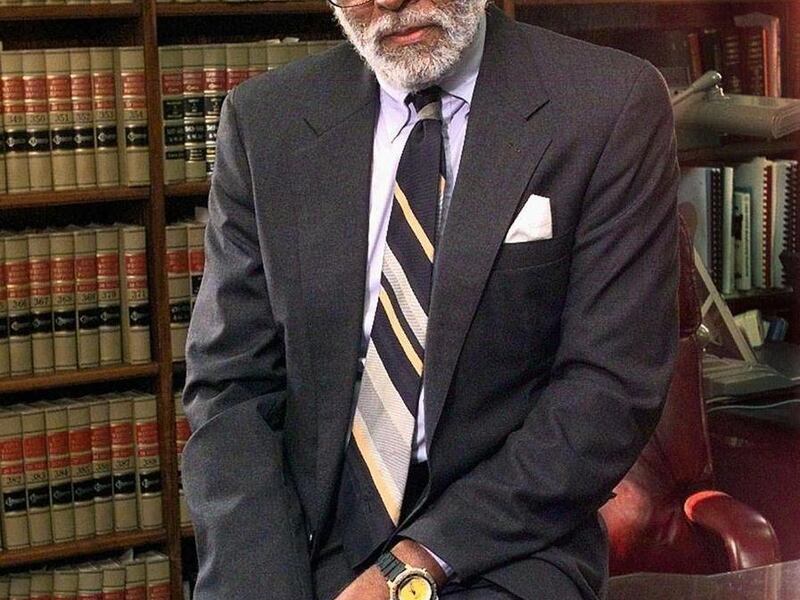
NASHVILLE, Tenn. — Adolpho A. Birch, the first black chief justice on the Tennessee Supreme Court who consistently challenged the fairness of death sentences in Tennessee, has died. He was 78.
Birch, chief justice in 1996 and 1997, died Thursday, Chief Justice Cornelia A. Clark confirmed Friday. WTVF-TV first reported his death.
The cause of death wasn't immediately released. Birch was diagnosed with pancreatic cancer in 2004 and took a temporary leave from the bench that year for chemotherapy and radiation treatment.
Birch began his judicial career in 1969 as a General Sessions Court judge in Davidson County. He went on to become a criminal court judge in Nashville and in 1987 a judge on the state Court of Criminal Appeals before he was appointed to the state Supreme Court in 1993 by then-Gov. Ned McWherter. He was twice elected to return to the Supreme Court before retiring in August 2006.
"As the only judge who ever served at every level of our legal system, Justice Birch had a keen understanding of the law, the judiciary and the people he served," Clark said in a statement. "That perspective served him well on the Supreme Court, especially in his role as chief justice. For his entire judicial career he continued to blaze trails to insure justice and access to the courts for all persons."
He was not the first black justice on the high court. George Brown of Memphis was appointed to the court by then-Gov. Lamar Alexander in 1980 to fill a vacancy created by the death of Justice Joe Henry but was defeated for election later that year when justices were popularly elected.
In dissenting opinions, Birch wrote in several death penalty appeals about "grave concerns" over the method the court uses to compare capital cases.
He repeatedly declined to uphold executions, arguing that Tennessee lacks an adequate "proportionality review" of whether death sentences are handed down fairly and consistently.
Many who knew Birch remembered him Friday as a mentor who generously gave his time to advise other lawyers and judges.
"I was very privileged to serve with Justice Birch on the court during the last year of his tenure and to have my office around the corner from his," Clark said. "I often sought his advice and counsel. He never hesitated to stop what he was doing and answer my questions, and I benefited greatly from his wisdom and patience."
"I'd have no career without guys like A.A. Birch," said lawyer Luther Wright Jr., 40, of the firm Ogletree Deakins. "Had it not been for him, I think there would be fewer African-American attorneys in Nashville, likely in Tennessee."
Wright said Birch repeatedly used a simple quote in urging black attorneys to keep a high profile in their communities as a way to inspire other African-Americans: "You can't be what you can't see."
D'Army Bailey, former circuit court judge in Memphis and a founder of the National Civil Rights Museum, said Birch was the main one to encourage him to seek appointment to the Tennessee Supreme Court.
Birch, who presided over many criminal cases, developed a reputation as a firm but respectful judge, according to lawyers and judges who worked with him.
"He was humble and polite and, when he needed to be, strict," Court of Appeals judge Richard Dinkins said.
"Justice Birch was a pioneer in the legal profession and a consummate gentleman," Alexander said in a statement.
Attorney General Robert E. Cooper Jr. said in a statement that Birch was "rigorous but fair, with a great sense of right and justice."
Birch was born in Washington, D.C., where he grew up. He attended Lincoln University in Pennsylvania and then received his bachelor's and law degree from Howard University in Washington.
He practiced law in Nashville from 1958 to 1966, and was an assistant public defender from 1963 to 1966.
He was on the teaching faculty at the Nashville School of Law, was a former associate professor of legal medicine at Meharry Medical College in Nashville and had lectured on law at Fisk and Tennessee State universities.
Birch played a key role in adopting a Supreme Court rule that allowed cameras in state courtrooms, giving media and the public greater access to the judicial system.
"I think our system needs to be transparent. People need to see it," Birch said when he retired.
Gov. Bill Haslam praised Birch as a pioneer.
"He inspired generations of Tennesseans and enjoyed a distinguished career," Haslam said in statement. "He made our state a better place, and I am grateful for his work for all of us.
Associated Press writers Lucas L. Johnson II and Joe Edwards contributed to this story.