


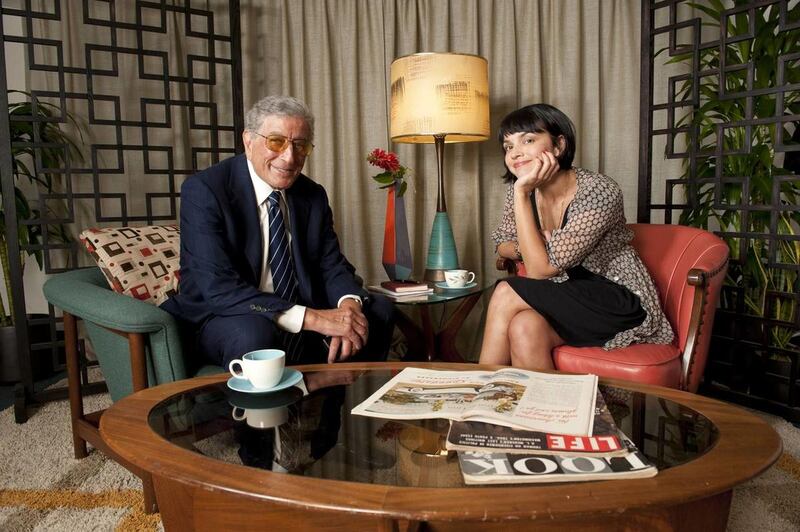

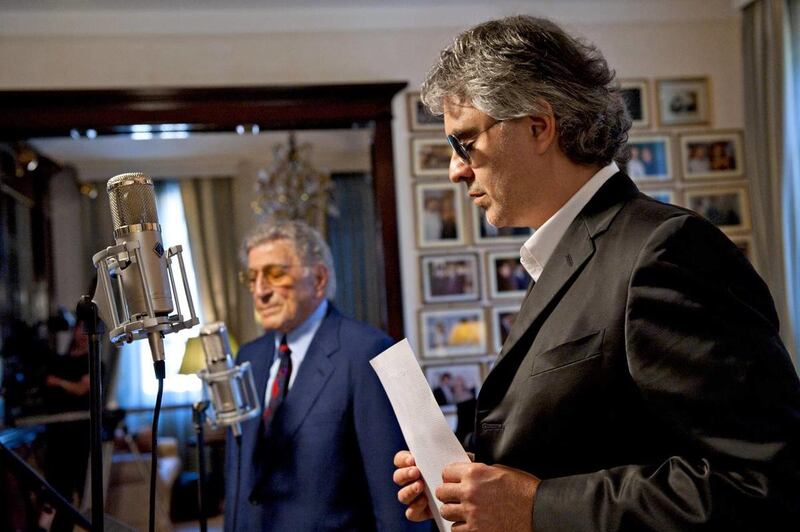
Tony Bennett has recorded more than 100 albums and been awarded 15 Grammys. In the City by the Bay, he’s a revered icon for “I Left My Heart in San Francisco.” When he released “Duets II” last September, in celebration of his 85th birthday, the legendary crooner made history as the oldest vocal artist to achieve the No. 1 spot on the Billboard Album charts.
The PBS telecast “Tony Bennett: Duets II,” airing on Friday at 8 p.m. on KUED, documents the live recordings with his CD duet partners, from traditionalists like Michael Buble and Andrea Bocelli to hipsters like John Mayer, Norah Jones and Faith Hill, and in her last recorded track, the late Amy Winehouse.
For Bennett fans, it’s a nose-pressed-against-the-glass view of the master interpreter while recording, but “Tony Bennett: Duets II” is also required viewing for anyone with a passing interest in the Great American Songbook.
Few contemporary singers understand song phrasing that Bennett has mastered, and he generously shares a master class with his guests. And Bennett has a love for music that is infectious.
“The sparkle … is still there,” notes Josh Groban. “I love that he can keep his child-like excitement for music and (a knowledge of) what music brings to people. I see that love and passion to reach and connect with people that will never go away.”
Groban duets on the Gordon Jenkins-penned “This Is All I Ask,” with its famous line, a heartfelt plea: “Beautiful girls, walk a little slower when you walk by me.” Groban and Bennett first simmer then together percolate to a full boil on the treasured classic.
Bennett explains the secret behind a great duet is the joining of two distinctive voices. When he pairs with Queen Latifah on Leslie Bricusse and Anthony Newley’s “Who Can I Turn To?” from “The Roar of the Greasepaint, the Smell of the Crowd,” Bennett says, “The contrast is just dynamite. She sings so sweet and beautiful, and I was singing the song as if there were a social problem. You know, maybe tomorrow (life) will get better.”
Frank Sinatra pioneered the trend of recording duets with disparate partners, but those recordings never really caught fire. The guests with Ol’ Blue Eyes sang along to tapes of his already recorded performances, and there was no collaboration.
The documentary includes many scenes of reviewing the singers’ parts and discussing their interpretation of the songs. It’s also worthy to note that the live recordings of the full songs are presented. With 16 of the CD’s 17 tracks in “Tony Bennett: Duets II,” one is prompted to ask, where’s Mariah Carey?
Another criticism of “Tony Bennett: Duets II” is the short shrift given to composers. A graphic of the opening page of sheet music opens each song, and then it is shown again with an inscription to Bennett at the song’s end. Above the sheet music song title is two columns of type, listing Bennett and the name of his duet partner on one side, and “Tony Bennett, ‘Duets II’ ” in the other column. Traditionally, in one of those two columns, the name of the song composer and lyricist are printed.
Leave it to Lady Gaga to point out, “Rodgers and Hart, Rodgers and Hammerstein, we’re talking about the greatest composers of all time.” Gaga is in full swing mode with the delightfully surprising “The Lady Is a Tramp,” from the Rodgers-Hart musical “Babes in Arms.”
Bennett shows no signs of slowing down. His next project will be “Duets III,” with Latin recording artists performing in Spanish opposite Bennett singing in English.