

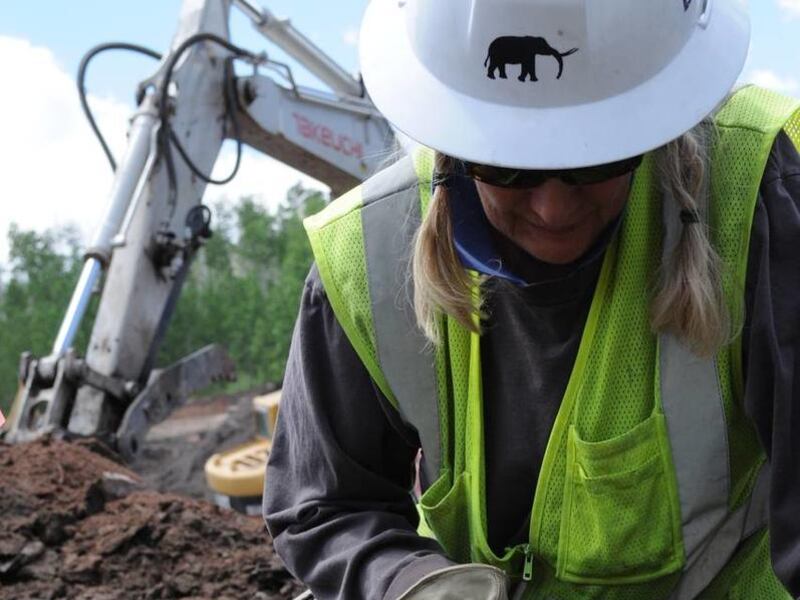

Strap on your goggles and put on your hard hats, amateur paleontologists. Make sure your rucksack is packed with your geological hammer, pick, chisel and paintbrush. For this dig, leave your tiny field lens at home.
These bones are massive. There’s a giant bison skull, with a horn spread more than seven feet wide.
The dig is huge. At about two acres, it’s the largest-ever dig in the Rocky Mountain region.
And it’s a treasure trove. Crews unearth a record 5,000 bones and, with the remains of eight to 10 American mastodons, it’s the “finest mastodon site in the world.” But there are a total of 41 different kinds of antediluvian animals — ice-age bison, deer, Colorado’s first-ever Jefferson’s ground sloth and several smaller animal species, and hundreds of pounds of plant material.
Even more impressive is the pristine condition. Some plant matter is still green, and beetle exoskeletons are still iridescent. The area is called a perfectly preserved ice-age zoo.
“It’s like the bones were put in Tupperware and sealed,” said Kirk Johnson, chief curator for the Denver Museum of Nature and Science, which is in charge of the dig. “The quality of the preservation here is staggering.”
Johnson takes viewers to the spectacular, history-making dig that came to be known as the Snowmastodon Project on PBS’ “Ice Age Death Trap,” airing on KUED on Wednesday at 8 p.m. We’re right alongside the paleontologist and his team as the site was painstakingly excavated.
In October 2010, while beginning construction near the ski-resort town of Snowmass Village, Colo., a bulldozer driver dug up something strange: a tooth so huge it takes two hands to hold it. Scientists from the Denver museum raced to the scene and identified it as a tooth from an extinct mammoth.
An agreement was reached that construction to expand a reservoir dam will be halted until July 1, 2011. The scientists were in a frenzy to meet the deadline while awe-struck at their daily discoveries, shovelful by shovelful. The schedule was so tight that even area schoolchildren were recruited to help.
There’s also the perplexing riddle of why so many animals died as they grazed beside an ancient lake. A scenario emerges that either a single or a series of earthquakes could have quickly liquefied the soil near the waters. As the ground hardened again, the animals were trapped until they slowly starved, and the death trap of the program's title is created.
Research continues at the Denver Museum of Nature and Science on the discoveries and the educational institution has many of the amazing finds on display. Johnson and a colleague are about to publish their firsthand account, “Digging Snowmastodon.” Until you’re able to visit the museum or read the book, there’s “Ice Age Death Trap,” with viewers able to excavate beside the scientists — and it’s a fascinating experience.