


She was terrified to make the phone call.
A slave to the diplomat who brought her to the United States from the Philippines, all Amalia knew of the country was 24-hour video surveillance, verbal abuse and long hours scrubbing toilets behind locked doors. Could she trust the people on the other end of the line? Her English was broken. Would they understand her plea for help?
But the phone number was all she had; she was painfully aware of that. She mustered courage and dialed.
1-888-373-7888.
In her Washington D.C. office, Vanessa Chauhan was waiting by the phone.
"National Human Trafficking Resource Center," she said. Her voice was friendly, comforting. "How may I help you?"
That call was the start of a months-long relationship that would support the Filipino woman through the process of escaping modern-day slavery and building a new life for herself.
A hotline may seem an insignificant weapon in the fight against a crime that oppresses an estimated 150,000 people in the United States. But Chauhan and her colleagues, who give up weekends, holidays and sometimes a full night's rest to make sure no call for help goes unheard, do more than just answer phones. The National Human Trafficking Resource Center, which is run by the nonprofit Polaris Project, coordinates anti-slavery efforts all over the United States, working with more than 3,300 organizations to find victims and connect them with the services they need. With support from a growing number of state legislators and law enforcement leaders, the hotline has drastically expanded its reach in recent years. Since 2008, when Polaris Project took over responsibility for the hotline, call volume has grown by more than 300 percent. In less than 5 years, the organization has helped more than 5,600 people escape slavery.
"Everybody in the anti-trafficking field is very networked," said Ronna Bright, manager of the Central Valley Against Human Trafficking program in Fresno, Calif. "The hotline is like the hub of the wheel. They're at the center of everything."
Reaching Out
When Amalia, whose name has been changed to protect her identity, took a job as a housekeeper in the United States, she thought she was signing up for a 40-hour-a-week gig. Her employer, a high-ranking Taiwanese diplomat posted in Kansas City, Mo., agreed to pay her $1,240 a month. But things turned upside down almost as soon as she arrived on U.S. soil. Hsien-Hsien "Jacqueline" Lui, Director General of the Taipei Economic and Cultural Office, confiscated Amalia's travel documents and threatened to have her arrested if she "acted out," according to an affidavit filed by the United States Attorney for the Western District of Missouri. Amalia was forced to work 16-18 hours a day, received no time off for weekends or holidays and was only paid $450 a month. She was kept under video surveillance and was not allowed to leave the premises without supervision.
The hotline was always in the back of her mind. Before she left the Philippines, U.S. consulate staff gave Amalie a red, white and blue pamphlet titled: "Know Your Rights."
"If your rights are violated," the text instructed, "call this toll-free number."
The "Know Your Rights" pamphlet is part of a federal push to promote awareness about and assist in identifying victims of modern-day slavery, which is officially called human trafficking. States have also taken steps in recent years to promote awareness about the issue. In the past five years, nine states have passed laws encouraging or requiring establishments like bars, truck stops, restaurants or hotels to post hotline information. Twelve more are considering legislation.
"After about a decade of hard work, the issue of human trafficking is getting legs in the U.S.," said Sarah Jakiel, deputy director of Polaris Project. "We are starting to hit our stride. There's a deeper level of awareness. We're becoming more of a mainstream human rights issue."
As lawmakers have signed on, calls have poured in. In 2007, the National Human Trafficking Resource Center took just 237 calls. In 2011, that number had swelled to 19,427. People call in from all 50 states, but — not surprisingly — more call in from those states that encourage the dissemination of hotline information. The year after Texas passed the first mandatory posting law in 2007, the state accounted for a full 30 percent of the hotline's traffic.
"These laws make a huge difference," said Texas State Senator Leticia Van de Putte, who pushed the legislation through. "We saw a huge spike in the number of calls — and that's a big step forward in this fight. Every call is a potential saved life."
Even if people don't dial the number, Pennsylvania State Senator Daylin Leach believes posting hotline information raises awareness about the crime.
"If someone sees this number every day, they are going to start thinking about it," said Daylin, who is sponsoring a hotline bill. "The more people we get thinking about this, the better."
Lifeline
Unsure where to go after a Filipino she met at the grocery store helped her escape from Liu's house, Amalia called Chauhan. At the time, she didn't know she was a victim of human trafficking. She just knew something wasn't right.
Human trafficking victims rarely self identify. That's one reason it's difficult to rescue them, Jakiel said. The public, which plays an important role in alerting authorities to suspicious situations, gets confused about the crime's definition. Because all state anti-slavery laws have hit the books within the last decade, even law enforcement officials sometimes struggle to recognize victims.
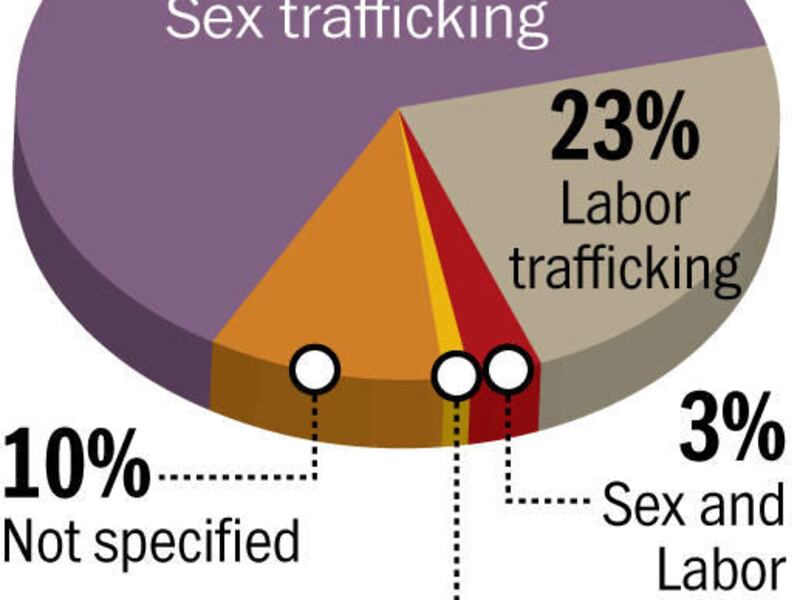
Slavery in America isn't limited to foreign national housekeepers. It's found in hair-braiding salons and massage parlors. Its victims are forced to work on farms, hawk their bodies on the streets and even sell magazines door to door. While the U.S. government believes between 14,500 and 17,500 people, like Amalia, are trafficked into the country each year, a large chunk of the nation's slaves are U.S. citizens. Between 244,000 and 325,000 American youth are at risk of being sold into sexual slavery annually.
"Victim identification is the primary and paramount goal of the hotline," Jakiel said.
Chauhan, a fresh-faced 32-year-old with a thick, black ponytail, had to coax the details of Amalia's five months in slavery out of the frightened woman one by one — a process that took several calls. She helped Amalia relax by bringing an interpreter online so she could tell her story in her native tongue. She informed the Filipina of the law and the resources available to her, but didn't pressure her to do anything with which she didn't feel comfortable. She earned the woman's trust by addressing the needs Amalia presented over the course of several months.
Where could she find a place to stay?
Chauhan found her a shelter.
Where could she get help sorting out her immigration status and collecting back wages?
Chauhan found her a lawyer.
Where could she find English lessons?
Chauhan found her a school.
When Amalia finally broached the topic of pressing charges, Chauhan found her a victim's advocate and connected her with law enforcement. She did a little happy dance in her leather office chair that day.
"It was very rewarding to watch her grow," she said. "I really admire her courage and confidence."
To connect victims with help, Chauhan and her colleagues at the National Human Trafficking Resources Center go to a network of more than 3,300 service providers across the country ranging from law enforcement contacts to nonprofit organizations. In every state, a point man is on call around the clock.
Finding help for a human trafficking victim can still be a struggle, though. Most of the organizations in the network are designed for victims of better-known crimes like domestic violence. Very few focus on helping victims of slavery.
"We spend a lot of time reaching out to labor rights, immigration, sexual assault and domestic violence organizations trying to find someone to help our victims," she said. "We just keep calling place after place."
It can be hard work. But, Chauhan said, it's rewarding.
When Lui was convicted of labor fraud in January and Amalia's story was headline news, she called back one last time.
No, she told Chauhan, she didn't need anymore help.
"I just called to say thank you," she said. "Thank you very much."
EMAIL: estuart@desnews.com