

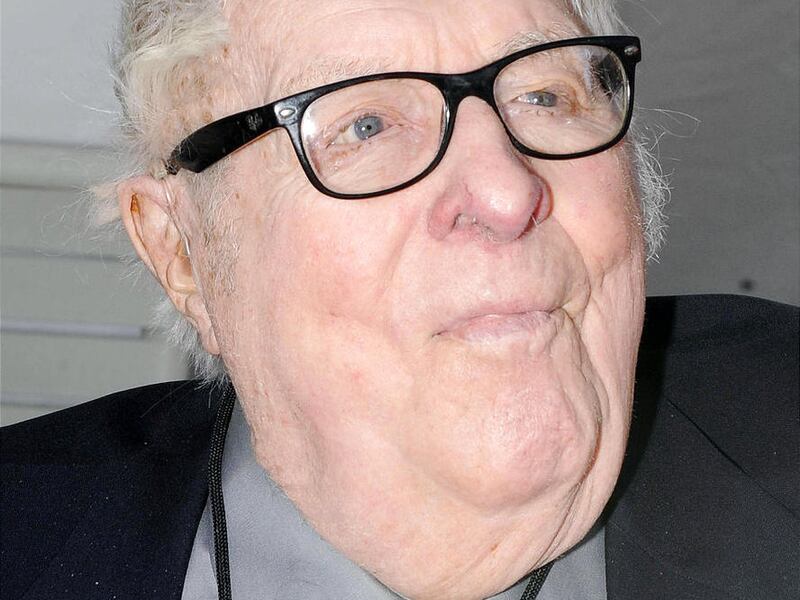
Over the years, especially during my tenure as this paper's movie critic for a pair of decades, I had the opportunity of interviewing a lot of big stars.
More often than not, it was just another day at the office, visiting for a few minutes by phone or in person with an actor or filmmaker who was on the stump to promote his or her latest movie.
Once in awhile, though, it became something more because the subject was someone whose work I had admired since my youth — James Stewart, Maureen O'Hara, Paul Newman, Charlton Heston, Michael Caine.
And I felt the same way when I got a call in 1983 from a Disney representative asking if I had any interest in interviewing the science-fiction writer Ray Bradbury.
Memories of that moment came swelling up when I read that Bradbury had died Tuesday in Los Angeles at the age of 91.
He was one of my writing heroes, and my relationship with his work goes way back to my childhood, dating from the day I picked up his episodic novel "The Martian Chronicles" at the local library and read it cover to cover one long summer day. I returned to the library the next day and picked up a few other Bradbury books, including three that would become favorites, "The Illustrated Man," "Fahrenheit 451" and "Dandelion Wine."
And then I began to see his name on movies and TV shows, as author of the short stories adapted for "The Beast From 20,000 Fathoms" and "It Came From Outer Space" (both 1953), as co-screenwriter of the 1957 film of "Moby Dick," and as a writer of episodes for "Alfred Hitchcock Presents" and one episode of "The Twilight Zone."
Bradbury introduced me to boundless imagination and a humanized view of science fiction, and yes, I'm not ashamed to admit that I was part of that group we now refer to as the "fanboy," and I tried to share him with anyone who would listen.
So, in April 1983, when the Disney rep called, internally I shouted, "RAY BRADBURY?" as the little kid inside my then-34-year-old body did a happy dance. But, attempting to adopt a professional demeanor, I made an effort (unsuccessfully, I'm sure) to contain my excitement.
A few days later — after watching the Disney production of "Something Wicked This Way Comes," adapted by Bradbury from his own novel — I was on the phone with the man himself.
Bradbury told me his own favorite was indeed "Something Wicked This Way Comes," which I had read and enjoyed again before seeing the film. He also said that this Disney film was his favorite cinematic treatment of his work. Of course, whether that was true or just hype for the film is anyone's guess, but whatever he thought of the finished product, he obviously took great delight in having been able to script it himself, and he did feel he had more control over its quality than his other filmed stories.
"They're fools," he said of the movie studio chiefs. "If I were running a studio and I bought a property for a film, I would certainly want to work with the author of the original work.
"In Hollywood, they think they know it all. You, as a writer, are essentially an outsider. Novelists and short-story writers, especially. And maybe the average writer doesn't care that much, but I care intensely."
Despite his disdain for the Hollywood studios, however, Bradbury said he was a rabid movie buff and had been pleased with some of the other adaptations of his work.
He said he was more than satisfied with Francois Truffaut's 1967 film version of his first novel, "Fahrenheit 451." "(Truffaut) got 75 percent of the book on the screen, and that's a high percentage for a book. (The movie) gets better every year, a haunting beautiful film."
And he said he was very proud of his screenplay adaptation of Herman Melville's novel "Moby Dick," referring to the John Huston-directed film that stars Gregory Peck as Capt. Ahab.
But there were big- and small-screen treatments of his other books that left him less than pleased. And he didn't shy away from talking about them.
The 1969 film of "The Illustrated Man," starring Rod Steiger: "There was no screenplay." He said Truffaut originally wanted to do "The Illustrated Man" before "Fahrenheit 451" but couldn't get financing. I told Bradbury that I wished Truffaut HAD made "The Illustrated Man," to which Bradbury lamented, "Don't break my heart."
The 1980 TV miniseries of "The Martian Chronicles," with Rock Hudson: "It was boring. They lost the audience. It was a good script (by fellow sci-fi author and friend Richard Matheson), but the director wasn't interested."
Bradbury added that his books and stories were like children to him.
During that 1983 interview, Bradbury was gracious and good-natured, but he certainly lived up to his feisty reputation. He was outspoken, opinionated and incredibly interesting. He didn't hold back but his responses to my questions never seemed scripted, as they so often do in celebrity interviews — and this from someone who had already been around long enough to have almost as many stories written about him as he himself had written.
And Bradbury was nothing if not prolific. He began writing at age 12 and his output includes some 400 short stories and another 100 novels, poems, and TV and movie scripts. According to the New York Times, more than 8 million copies of his books have been sold in 36 languages, and his most recent published story was just a couple of weeks ago in The New Yorker magazine.
When we spoke, Bradbury said the one book he hoped to see become a film was "Dandelion Wine," one of his autobiographical novels that is really a collection of short stories with the same characters. But it was not to be. Although from time to time "Dandelion Wine" crops up on lists of films "in development," nothing substantial has ever surfaced.
First and foremost, however, Ray Bradbury was a writer, and when the muse struck, it completely overtook him. As he explained it to me, "I don't have any regimen. I don't control my writing — it controls me."
EMAIL: hicks@desnews.com