
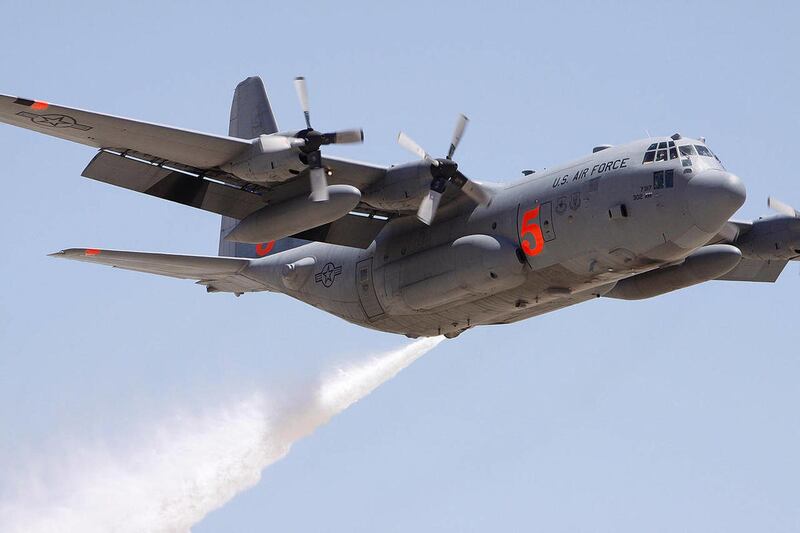
CHEYENNE, Wyo. — Six military cargo planes that are employed to drop fire retardant around wildfires have been moved to air tanker bases in Utah and Idaho to put them closer to the most active fires in the West.
Four of the C-130s were staged at the Boise Air Terminal and two were at Hill Air Force Base near Salt Lake City on Thursday. In recent weeks, the planes were staged in Cheyenne and Colorado Springs, Colo., to fight fires in Colorado, Wyoming, Montana and South Dakota.
Last weekend, a cold front brought rainy weather to the eastern Rocky Mountains. On Wednesday, firefighters succeeded in fully containing the Waldo Canyon Fire that killed two people and burned 350 homes in Colorado Springs, making it the most destructive fire in Colorado history.
Massive fires that prompted evacuations in Wyoming also cooled off somewhat.
"With all the recent rain in the Rocky Mountains, they just don't need us down there right now," Col. Jerry Champlin, commander of the Wyoming Air National Guard 153rd Air Expeditionary Group, said in a release.
On Thursday, the most active fires were in Idaho. There, 10 fires had burned some 445 square miles of mostly grass and brush, according to the National Interagency Fire Center in Boise, Idaho.
The six C-130s were already flying some missions into Idaho before the U.S. Forest Service asked the military to move them closer to the more active fires.
A total of eight C-130s outfitted to drop fire retardant were operated by four military units: Two each by the 153rd in Wyoming, the California Air National Guard 146th Airlift Wing, the North Carolina Air National Guard 145th Airlift Wing, and the 301st Airlift Wing, a Colorado Air Force Reserve unit.
One of the North Carolina planes crashed in the Black Hills on July 1, reducing the fleet to seven. The other North Carolina plane is not presently fighting wildfires. Forest Service officials said they only needed the use of six C-130s.
The crash killed four crew members and injured two others, and remains under investigation by the military.
Each plane is fitted with a bus-sized device called a Modular Airborne Firefighting System that is specially designed to be rolled on and off a C-130. The MAFFS devices owned by the Forest Service carry up to 3,000 gallons of slurry that can be sprayed in less than 5 seconds.