

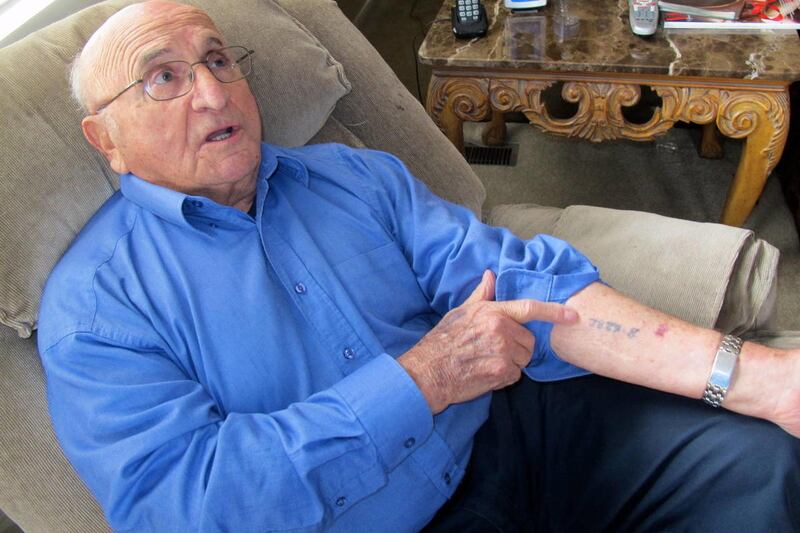

SOUTH SALT LAKE — With no discernible fanfare, Abe Katz unbuttons the cuff of his blue dress shirt and rolls up the sleeve to reveal the tattoo on his forearm that tells so much about his life.
He was 16 years old when he got it in 1940, courtesy of Adolf Hitler’s Third Reich, as he stood in a long line at the entrance to a concentration camp the Nazis had recently erected in Poland called Auschwitz.
The tattoo the SS guard stenciled – B 6282 – was all he would answer to for the next five years as he was moved from camp to camp, a number, not a human being, eventually winding up at Buchenwald in Germany.
When the 3rd American Army liberated Buchenwald in April 1945, he weighed 78 pounds. He and his fellow survivors were so close to death that no one dared move them until they’d done nothing but rest and eat for two months. In the midst of the recovery period, Gen. Dwight Eisenhower himself drove to Buchenwald to see if the atrocities were as bad as reported. The supreme allied commander took one look at the crematorium and, Abe reports, “cried like a baby.” Then he walked inside the gate and shook Abe’s hand, and everyone else’s.
Katz couldn’t go back to his native Poland because he would have been inducted into the Polish-Russian Army. Besides, his parents were no longer there. Both were dead, as were all six of his aunts and uncles.
He made his way to the American consulate in Munich, where he stood in a long line of people seeking to emigrate.
When he got to the front of the line he rolled up his sleeve and showed them his tattoo.
That was all it took.
Sponsored by the Jewish Federation, he was sent to Salt Lake City. He was met at the Rio Grande train station and put up in the Congress Hotel on the corner of Second South and State. He couldn’t speak a word of English, so for dinner he walked to the Dee’s restaurant next door and pointed to a picture of a hamburger steak and a frosty beverage in a mug that he assumed was beer. Close, but not that close. It was root beer. He took one sip and spit it all over the counter.
But he drank up the freedom. Suddenly he found himself in a place where he could make his own decisions, move where he chose, do what he wanted, say what he pleased.
Five years to the day since he landed in the United States, in the absolute shortest time allowed by law, he became an American citizen.
He enrolled in vocational school and became a machinist. He made his way back to Germany long enough to marry Charlotte, the pretty girl he met at a dance not longer after he’d been liberated, and brought her back to Utah. They had a family — two children, a girl and a boy — and in 1963 they paid $18,000 for a home on Haven Lane in South Salt Lake where Abe resides to this day. The mortgage was $91 a month for 30 years, and after they signed the papers to live the American dream, Abe was so worried he couldn’t sleep for a month.
Six years ago, Charlotte passed away. Abe, who will turn 91 in December, is astonished by two things: how much he misses her: “every hour of every day,” and that he outlived her. “Never in my wildest dreams did I think that would happen, after all I went through.”
He takes it easy these days. Paces himself. Doesn’t push it. But on Nov. 4, a week from Tuesday, no matter how he feels, rain or shine, hot or cold, there is something he absolutely, positively will do:
Vote.
He’s never missed an American election, he’s proud to say, since he gained the right to mark a ballot 59 years ago. He’s a staunch Democrat, he’s also proud to say, a “working man” who has rarely broken ranks, making an exception once for Jon Huntsman Jr. and once, of course, for Eisenhower.
“It’s our responsibility to vote, and our great privilege,” says Abe Katz, Holocaust survivor, as he pulls the sleeve of his blue dress shirt back down over the tattoo on his forearm and buttons the cuff again at the wrist.
Lee Benson's About Utah column runs Mondays. Email: benson@deseretnews.com