

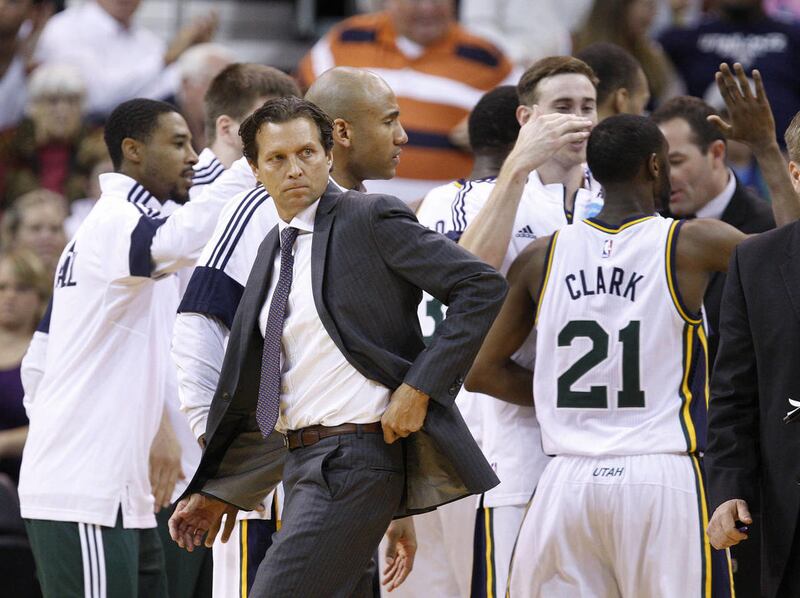
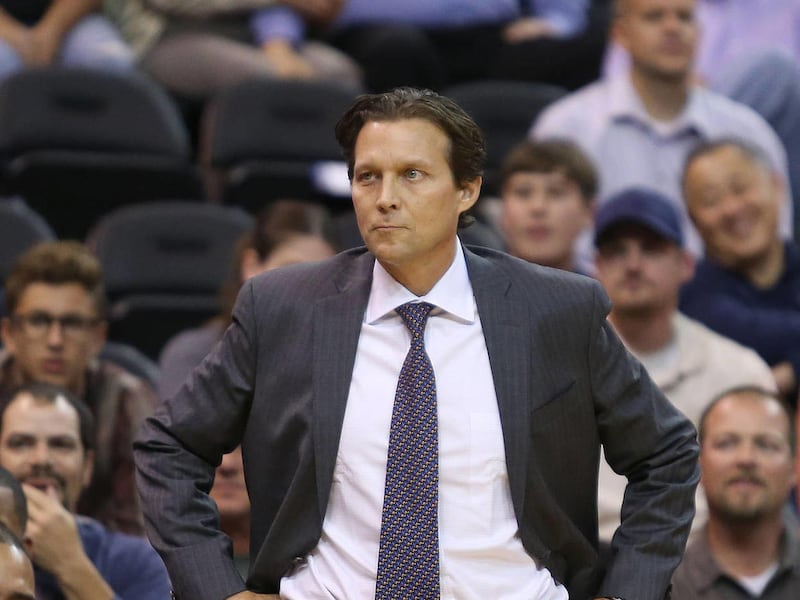
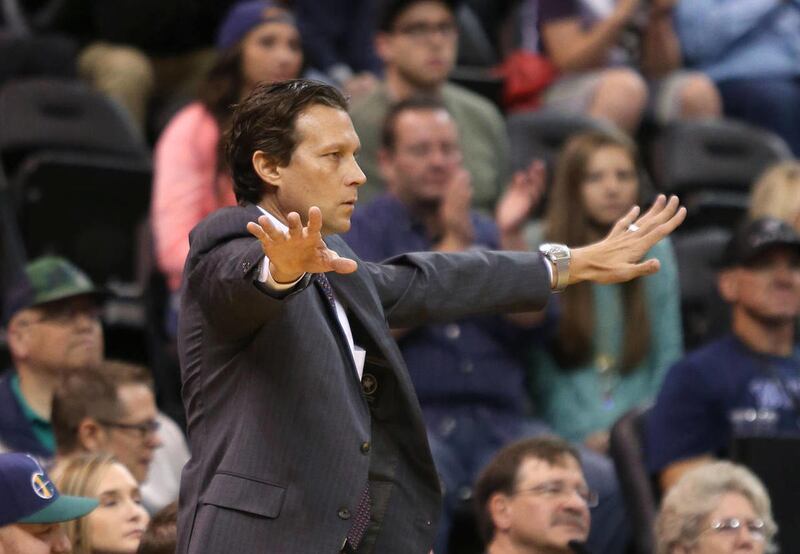
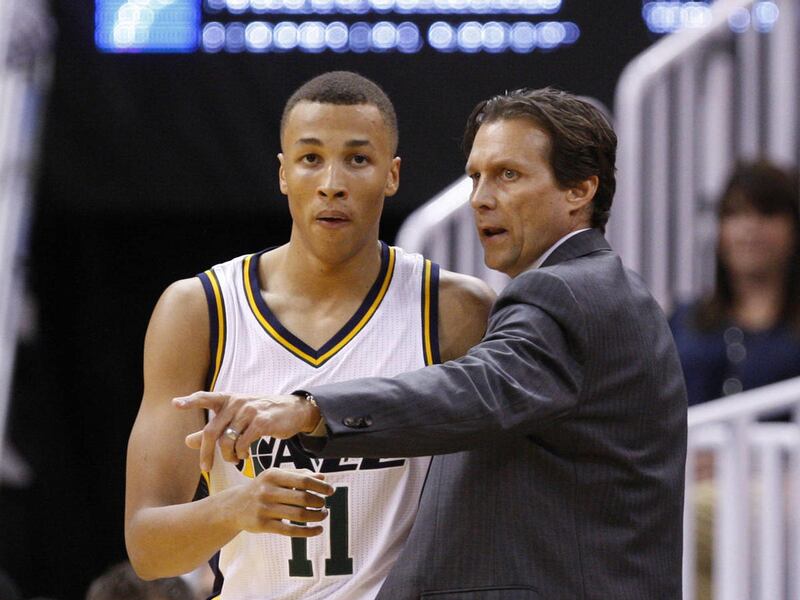
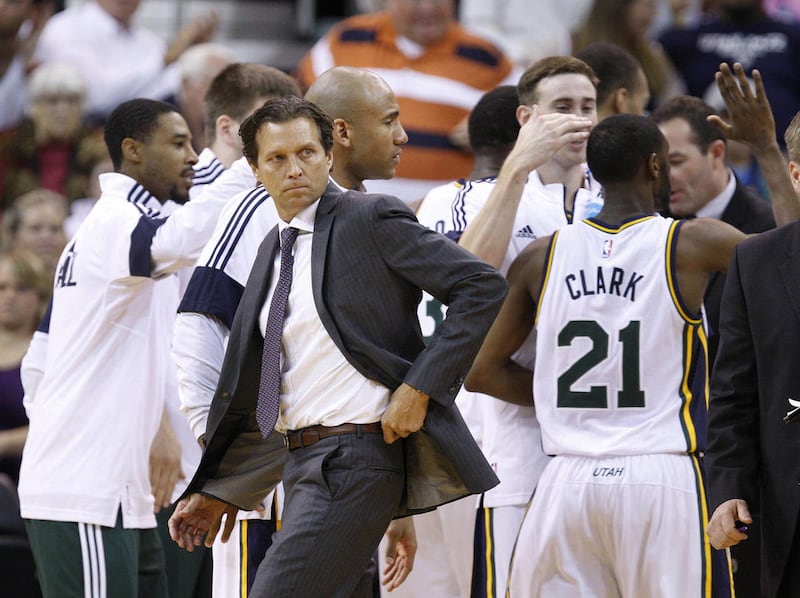
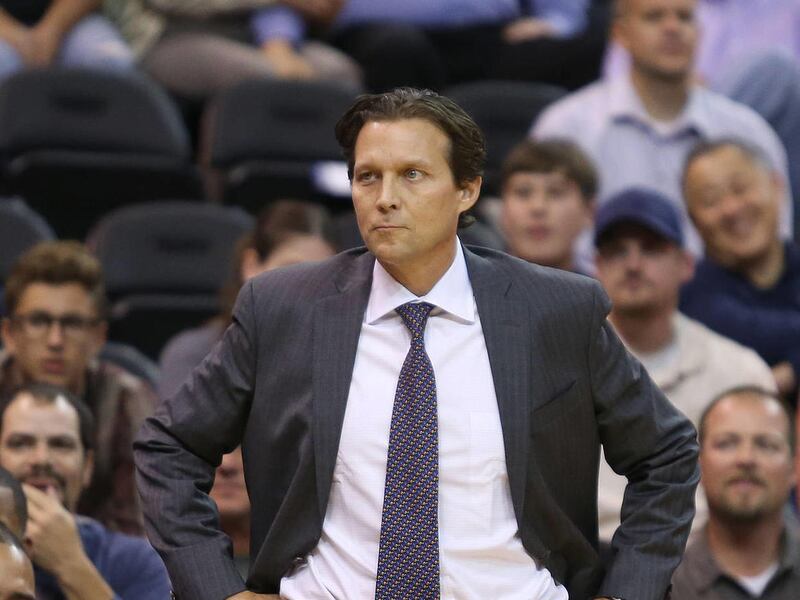
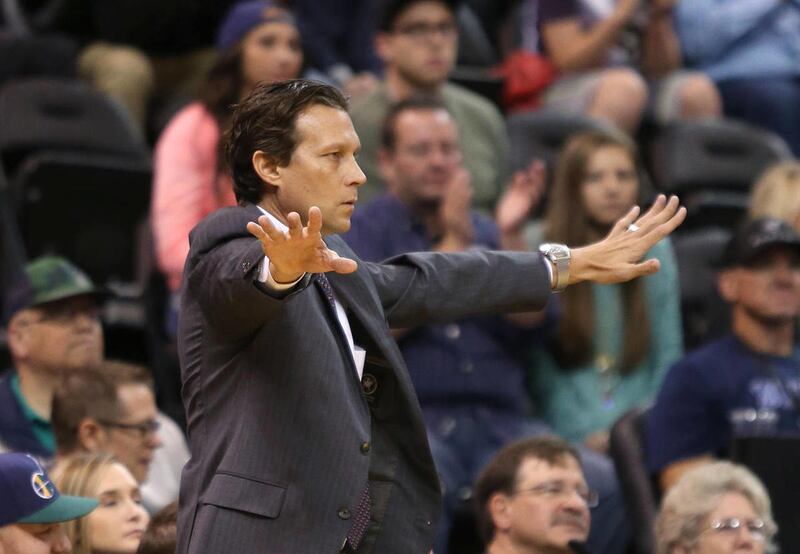
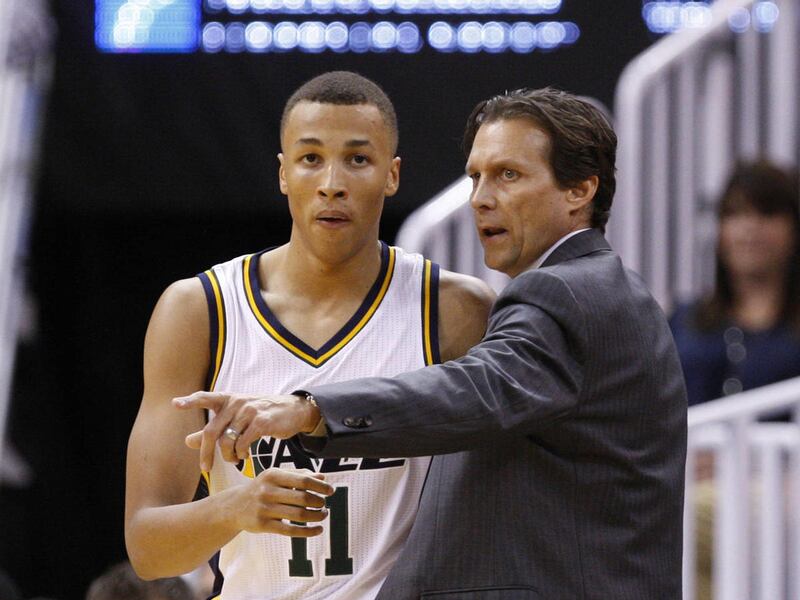

SALT LAKE CITY — During the preseason, Quin Snyder was conducting a pregame interview when a broadcaster from Los Angeles mentioned the new NBA head coach’s time with the Clippers.
Snyder had just finished his collegiate career at Duke — where the point guard was fortunate enough to experience three Final Fours — when then-Clippers coach Larry Brown hired him as an assistant.
Two-plus decades later, Snyder chuckled at the phrase used to describe what’s transpired since he made his NBA coaching debut in that 1992-93 season.
“Covered a lot of ground,” Snyder said, repeating the broadcaster. “I like that.”
Between that stint and Wednesday night, when he’s the Jazz maestro for the first time in a game that actually counts, Snyder has bounced around from his initial Southern California gig, back to North Carolina to be Mike Krzyzewski’s assistant at Duke, to Missouri (NCAA head coach), then to Austin (D-League head coach), Philadelphia (player development), Los Angeles (Lakers assistant), Russia (CSKA Moscow assistant) and Atlanta (lead assistant) before finally landing in Salt Lake City, where he convinced Jazz ownership at CEO Greg Miller’s kitchen table that he was the right man to replace Tyrone Corbin.
Phew.
If you think that paragraph was long, try moving around that many times before getting your big shot.
Covered a lot of ground indeed.
That’s especially true since 2007, when he picked himself up after a rough-ending Missouri experience to begin climbing the coaching ladder in the pro ranks with a three-year adventure as the Austin Toros’ bench boss.
In the past seven years, Snyder has lived and worked in all four time zones in the United States along with his one-year stint in Europe.
It’s presented him myriad learning opportunities. He’s tutored under and worked for a group of men he calls “some of the best minds in basketball,” including Coach K, Gregg Popovich, Brown, Doug Collins, Ettore Messina, Mike Brown and Mike Budenholzer.
Now Snyder is genuinely excited to spearhead an organization with a rich hoops history, highlighted by the Hall of Fame careers of Pete Maravich, Adrian Dantley, John Stockton, Karl Malone and one of his coaching predecessors and new adviser, Jerry Sloan.
“I feel like I persevered through some things and just tried to work hard and have been fortunate to have support from a lot of good people,” Snyder said at his introductory press conference. “Hopefully, this is the result from a lot of that hard work.”
It certainly helps that he has a history with Jazz general manager Dennis Lindsey, who shares Snyder’s desire to build a championship-caliber foundation based on detail-oriented hard work, an up-tempo, creative and unselfish offense, a stingy and energetic defense, accountability and a competitive moxie.
"The fit for me in this job is terrific,” Snyder said.
If nothing else, at least he and his wife won’t have to pack boxes and change addresses in the near future after a tumultuous span of moves.
Snyder feels at home in Utah and with the Jazz organization almost six months after being hired.
“I’ve been pretty comfortable in one sense to feel that this is the right place for me,” Snyder said. “I think there’s a different comfort that I hope I never feel, which is too comfortable. I don’t think there’s any risk of that with what we’re about to go through with the regular season.”
Snyder’s first foray into one of the world’s 30 most prestigious coaching jobs in professional basketball isn’t without challenges.
He inherited a team that flailed and floundered in Corbin’s final season, a rough 25-57 year that happened after management decided to let its key cogs, Al Jefferson and Paul Millsap, play elsewhere, while Utah did a cannonball dive into the rebuilding pool and draft lottery.
Snyder has talent to work with, but it’s young and inexperienced in a league that is oft-dominated by savvy and star-powered veterans. Gordon Hayward is the oldest starter, and he’s only 24 years old (which happens to be the average age of the entire team). He’ll rely on rookies Dante Exum and Rodney Hood and two more second-year players, Trey Burke and Rudy Gobert, to perform in the rotation. He'll need Derrick Favors, Alec Burks and Enes Kanter to increase their production.
Knowing the difficulties that lie ahead — even if his team exceeds expectations of being one of the league’s worst — Snyder scoffed when asked if he sees himself as a franchise savior.
Snyder prefaced his response by referring back to his fortune of working for teams that had a lot of success. He added, “Does that mean I just come here and it’s successful? No. That’s what we’re going to try to do.”
But Lindsey, Snyder and Jazz management have been careful to try to openly temper expectations and preach a message about how it's most important to build habits.
It’s a process.
It will take time.
“We have to avoid pie-in-the-sky (thinking),” Snyder said. “We need to have our feet on the ground. We need to commit ourselves to (development and system success). I think we get there in a workmanlike way.”
That work is detailed and demanding in practices, if you ask his receptive players. Drills are done “extremely fast,” Hayward explained. The purpose is to make players learn to “think on the fly” and to play with pace, offensively and defensively.
“Coach Quin has been really hard on us, really intense, asking a lot of us as a team,” Hayward said. The fifth-year swingman added that he’s proud of the players’ “focus … to be able to take his teaching and really kind of put it into effect.” That helped them go a surprising 5-3 in preseason.
“He just has been very prepared,” veteran newcomer Steve Novak said of Snyder, who installed a defensive philosophy into his team before moving to offense. “(At Saturday’s practice) all we did was script (offensive sets) for about an hour, went though plays. He realizes that our execution is going to be so important; that’s what we’ve put such an emphasis on. He also allows us to play. He trusts us.”
That part of the work began right after the Millers hired him.
For Snyder, whose 48th birthday is Thursday, it’s important to create personal and professional relationships with his players. It’s part of the trust-building process. It garners a mutual respect, opens doors of communication, fosters chemistry.
It makes players want to play hard for you.
As serious as Snyder is about his job — a seriousness that will get him to raise his voice or give an almost-menacing glare or demand even more from players and his coaches — he’s also got a playful side.
Snyder showed the light-hearted part of his personality at times this past month. After graciously declining Hayward's offer to participate in the annual rookie dance-off at the intrasquad scrimmage, Snyder joked that he might punish the well-intended athlete by not putting him in the starting lineup. Another time, Snyder was surprised to hear he was in the "NBA2K15" basketball video game and quick-wittedly responded, “Maybe Gordon will start listening to me now.” Hayward’s humorous response: “I’m not a NBA video game player, really, so I don’t think that’s going to help him at all. He’s going to have to do something else.”
The bonding process began for Snyder and Kanter when the new coach visited the big man in Chicago this summer. Snyder told Kanter he wanted him to shoot 3-pointers.
“I was just like shocked that the first time he met me he gave me that confidence,” Kanter said. “It means a lot to me.”
The connection between Snyder and Burke began with texts and continued with an open-eared pupil learning from an appreciative teacher, including in personal film study. Snyder has lauded Burke's ensuing effort and focus on defense and leadership. He even said the way the 21-year-old has "embraced" his teaching is "on a deeper level."
After Burks said, "I feel like Quin plays my style," Snyder returned the compliment. “He’s a good fit for me,” the coach replied about the shooting guard.
The rapport between Snyder and Hayward was enhanced with simple messages of confidence and challenges that the coach gave the small forward who got a big contract in the offseason after a bumpy-but-successful 2013-14.
“Sometimes the growth process is hard. There will be things that he’ll fail at just naturally, but in doing that he has a real opportunity," Snyder said. "We don’t need Gordon to play it safe. We need him to let it out.”
Something Hayward, whose commitment was lauded by Snyder, said early in training camp remains truer than ever a month later.
“At the end of the day, Coach is our leader,” Hayward said. “We’re definitely behind him 100 percent. That’s what we’re most excited about – him and what he brings to us as a team."
That process started in June.
It starts counting Wednesday night.
“I feel like I’m as prepared as I’m going to be,” Snyder said.
Though he hopes onlookers will see a "well-coached team," Snyder is as realistic about the NBA as he is idealistic about doing things the right way — the way he learned from numerous coaching mentors and from veterans like Mark Jackson and Ron Harper with the early-'90s Clippers, from experiencing the proverbial “Spurs way” with San Antonio’s D-League affiliate, from gleaning knowledge from hoops conversations with Kobe Bryant in L.A. and former Jazzman Millsap in Atlanta, and from out-of-box thinking and different organizing and game-flow concepts he gained in his year in Russia.
Ready or not, it’s time to put all of those lessons to use in an NBA regular season.
Mostly, Snyder just wants his team to play with a purpose, go hard, be smart and get better. He knows the margin of error is slim, and he won't mind losing if the Jazz play well.
"In our case, success over time puts you in a position to have more success. Our focus, I think, has got to be process-oriented, where we have those small successes, whether it’s in practice, it’s individual, it’s in a game," he said. "Sometimes it may not equate to the result we want, but it will equate to a growth process that will ultimately give us that result."
Let the Snyder Era in Utah begin.
Players, team employees and, it seems, the Jazz community are eager to see where he'll take them.
With conviction and a simple vote-of-confidence statement, a reinvigorated Hayward reconfirmed his allegiance to his new coach.
“We’re excited to follow his lead.”
Quin Snyder Utah Jazz head coach, first season
College: Duke (1985-89)
Coaching experience: Los Angeles Clippers assistant (1992-93)
Duke assistant (1993-99)
Missouri head coach (1999-2006)
Austin Toros head coach (2007-10)
Philadelphia 76ers player development coach (2010-11)
Los Angeles Lakers assistant (2011-12)
CSKA Moscow assistant (2012-13)
Atlanta Hawks assistant (2013-14)
Utah Jazz head coach (2014-present)
Personal: Turns 48 on Oct. 30. … Born in Mercer Island, Washington. … Two-time Washington player of the year and a McDonald All-American. … Has three children with wife, former Utah State student Amy Snyder: Anika, Wyatt and Madeleine. Also father of a son named Owen. … Earned multiple degrees from Duke: undergraduate in philosophy and political science; MBA and a Juris Doctor.
EMAIL: jody@desnews.com
TWITTER: DJJazzyJody