
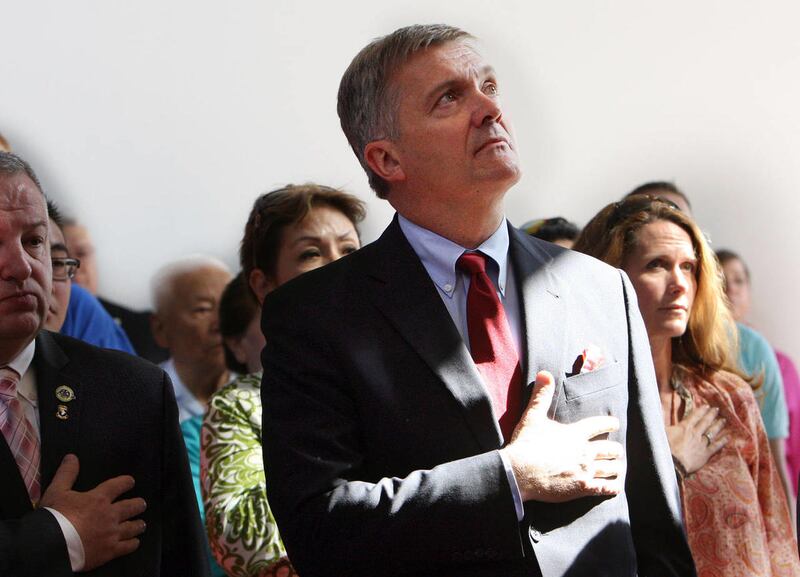

SALT LAKE CITY — Michelle Thomas first heard Rep. Jim Matheson speak in a small conference room in St. George in 2002.
The Democratic congressman was running for re-election for the first time, and Thomas wanted to hear what he had to say and ask some questions. As an advocate for downwinders — or those who have been exposed to radiation from nuclear testing — she knew Matheson's father, Scott, the former Utah governor who died in 1990 of a rare form of cancer caused by radioactive fallout from open air testing of nuclear weapons in the 1950s.
Though Thomas wasn't familiar with the younger Matheson, it didn't take long for him to endear himself to her.
"He was with us. He was one with us, and really a genuinely tender-voiced man. He doesn't try to be omnipotent or all-knowing," said Thomas, 64, who has debilitating autoimmune disease and has endured lung and breast cancer.
Shortly after that meeting, Matheson's staff asked her to give his nomination speech at the state Democratic Party convention. Thomas obliged.
"I just knew he was the real deal," she said. "There's nothing politically squirrely about him."
Matheson won that election and every subsequent election — sometimes by the skin of his teeth — until deciding last December not to seek an eighth term.
Asked about his legacy, Utah's lone Democrat in Congress the past 14 years says he isn't ready for a eulogy: "My body's still warm."
But the question reminded him of the speech he gave when he kicked off his first campaign from his mother's driveway in 2000. He said he didn't expect people to agree with him on every issue, but that they could expect, even demand, a thoughtful, common sense approach that put Utah before party and politics.
"I think I kept that promise," he said. "I think that's the most important legacy of all."
Matheson, 54, talks like he has more politics in him but continues to hold his future plans close. He is widely mentioned as a possible candidate for governor or U.S. Senate in 2016.
"I honestly don't know what the next step is," he said, though he figures he'll "somehow" be involved in the public policy arena.
He anticipates being affiliated with the University of Utah's Hinckley Institute of Politics in some way but not as a full-time job. Before running for office, he worked in the energy field and on environmental policy for several companies. He later started his own energy consulting firm.
Matheson's wife, Amy, is a Salt Lake pediatrician. They have two sons, Will, 16, and Harris, 8.
Alyson Heyrend said she learned a lot about public service in 12 years as Matheson's communications director.
"This sounds corny, but with the Matheson family it really is a noble pursuit. It's in their DNA," she said.
Matheson often traveled with his parents when his father was governor and his mother, Norma, served as first lady. While the governor was in meetings, Matheson went with his mother to senior centers.
"I think Jim really learned a lot from watching how his mother worked as first lady," Heyrend said.
Matheson made a conscientious effort to get to know residents in his district. He visited hundreds of businesses, service organizations and schools. He proved to be a good listener who cared about those in his district.
"The more I engaged with people in Utah, the more I felt good about the fact that my style and my representation was appropriate, was something they wanted," he said.
Matheson takes the title of representative — the one he will give up in January — literally. He often told groups that he represents the people who voted for him and against as well as those who didn't vote. He had more staffers in Utah than he did in Washington to stay connected to his constituency.
"I would say he's been a pragmatic, balanced voice for Utahns," said Utah Democratic Party Chairman Peter Corroon. "He was not a United States representative who forgot where he came from."
Kirk Jowers, head of the University of Utah's Hinckley Institute of Politics, called Matheson an "incredible public servant." He said the congressman has arguably had the best constituent services operation of any of the state's legislators the past several decades.
Matheson's campaigns are blueprints for Democratic success in Utah, said Jowers, a Republican. He made sure people knew him, liked him and understood that he was working for them.
"He was always in a very tough spot demographically, but he made the most of it," Jowers said.
Republican state legislators twice tried to write him out of office when it drew new congressional districts in 2001 and 2011. He served in the state's 2nd District for 12 years before jumping to the newly formed 4th District in 2012.
Looking back, Matheson said those attempts to get rid of him might have actually backfired on the GOP.
"I think it forced people in the new districts to say, 'This guy's kind of been thrown to the wolves here.' But I think in some strange way it gave them an inclination to at least give me a look," he said.
"I was the target of a group of people who were not playing fair, in my personal opinion. Maybe in a strange way the egregiousness of gerrymandering benefitted me a little bit."
The only Democrat in Utah's six-member congressional delegation, Matheson looked for bipartisan opportunities such as working with GOP Sen. Bob Bennett on a public lands bill in Washington County. Two dozen points of view came to the table, and, five years later, everyone, including ranchers and environmentalists, supported the deal.
Matheson said the legislative process is all about building consensus, something that is sorely lacking in Washington's polarized environment.
"It's not exciting. It's actually a lot of long hours, and hard work. That's how you legislate. Piece together all the points of view," he said.
Matheson harks back to a time when Congress works, Jowers said. Blue Dog Democrats and Rockefeller Republicans provided a nice mix of people in the middle who could bridge the gaps and get things done.
Jowers said one "prominent" GOP member of the Utah delegation told him Matheson's departure is a "huge loss for Utah because we really need one of our six to be a Democrat so we can at least find out what's going on over there."
Former St. George Mayor Dan McArthur sported a "Friends Don't Let Friends Vote Democratic" T-shirt when the Matheson campaign first met him. Though he never switched party allegiance, he ended up doing campaign ads for the Democratic congressman.
McArthur said he had no problem telling voters what Matheson had done for the city, though he didn't tell them who to vote for in the commercials.
"Many of us here in elected positions felt that he treated us right," said McArthur, whose 20-year run in office ended last year.
Matheson "went to work for us" on issues including public lands, roads, utilities and a new airport, he said.
McArthur said Matheson will be a good representative wherever he decides to serve.
If Matheson runs again, Thomas expects to be there. And she'll bring her autographed breast prosthetics — one signed by former Democratic Senator and Defense Secretary Chuck Hagel and the other by the late Robin Williams.
"He better invite me to his next announcement party because I'll be flag-waving and I'll auction off Robin Williams' breast for his first down payment on his campaign," she said.
As Jowers put it, Matheson remains the one Democrat no Republican wants to face in an election.
Email: romboy@deseretnews.com
Twitter: dennisromboy