




We are emotional and we are spiritual. And even if you are an atheist, that is a belief system, and often times atheists are humanists, so they feel connected to something beyond themselves — which might be another person — or they feel connected to creation and you know nature and those kinds of things. – Susan Roberts, University Hospital chaplain
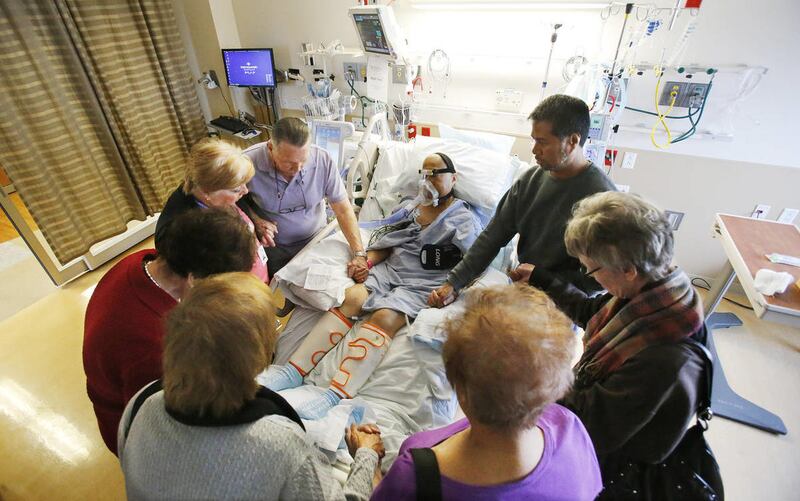
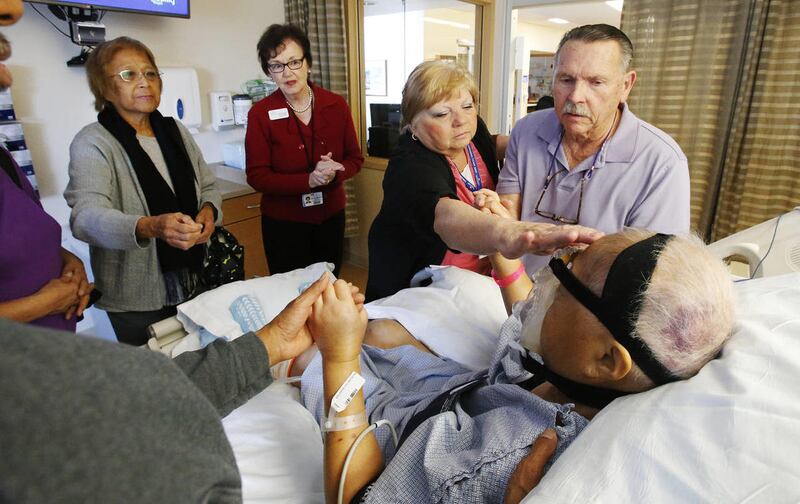
SALT LAKE CITY — Family and friends surrounded the bedside of Sylvia Boldwyn, who was near death after cancer remission.
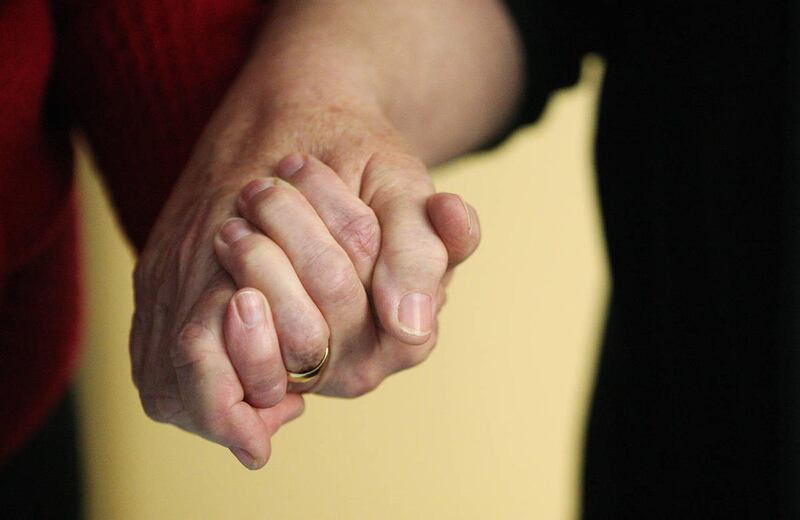
They all held hands as Pamela Grant, a eucharistic minister with St. Vincent's Parish, offered a spiritual Holy Communion prayer. Normally Grant would bring consecrated hosts for Communion, but when someone is not physically able to take the host, she says a prayer instead.
"Lord, I am not worthy that Thou should enter under my roof, but only say the word," she said during Communion before others in the circle joined in. "And my soul shall be healed."
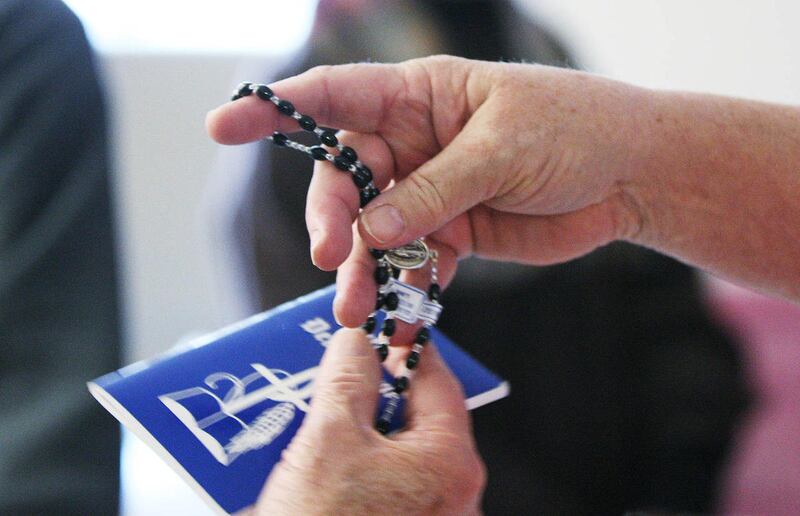
Boldwyn nodded, an oxygen mask covering her face, as Grant told her she had "received the Lord." She reached for and held Grant's hand in what seemed to be an act of gratitude after Grant finished her prayer. Grant remained with Boldwyn and her family, handing out rosary beads and prayer books for those who had to hastily leave their homes.
Grant is a volunteer minister at Intermountain Medical Center, one of the area hospitals that prioritizes spiritual care in addition to physical healing.
Upon check-in at hospitals, patients indicate their religious or spiritual preference. Hospital chaplains and volunteers will connect patients with their local congregation, religious group, or family members, provide for their spiritual needs and give them a safe space to heal. They often receive several requests or pages for spiritual care every day.
“I believe that they are thirsting for the spiritual, and our world doesn’t ever say people are thirsting for the spiritual because we’re in a whole different mode,” said Rosemary Baron, palliative care chaplain at Intermountain Medical Center. “Now does the spiritual mean a walk in the mountains? Does it mean maybe coming out here and sitting next to this fountain as it's flowing? Or does it mean praying or does it mean receiving the sacrament? But people are thirsting for the spiritual, there’s no doubt in my mind.”
Latter-day Saint and Catholic congregations and parishes often send missionaries, ministers or volunteers like Grant to help take care of their congregants. Palliative care or hospital chaplains provide spiritual care for these patients as well as those of other faiths or no religion.
“I think that we have all these physicians and caretakers that are taking care of us and yet we are a whole body and we’re not just a physical body," said Susan Roberts, University Hospital chaplain. “We are emotional and we are spiritual. And even if you are an atheist, that is a belief system, and often times atheists are humanists, so they feel connected to something beyond themselves — which might be another person — or they feel connected to creation and you know nature and those kinds of things."
At St. Mark's Hospital, those who are spiritual but not religious, known as "nones," make up the majority of the two full-time and one part-time chaplains' visits.
"Most of them pray or often want to be prayed for," said chaplain Saundra Shanti.
Chaplains at St. Mark's approach everyone who enters their doors with an attitude of "cultural religious humility," engaging patients with an attitude of "'I don't know,' rather than, 'Oh, yeah. I know about your religion,'" said Lincoln Ure, St. Mark's director of pastoral care.
He scrambled on his knees around the chapel inside St. Mark's, gathering religious books from underneath seats to try to show the diversity of religions they serve. He produced a Bible and Bhagavad Gita among other texts found in the chapel, with symbols from various religions seen throughout the room.
Similarly, other area hospitals have chapels or meditation centers where they try to represent all faiths, or be faith-ambiguous, to meet the needs of each patient.
"I often call this the mirror of our society, our hospital being the mirror of our society. So whatever we find in our society, we're going to find here in our hospital as well," Baron said.
The chaplains have different approaches of how they approach the patient and the rigor of their qualifications for spiritual care providers. But one common thread seems to be that they come ready to listen.
"I'll ask them, 'What is healing for you?'" said Jeff Price, chaplain at Lakeview Hospital.
One woman said she would like a loom to help her heal. So Price went to a craft store and bought her a loom so she could make hats and gloves.
"That was healing for her," he said. "That was the emotional connection for her."
In another instance, an adult woman's father asked him to come and "preach Christ" to his daughter who was in for same-day surgery. He asked to visit with her first and found that the woman followed what Price described as "more of a Native American spiritual base."
She found nature to be healing and requested to stay in a room that had a window to allow her to see the moon. She also confided her worries that her upcoming surgery would not allow her to participate with her grandchildren and wanted to "talk to nature for a moment," he said.
"Ultimately what I have found is patients know. They know what they need," he added. "That's, for me, what ends up leading to really good results for them."
Price, a Latter-day Saint, said he encounters many chaplains in training who are worried they will have a difficult time ministering to those of other faiths because they will not be able to be authentic.
"I have my faith tradition and that's what's healing for me. And I identify that every day, that that's what's healing for me. But it doesn't influence negatively my availability for a patient that expresses (another) faith or expresses no faith," he will tell them. "I find that their source of healing is enough. I don't have to find a place where it settles OK with me. Because I'm OK with me and my faith tradition."
One challenge that chaplains face is being with others in their pain, rather than attempting to fix or run away from pain. At St. Mark's, chaplains minister on three levels: the first is to arrange for blessings, Holy Communion, sacraments or other religious rituals. Next, they establish a safe relationship and then seek to learn about someone's life story and guide them as needed.
"We’re unusual in that to do the work, we bring only our person. Only myself. I have no needles. I don’t wear a stethoscope. I have no equipment. So when I go in, this is it. This is what I got. So we do a lot of inner work,” Shanti said.
The chaplain and spiritual care ministry extends to staff at the hospital as well.
Jamie Farneus, a housekeeping worker at St. Marks, came to Ure with a concern about what was causing a door to rattle in what she said was an "eerie" way.
Ure listened to her and told her to tell him if it happened again.
"The door got fixed," she recently told him, laughing with relief.
This is part of Ure's effort to help each person under his watch feel validated.
“It’s just really important for (Farneus) … just to support her and how important she is,” he said.
The spiritual care workers offer "a supplement to the medical care that we give. They offer the compassion to help them with their spiritual issues, their emotional issues and also a lot in terms of disposition," said Brian Shiozawa, an emergency room physician at St. Mark's.
Shiozawa, also a senator in the state representing Cottonwood Heights, said the spiritual care team can spend time with families and patients to make sure their emotional needs are met.
“The thing about hospitals is we’re pretty good technically, but I don’t know how good we are from, you know, the behavioral or emotional side of things. And frankly we don’t have time,” he said.
Shiozawa's appreciation of the necessity of spiritual and emotional healing is reflective of a shift in the medical community, Ure said.
"They're beginning to realize that if folks can get soul connected, it may not cure them and their illness, but its profoundly healing. … If you can enter into that sense of well-being … you can get there."
As part of this walk toward well-being, a priest visited the Boldwyn family at the Intermountain Medical Center the night before Grant and Baron made their visit to deliver spiritual Communion. Boldwyn's husband and family were appreciative of the care they received.
“I find it comforting. I find it reassuring that we have a forgiving God … one that loves us,” Kenneth Boldwyn said. “Her physical being is still deteriorating, but I think it helps her be at peace and it’s always good to know that people care. … I get the feeling that they’re not just going through the motions, that they actually have a sincere caring for you and what you’re going through and believe me, it’s a very difficult time. Very hard."
Email: wevans@deseretnews.com
Twitter: whitevs7