
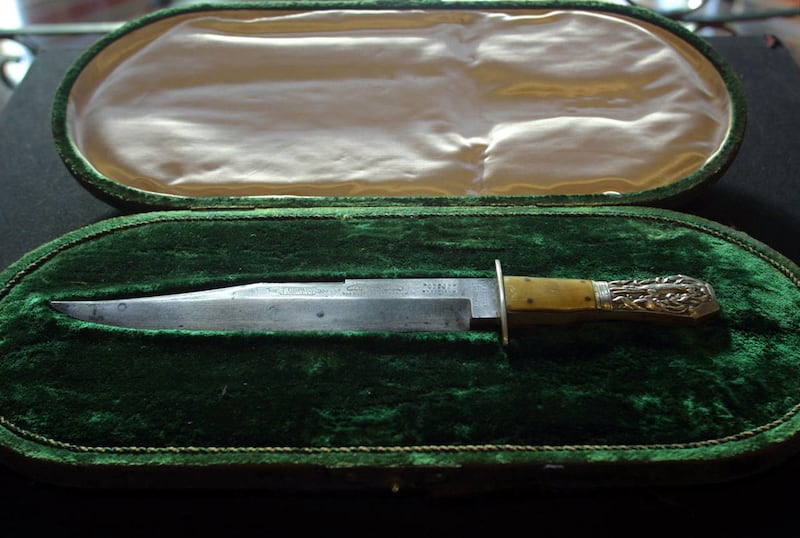
On the evening of April 14, 1865 — the same night that President Abraham Lincoln was assassinated — Secretary of State William Seward was the victim of an assassination attempt as well. Both men, as well as Andrew Johnson, the vice president, were targeted by John Wilkes Booth's conspiracy.
Seward had been a lawyer and politician from New York, eventually rising to become governor and then U.S. senator. (His home in Auburn, N.Y., boasted a fireplace built by a young Brigham Young.) During the 1850 crisis, when many Southern states threatened to secede from the Union if California was admitted as a free state, Seward gave his famous “Higher Law” speech, in which he argued that basic morality was a higher law even than the U.S. Constitution, and that the continued practice of slavery was antithetical to basic morality.
In the mid-1850s, when it appeared that the country was no closer to solving the fundamental problems of slavery than it had in 1850, Seward and several like-minded politicians formed the Republican Party. When the party had its convention to nominate its candidate for president in 1860, many were convinced that it would be Seward. After some deft political maneuvering, Lincoln gained the nomination, and soon asked Seward to serve as his secretary of state.
The two men worked closely together throughout the Civil War and came to admire each other greatly. It was Seward who suggested to Lincoln that he wait until after a major Union victory before issuing the Emancipation Proclamation in 1862, lest it look like the Union was only attempting to free the slaves out of desperation owing to the poor military situation. With the end of the war in sight, early April 1865 saw Seward involved in a carriage accident that broke his jaw and dislocated his shoulder.
That same month saw John Wilkes Booth advancing his nefarious plans against the U.S. government. Booth's original plan was not assassination, rather he hoped to kidnap key members of the government and hold them for ransom against the release of Confederate prisoners of war. After Gen. Robert E. Lee surrendered to Ulysses S. Grant at Appomattox Courthouse on April 9, Booth twisted his original plan into one of revenge.
Booth's fellow conspirators were an odd bunch: there was the pharmacist's assistant David Herold, the German-born repairman George Atzerodt, and Confederate spy John Surratt. Often meeting in the home of Surratt's mother, Mary, the motley crew also included the former Confederate soldier Lewis Powell.
In his book “Manhunt: The 12-Day Chase for Lincoln's Killer,” historian James L. Swanson wrote: “Lewis Powell, 21-year-old son of a Baptist minister, enlisted in May 1861 as a private in the Second Florida Infantry. An attractive, well-muscled six-footer, Powell exemplified the best that the Confederate army could muster. A loyal, obedient, and hard-fighting soldier, he saw plenty of action until he was wounded and taken prisoner at Gettysburg in July 1863. Paroled, he made his way to Baltimore and fell into the orbit of Surratt and Booth.”
The plotters decided that on the night of April 14, Booth would target Lincoln, Atzerodt would assassinate Johnson, and Powell would kill Seward. Atzerodt booked a room in the Washington, D.C., hotel where Johnson was staying, though could not find the courage to act. Instead, Atzerodt got drunk in the hotel bar.
Powell, however, was determined to carry out his part of the plot. In a sense, Powell had it much easier than his fellow conspirators. While Booth and Atzerodt would have to improvise to find out exactly where Lincoln and Johnson would be when they wanted to strike, Powell knew exactly where to find Seward. The secretary of state was convalescing in his Washington home. Beyond that important fact, however, Powell was in the dark. Where in the house was Seward? Who else was in the house with him? How would Powell gain access to the house?
Accompanied across town by Herold, who waited across the street, the veteran of Gettysburg knocked on Seward's front door. Seward's servant, a young free black man named William Bell, answered. Powell explained to him that he had medicine for Seward and must deliver it personally, as he must transmit specific instructions from the doctor for its use.
When Bell refused, stating that the secretary of state was sleeping, Powell firmly moved into the room, pushing past Bell, though still maintaining that he was there to deliver medicine. As he made his way upstairs (it was unlikely that Seward was recuperating on the ground floor), Seward's son Frederick stopped him and told him that he could take the medicine, but Powell would not be admitted to Seward's room.
The two men argued for a few moments when Seward's daughter Fanny emerged from a side room, and indicating that Seward was asleep inside. Powell appeared to relent and started moving back down the stairs when he spun around suddenly and jammed a .36 caliber pistol in Frederick's face. The gun misfired, and though several more rounds were loaded, in his frustration Powell brought the gun down hard on Frederick instead of firing. The force of the impact damaged the gun, rendering it useless.
Bell bolted out the front door and yelled in the street “Murder!” Hearing this, Herold fled. Also sitting with Seward was his army nurse, Private George Robinson, himself a recovering wounded veteran. Robinson went into the hall to see what was happening. When the door opened, Powell turned from the business of beating Frederick, and bolted past Robinson into the room. With his knife, Powell slashed at the army nurse, cutting his forehead. Fanny moved in between Powell and Seward, imploring Powell not to kill her father.
At this, Seward roused and noticed Powell, recalling later that his thoughts were simply that his assailant was a good looking young man and noting “what handsome cloth that overcoat is made of.”
Powell leaped over to Seward and started slashing with his knife. A deep cut into his cheek produced copious amounts of blood. Seward was wearing a metal device to keep his jaw in place, and some have theorized that it successfully deflected Powell's attacks, which otherwise easily could have cut into his jugular vein. In her book, “Team of Rivals: The Political Genius of Abraham Lincoln,” historian Doris Kearns Goodwin wrote:
“Fanny's screams brought her brother Gus into the room as Powell advanced again upon Seward, who had been knocked to the floor by the force of the blows, Gus and the injured Robinson managed to pull Powell away, but not before he struck Robinson again and slashed Gus on the forehead and the right hand. When Gus ran for his pistol, Powell bolted down the stairs, stabbing Emerick Hansell, the young State Department messenger, in the back before he bolted out the door and fled through the city streets.”
Seward, Bell, Robinson, Hansell and Seward's sons all survived Powell's attack, though his wife died just two months later, the excitement of the attack devastating her health. Her funeral was said by many to be “the largest assemblage that ever attended the funeral of a woman in America,” according to "Team of Rivals." The next year, Seward's daughter Fanny died from tuberculosis, only two months before her 22nd birthday. Seward made a full recovery, though he sported the scar on his cheek for the rest of his life. He continued to serve as secretary of state until 1869, notably acquiring Alaska for the U.S. in 1867. He died in 1872.
Powell fled the scene of the assassination attempt and hid for three days, finally emerging to seek refuge with Mary Surratt. His timing couldn't have been worse. He arrived just as federal authorities were taking her into custody for her part in the plot. His identity was soon discovered and he was arrested as well.
Powell was tried with the other conspirators, while Booth was shot while attempting to resist U.S. forces trying to arrest him. Together with Mary Surratt, Atzerodt and Herold, Powell was hanged on July 7, 1865.
Cody K. Carlson currently teaches history at SLCC and is an avid player of board games. His blog is at thediscriminatinggamer.com. Email: ckcarlson76@gmail.com