

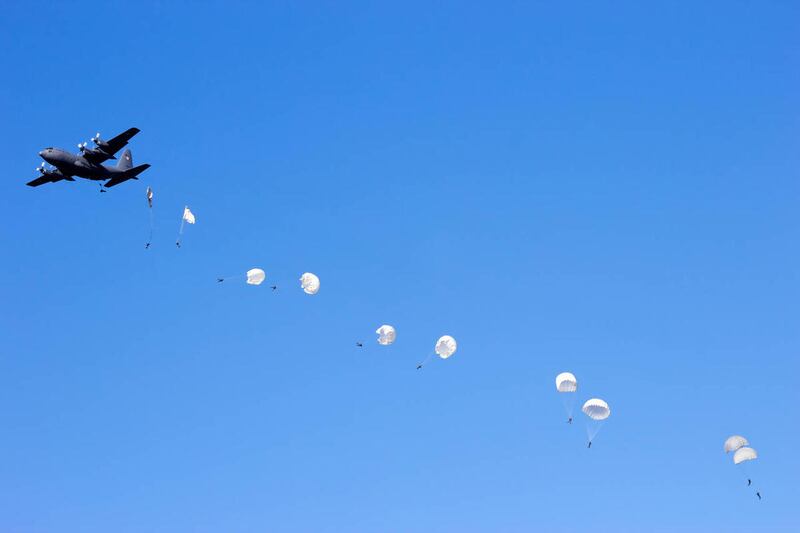
On Sept. 25, 1944, 70 years ago this week, the Allied armies suffered a major setback against the Germans in Holland, when Operation Market-Garden, a largely airborne operation intended to win World War II in Europe by Christmas, ended in disaster.
By late summer 1944, it was clear that Germany was in retreat across Western Europe. In June, the D-Day landings had placed a substantial Anglo-American army in France, and by mid-August, Paris had been liberated. Some expected Germany to surrender, while others believed the Allied army would invade Germany and take Berlin in a matter of a few more months.
One major obstacle to the invasion of Germany, however, was the rivers along Germany's western border that blocked the Allied advance. Many of these rivers, including the massive Rhine River, flowed through the German-occupied Netherlands. The great fear for Allied military planners was that once the Allied armies pushed too far into Holland, the Germans would blow up all of the bridges, ensuring the war would last well into 1945.
In order to overcome this war-lengthening scenario, British Field Marshal Bernard Montgomery offered a plan in early September to Supreme Headquarters Allied Expeditionary Force or SHAEF, commanded by American General Dwight D. Eisenhower.
In Omar Bradley's post-war memoir, “A Soldier's Story,” the then commander of the U.S. 12th Army Group wrote, “Had the pious teetotaling Montgomery wobbled into SHAEF with a hangover, I could not have been more astonished than I was by the daring adventure he proposed. For in contrast to the conservative tactics Montgomery ordinarily chose, the Arnhem attack was to be made over a 60-mile carpet of airborne troops. Although I never reconciled myself to the venture, I nevertheless freely concede that Monty's plan for Arnhem was one of the most imaginative of the war.”
Essentially, the plan called for the Allied armies to drive a salient of 60 miles into the German lines in Holland, outflanking the major German fortification lines. Within this projected salient stood five water obstacles. North of Eindhoven sat two canals that would have to be bridged. Next sat the Meuse River, then the Waal River. Finally, there sat the daunting Rhine River.
Given the code name Market-Garden, the Market portion of the plan represented its airborne component. British and American paratroopers and glider borne troops were set to land at various bridges behind the German lines, ensuring that the Germans could not blow them up. The job of the paratroopers was simple, secure the bridges and hold until they were relieved. It was a daring plan that called for the American 101st Airborne Division to land near Eindhoven, the American 82nd to land near Nijmegen on the Waal, and the British 1st to land near the most important and furthest of the bridges, Arnhem on the Rhine.
The second part of the plan, Garden, represented the ground forces that would strike at the German lines and punch their way through to link up and relieve the airborne troops. Garden consisted largely of the XXX Corps, made up of British units under Montgomery's command.
Some historians contend the plan was doomed from the outset as Allied planners refused to pay heed to intelligence reports that conflicted with their assumptions. Also, the sheer logistical scope of the operation, while certainly within the Allied armies' ability, depended upon everything working like clockwork. They would have done well to heed the advice of the great von Moltke the Elder, who had stated 60 years earlier, “No plan survives contact with the enemy.”
By chance, the Germans had taken the 2nd SS Panzer Corps, under the command of Lt. Gen. Wilhelm Bittrich, out of the line and sent it somewhere quiet to refit and recoup its strength. By chance, the site the German High Command chose was Holland, near Arnhem. The presence of such a relatively strong unit in their avenue of advance was something Allied planners had not accounted for.
The attack began on Sept. 17 and met with initial success. Twenty thousand airborne troops dropped over the skies of Holland, conveyed and escorted by more than 5,000 aircraft and 2,000 gliders. With the U.S. paratroops in place, the tanks of the XXX Corps smashed through German defenders and linked up with U.S. Airborne troops at Endhoven, the Meuse at Grave, and eventually at Nijmegen. The bridges were captured intact.
In historian Terry Brighton's book, “Patton, Montgomery, Rommel: Masters of War,” he wrote: “Then it went wrong. The British 1st Airborne Division was dropped six miles from the planned zone and their armored jeeps were lost, leaving them to make a four-hour trek on foot to the road and railway bridges at Arnhem. This delay meant that German reinforcements reached Arnhem before the British. Worse still, that reinforcements included the 9th and 10th SS Panzer Divisions, which had been refitting just outside the town. Ironically, the panzers had just returned from a training exercise that involved defeating a mock airborne assault.”
Additionally, the British 1st Airborne could not be reinforced by the Polish 1st Independent Brigade because of inclement weather. It was becoming increasingly obvious that the goal of reaching the British 1st Airborne with the XXX in only three days could not be achieved. By Sept. 20, the XXX Corps had only managed to reach Nijmegen. The next morning the British tanks rolled out to rendezvous with the British 1st Airborne, which by that point was fighting for its life against the SS. It had failed in its mission to capture the length of the bridge.
Bradley wrote: “The British 1st Airborne soon found itself pinned in position by furious enemy counter-attacks. For five days those red-bereted British airborne troops clung to that embattled bridgehead until on Sept. 25, having despaired of breaking through, Montgomery ordered their withdrawal back across the Rhine. Of the 9,000 British troops who parachuted into that bridgehead, fewer than 2,500 infiltrated back to our lines.”
The Allies took around 15,000 casualties from the battle. German casualties are sketchy, with some suggesting as many as 13,000 casualties, others stating the number was far lower. The failure at Arnhem did indeed ensure that the war lasted well into 1945, not by Christmas as Montgomery had promised. Also, the resources the operation consumed stole much of Gen. George Patton's thunder, whose Third Army had been making headway further south.
The victory also gave the Germans time to regroup and reinforce the Siegfried line further south, the fortifications that Market-Garden was meant to circumvent. It also improved what had been a non-existent German morale, and paved the way for Hitler's last great offensive of the war, the Battle of the Bulge, which launched through the Ardennes Forrest against the Americans and British in December 1944.
Cody K. Carlson holds a master's degree in history from the University of Utah and teaches at Salt Lake Community College. An avid player of board games, he blogs at thediscriminatinggamer.com. Email: ckcarlson76@gmail.com