



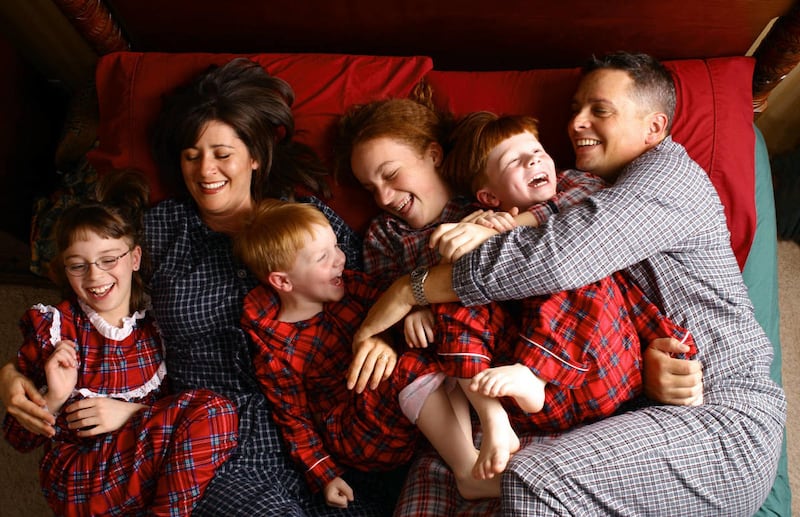

Seven of nine children in the Grotheer family reached their 50th anniversaries. Could it be that people who grow up in large families learn skills like compromising or sharing that make it more likely that they'll have enduring marriages when they get older?
Anita Creamer of the Sacramento Bee tells the story of Betty Grotheer, who married Lewis Pritten when she was 17 and he was 23. They are closing in on their 60th anniversary. Her sister Nancy married when she was 19 and they're on course to celebrate their 50th in a few weeks. They are reportedly among about 6 percent of couples who reach their golden anniversaries.
But why?
"A key reason, said University of Virginia sociologist Brad Wilcox, is that a greater proportion of older adults come from large families, born into an era when big families were the norm in American life — and research shows that having lots of siblings correlates with a lower statistical likelihood of divorce," Creamer writes.
Wilcox told her it could be that learning to share and live with the "exceptional stress of having all those different personalities to deal with" provides skills that allow couples to weather marital storms.
Ohio State researchers last summer published a study that found there's no such thing as too many brothers and sisters when it comes to marital longevity. Douglas Downey, a sociologist, and his colleagues found that being a singleton or having a couple of siblings didn't increase potential for long marriages, "but when you compare children from large families to those with only one child, there is a meaningful gap in the probability of divorce," he said in a written statement.
That study said each additional sibling one has, up to about seven, "reduces the likelihood of divorce by 2 percent." And that held true even after the researchers controlled for education, socioeconomics, family structure, race, age when they married, whether there were children, religious affiliations and more.
Perhaps it is a process of socialization. In an earlier study, Downey showed that kids with siblings were more likely to adapt to the other kids in kindergarten and play together nicely.
"Siblings fight with each other, they have conflicts, but they also figure out how to resolve those conflicts. That probably helps them deal with other children when they go to school,” he said in a news release for that research. That skill set might be helpful in times of marital conflict, as well.
Twenty years ago, psychologist John Gottman led a team of researchers on a quest to see if they could figure out why some couples divorce and others don't. According to Melanie Tannenbaum, writing on a Scientific American blog, they found four behaviors that predict divorce.
"Yes; in case the enormity of what I just said didn’t sink in quite yet, solely based on how often you notice four behaviors occurring in a single, 15-minute conversation, you can predict with 93 percent accuracy whether or not a couple will still be married 14 years from now," Tannenbaum wrote. The list, which Gottman and company called the "Four Horsemen of the Apocalypse," was simple: "contempt, criticism, stonewalling and defensiveness."
There's no shortage of advice on how to make a marriage last. Esquire magazine interviewed several "lifers" for their advice on going the distance. Among those asked was Paul Wexler, married 40 years. "Hilary tells me that women say that they need three husbands in their lifetimes. As a young woman, they need an adventurer. As a mother, they need a father to their children. And as an older woman, they need a companion, a steady type of guy. If you can fill those roles over the course of decades, you're in luck," he said.
Actor John Travolta told Closer magazine that having kids helps a marriage last, too.
Email: lois@deseretnews.com, Twitter: Loisco