

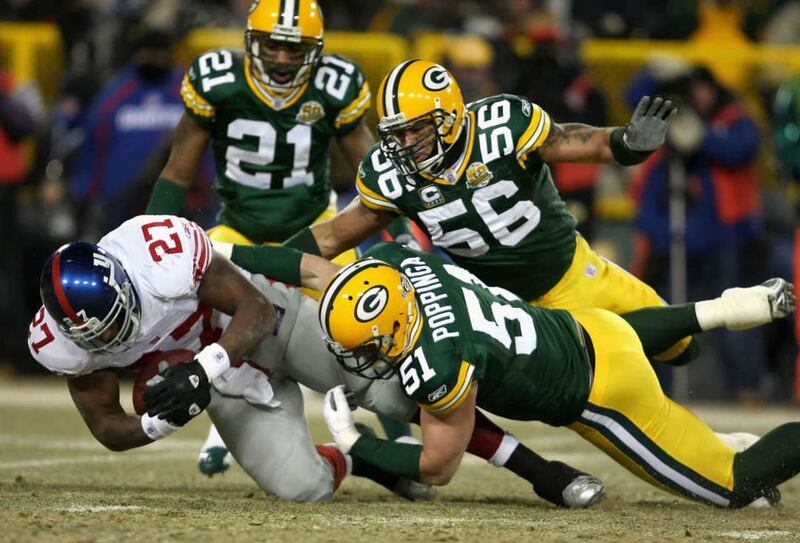
Editor's note: The following is an excerpt taken from Brady Poppinga's book "True Spirit of Competition."
As I became eligible to enter the NFL Draft following my senior season, many of the draft experts felt like they knew me better than I knew myself.
Many of them predicted I would run a slow 40-yard dash and negatively affect not only my draft status, but my chances of ever playing in the NFL as well.
The only problem, though, was they didn't really know me. The best way to show them what I was all about was to impress them in person at the 2005 NFL Combine.
Feeling confident and ready to go, we made our way to a frozen Indianapolis for the scouting combine. The combine experience in many ways is compared to a big meat market. For the first two days of the three-day combine, we were paraded around like a bunch of cattle. There was a time when we were dressed in only our underwear so scouts, coaches, and team executives could see our body composition up close.
We all lined up to the side of the stage lit by a spotlight. One by one we would stand in the light of the spotlight and get weighed and measured shirtless in front of hundreds of NFL personnel, executives and coaches. We had in-depth tests done on our health and our bodies so the teams would have as much information as possible before making a multimillion-dollar investment. You get poked, prodded and asked the same questions over and over again by all 32 teams’ physicians, doctors and orthopedic surgeons.
After all of the medical procedures, you interview with individual position coaches and with teams. At this point in the process, it was no surprise to me that many of the teams and individual coaches had the same questions about my speed as the draft gurus and the trainers leading up to the combine. I had one meeting with two teams at once, the Denver Broncos, and my eventual linebackers coach, Winston Moss, who at the time worked for the New Orleans Saints.
During the meeting, they made it clear that my speed was a question mark. They explained to me that if I didn’t run a fast 40-yard dash, the NFL might not be for me.
In a meeting with Tony Dungy and the Indianapolis Colts, he asked me how fast I would run my 40. Not wanting to limit myself, I didn’t give him a specific time. Instead, I confidently said, “I will run fast — very fast.”
Again, if I had accepted what all of the true experts thought, like the coaches and talent executives of every team, I, too, may have conceded that I wasn’t as fast as I once thought because of all those who had questions about my speed. But because I knew who I was even more than the so-called experts, I was confident that I would set them all straight the next day when I would finally be able to put to rest the question of my speed. The next day wasn't only the last day of the combine, but the day we would finally run our 40-yard dashes.
Waking up at 6 a.m. Eastern time, which was be 3 a.m. Pacific time, we were scheduled to run our 40s at 9 a.m. The teams wanted to put you in a pressured situation when running your 40 to get an idea of how you would perform in a somewhat pressure-packed situation. That is why they woke you up early and had you run your 40 so early in the morning.
When we arrived at the football field where we would be running our 40s, the stands were packed with coaches, scouts and executives with their own handheld stopwatches on the side next to the 40-yard dash track. Even though there is an official 40 time, every team has its own time. It is not an objective process in timing prospective players in their 40-yard dashes. Where one team may have timed a guy at 4.7 seconds, another team may have timed the same guy at 4.5. Those two-tenths of a second could mean a difference of a lot of money come draft day.
After I took in the surroundings, my focus went to activating my body and warming up like I had been doing over the past few months in training. As I went through my routine I felt quick, explosive and awake. I cared less that is was 8:30 a.m. Eastern time, 5:30 a.m. Pacific time. I was focused on doing what I had come to Indianapolis to do, and that was to show the talent evaluators who I was.
After warming up, we all lined up alphabetically. One by one each guy took his turn running his 40-yard dash. It was somewhat eerie in the sense that after guys would finish running their 40s, there were no cheers, not even a peep from the coaches, executives and scouts in the stands. No one wanted to show his hand as to who he liked or didn’t like or who he had timed who ran really fast or not.
After watching all the guys before me go, it was now my turn. I confidentially strutted up to where I would start. At the starting line I saw Al Davis, the owner of the Oakland Raiders, sitting in the second row about 10 feet from the starting line. He was one of the many decision-makers who was enamored with the 40-yard dash.
If you run fast, in most cases on the Raiders’ draft board, you would really jump up the ranks. As I positioned myself in my stance to start, everything was quiet, except for Davis' heavy breathing. Redirecting my thoughts from his breath to mine, I leaped out of my stance. After somewhat stumbling, I gathered myself and ran as fast as I could through the finish line. I felt explosive and fast, but that stumble might have cost me a couple of hundredths or even tenths of a second on my time, which could translate into hundreds of thousands of dollars lost.
Because I was confident in myself, my poise didn’t allow that one misstep to negatively affect me. My second turn came, and I ran well, this time without a stumble.
Being the impatient guy that I am and dying to know my time, I ran up to the first scout that I saw on the field and noticed that he had the official times. I asked him, “Sir, do you have our 40-yard times?” He said he did.
He already knew who I was, and he said, “59 and 59,” meaning 4.59 in my first one and 4.59 in my second one. I was pumped. I knew the whole time that I could run that fast. It validated my thought that in spite of what everyone else may have thought they may have known about me, I knew myself better than anybody. Not even the true experts like the NFL coaches, executives and scouts knew me as well as I knew myself.
Following my combine performance, my stock rose. The Packers, who place a high level of emphasis on the 40-yard dash, started to show a lot of interest in me leading up to the draft. They were impressed with my speed-to-size ratio, meaning I could run the 40-yard dash in the 4.5 range weighing 260 pounds. There aren’t many guys in the world who are big and fast. I ended up being one of only three guys who weighed over 250 pounds to run in the 4.5 range in all of the 2005 NFL Draft class.
Sure enough, with the 125th pick in the 2005 draft, I received a call from the Green Bay Packers. Matt Klien, the assistant to the head coach, was the one who called me. After having me wait for a few minutes, which to an impatient person like me seemed like a couple of hours, he asked, “How would you like to play in the frozen tundra of Green Bay?”
I replied by saying, “I was born and raised to play in that kind of weather, having grown up in Evanston, Wyoming.”
Editor's note: Go here to get the book, or here for a downloadable ebook to mobile devices.
Brady has played for the Green Bay Packers, St. Louis Rams and Dallas Cowboys. He has worked as a motivational speaker and studied business management at BYU.