


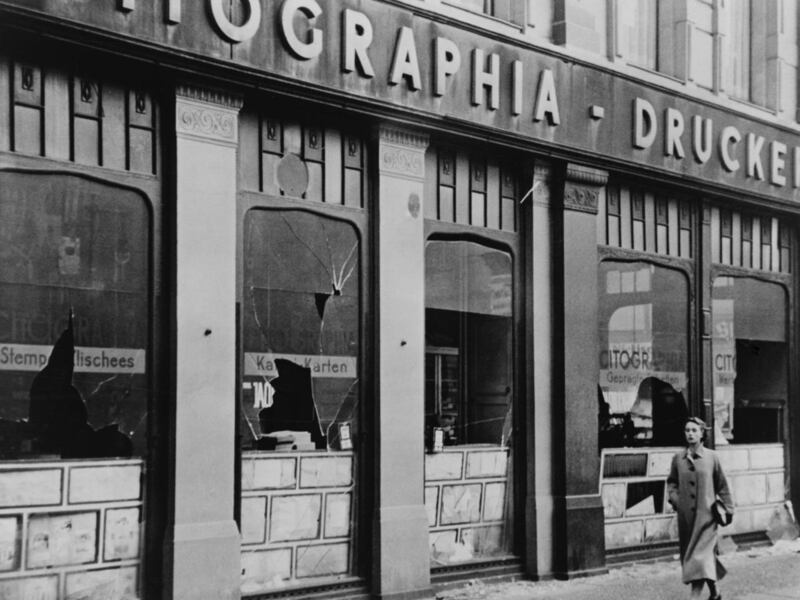


On the night of Nov. 9-10, 1938, the Nazis undertook a wild pogrom of violence against Germany's Jewish population throughout the country. The event, which came to be known as Kristallnacht — the Night of Broken Glass — saw Jewish shop windows smashed and synagogues burned, as well as Jews beaten, murdered or sent to concentration camps.
In late September 1938, Adolf Hitler had celebrated a major triumph over his Western rivals. Britain and France, hoping to avoid war with Germany, had withdrawn their alliance with Czechoslovakia and given Hitler the green light to invade and annex the Czech Sudetenland. While many throughout Europe breathed a sigh of relief that the crisis had not led to war, Hitler himself felt emboldened. Though the terms of the Munich Pact, the treaty which ceded the Sudetenland to Germany, had stated that Hitler would not make further territorial demands in Europe, his eyes were already fixed on Poland.
Anticipating an eventual showdown with Germany's eastern neighbor over the “Polish Corridor,” the swath of land that gave Poland access to the sea and the free city of Danzig even as it cut off Germany proper from East Prussia, Hitler decided to expel Polish Jews living in Germany. Many Jews who had lived in Germany for decades, despite their having been born in the Russian province of Poland, were quickly given notice at the end of October 1938 that they had to leave. Many of these Jews were marched to the border where they were handed off to Polish border agents.
Once the Polish officers had checked the Jews' passports and made certain that they were indeed Polish citizens, they were allowed into the country. The problem, however, was that Poland was not prepared for such an influx of refugees from Germany and had made no provision to accommodate them on such short notice. The Jews were taken to refugee camps near the border where they lived in deplorable conditions.
One Jew who took part in this forced exodus was Zindel Grynszpan, who along with his wife and younger children found himself in a village of 6,000 people having to accommodate 12,000. In Martin Gilbert's book “The Holocaust: A History of the Jews of Europe During the Second World War,” Grynszpan's account is included:
“The rain was driving hard, people were fainting — some suffered heart attacks; on all sides one saw old men and women. Our suffering was great — there was no food — since Thursday we had not wanted to eat any German bread.”
Grynszpan wrote a letter detailing his suffering to his 17-year-old son, Herschel, who was studying in France. Angered at the treatment of his parents, the younger Grynszpan obtained a gun and marched into the German embassy in Paris. Supposedly, his plan was to murder the German ambassador, though he could not get in to see him. Instead, a minor diplomat named Ernst vom Rath agreed to meet with the young man, and it was he that Herschel shot.
When news reached Berlin that a German official had been murdered by a Jew, many leading Nazis saw this as the perfect moment to strike out against Germany's remaining Jews. For years the Nazi government had been putting pressure on German Jews to leave the country, though relatively few did since the Nazis charged exorbitant fees to allow them to emigrate. Joseph Goebbels, the Nazi minister of propaganda, had fallen out of favor with Hitler because of his extramarital affair with a Czech actress and saw in this event a chance to bolster his standing once again.
When vom Rath died on Nov. 9, Goebbels coordinated an operation with the Gauleiters (district Nazi party leaders — Goebbels was the Gauleiter for Berlin) around the country and instructed Nazi paramilitary units like the SS and SA to participate. An order was given that most SS and SA units should wear civilian clothes, to make the operation appear as though it were a spontaneous movement of the German people.
The Nazis were set loose upon Jewish shops, synagogues and homes throughout Germany. The operation, such as it was, took on the characteristic of uncontrolled riots, as Nazi thugs acted with impunity against Jewish property and the Jews themselves. Several Germans who were mistaken for Jews were also beaten and some non-Jewish property destroyed as well. Jewish children were kicked out of orphanages. Hospitals were forced to evict patients. Even Jewish cemeteries were not immune to the violence, with gravestones toppled and smashed. Many Jews were beaten to death or shot. More were arrested.
Gilbert wrote: “In 24 hours of street violence, 91 Jews were killed. More than 30 thousand — one in 10 of those who remained — were arrested and sent to concentration camps. Before most of them were released two to three months later, as many as a thousand had been murdered, 244 of them in Buchenwald.”
So much glass from shattered Jewish shop windows led to the night being referred to as Kristallnacht — the Night of Broken Glass — a cynical phrase intended to convey the regret that so much property had been destroyed, rather than the human cost of the pogrom.
In the following days, Goebbels portrayed the anti-Jewish riots as an entirely spontaneous reaction to the murder of vom Rath, rather than the coordinated, cynical operation that it was. Gilbert noted, “Many non-Jews resented the roundup.” Indeed, a week later Swabian Pastor J. von Jan gave a sermon against the attacks on the Jews, only to be dragged out of his church and watch it defiled before he was beaten and sent to a concentration camp. Baden-Baden Doctor Arthur Flehinger compared the suffering of the Jews at the hands of the Nazis to the suffering of Christ. Most Germans, however, remained apparently apathetic.
The global community expressed outrage at the pogrom as well. Various world leaders sent Hitler telegrams expressing their outrage at the persecution. American aviator Charles Lindbergh, who had been living in France and had been planning on moving his family to Germany, decided against it.
The day after the pogrom, Nazis leaders were approached by members of Germany's insurance industry, horrified that they were going to have to pay out the astronomical damages caused by the riots. In the book “The Third Reich in Power,” historian Richard J. Evans wrote:
“All together at least 7,500 Jewish-owned shops were destroyed, out of a total of no more than 9,000 all together. The insurance industry eventually put the damage at 39 million Reichsmarks' worth of destruction caused by fire, 6.5 million Reichsmarks' worth of looted goods. Only in the course of the morning of 10 November 1938 did policemen appear and stand guard before the ransacked premises to ensure there were no further thefts.”
Hermann Goering, who wore many hats in the Nazi regime, among them the head of the German economy, came up with a plan. Since the Jews were responsible for the riots by murdering vom Rath, so Goering claimed, they must be held responsible for the costs associated with the cleanup. Goering announced that Germany's Jews would be collectively fined 1 billion Reichsmarks. This meant that all German Jews would forfeit one-fifth of their wealth as “taxes.” Additionally, in the wake of Kristallnacht, Germany's minister of the interior, Wilhelm Frick, promulgated a decree that made it a crime for any of Germany's Jews to possess a firearm.
Kristallnacht proved an important milestone on the road to the Holocaust. Jews had been increasingly persecuted by the Nazis since Hitler came to power, to be sure, but from that point forward it was clear just how far into the realm of violence Hitler and his gang were willing to take their anti-Semitic rhetoric.
Herschel Grynszpan remained in French custody awaiting a long-delayed trial until the outbreak of World War II. He was then evacuated south of Paris, but eventually Nazi security services caught up with him and took him into custody. What happened to him after he returned to Germany is unclear, but most believed he was killed in a concentration camp sometime during the war.
In an ironic twist of fate, the Gestapo hired vom Rath's father as an agent, presuming he had ample reason to hate the Jews and therefore would go after them without mercy. Instead, the elder vom Rath used his position to help Germany's Jewish community where he could, passing along information to give targeted Jews time to escape the Gestapo's clutches.
Cody K. Carlson holds a master's in history from the University of Utah and teaches at Salt Lake Community College. An avid player of board games, he blogs at thediscriminatinggamer.com. Email: ckcarlson76@gmail.com