

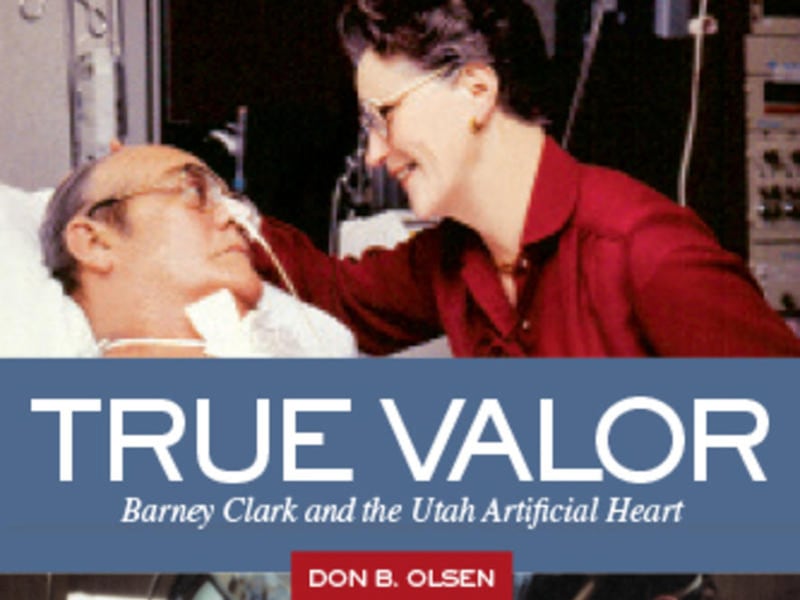

"TRUE VALOR: Barney Clark and the Utah Artificial Heart," by Don B. Olsen, University of Utah Press, $44.95, 432 pages (nf)
In the field of artificial heart technology, much was still not known in the winter of 1982. Doctors from the University of Utah has been working on developing a device since 1967, culminating in the Jarvik-7 heart. The world's first permanent artificial heart, it was made of aluminum and polyurethane and connected to a 400-pound air compressor. Led by Dr. Willem Kolff, Dr. Robert Jarvik and Dr. William DeVries, only animals had been used in experiments so far. That was about to change.
Written by Dr. Don B. Olsen, who worked on the artificial heart project under Kolff, "True Valor: Barney Clark and the Utah Artificial Heart" takes a candid, detailed look at the years of research leading up to the historic operation as well as the aftermath. Olsen uses interviews with Clark's wife and family and laboratory records to share this fascinating account.
The book focuses on Clark, a retired dentist from Des Moines, Washington, who suffered from a severe case of congestive heart failure. Early in 1982, Clark and his wife, Una Loy, traveled to Utah to volunteer for an experimental drug being tested by cardiologists at LDS Hospital. The drug ultimately failed, so doctors came up with another regimen for Clark. The cardiologist, Dr. Jeff Anderson, suggested a conversation with the artificial heart team at the University of Utah.
Returning to Utah the following October for another appointment with Anderson, the Clarks stopped at the U. to visit with DeVries. He cautioned Clark about participating because there were still many unanswered questions.
"I realize that. But still it would be a nice opportunity to do this for medical science," Clark responded.
Late on the snowy evening of Dec. 1, 1982, Clark was taken to the operating room to have his ailing heart removed and the Jarvik-7 was left in its place. The seven-hour procedure was successful, but Clark developed complications almost immediately. He lived 112 days with the device implanted, dying of circulatory collapse and secondary multiorgan system failure.
The book contains no swearing, violence or sexual content, but readers who are leery of hearing about medical procedures described may want to steer clear.
Ryan Curtis is a proud seventh-generation Utahn and also writes for Utah Political Capitol. In his spare time, he enjoys doing family history research and listening to '70s and '80s music. You can contact him at ryancurtis4218@gmail.com.