

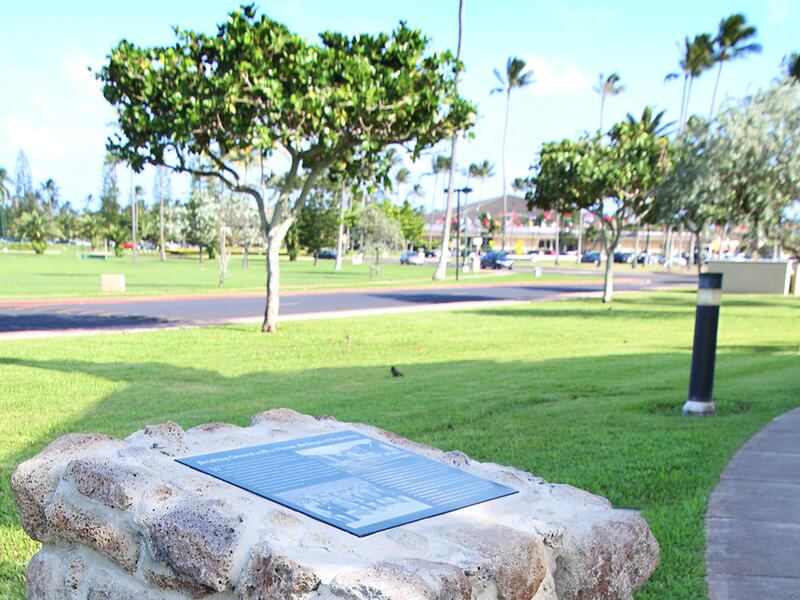
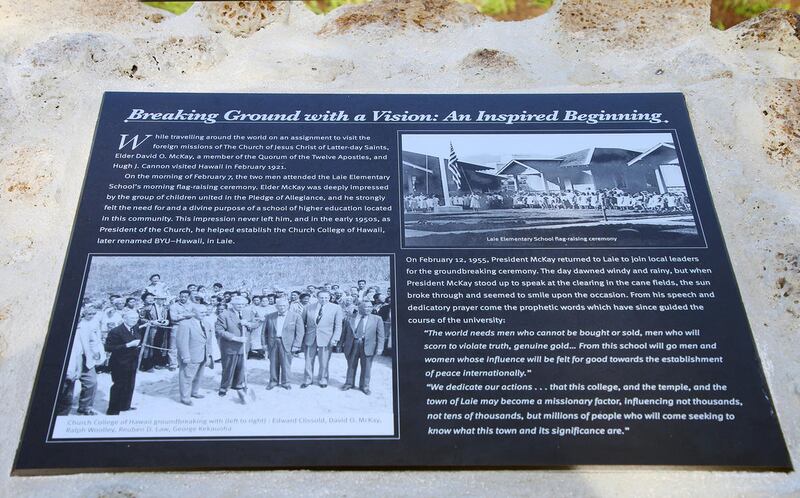
LAIE, Hawaii — Several hundred participants watched the unveiling of a new historical marker on the site where President David O. McKay broke ground for the future Brigham Young University–Hawaii campus during the Mormon Pacific Historical Society Conference on Oct. 24.
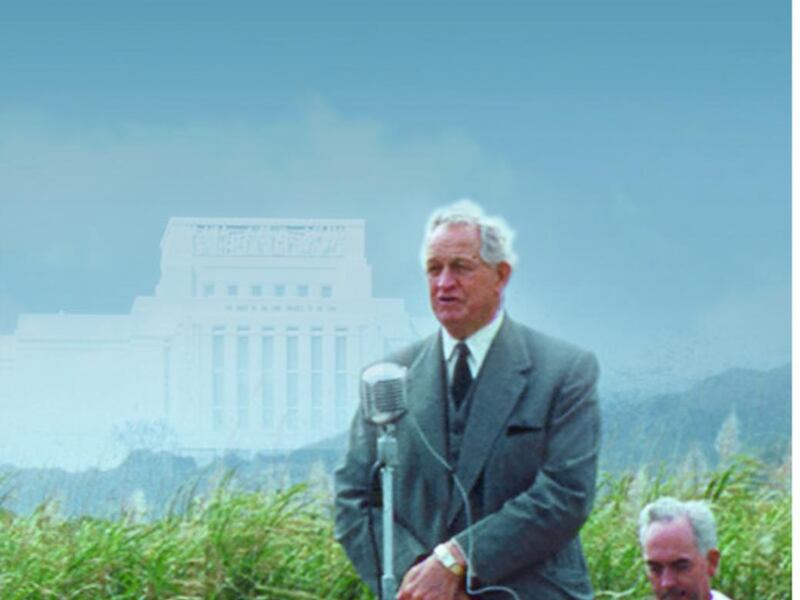
On that spot on the morning of Feb. 12, 1955 — 60 years ago — President McKay also delivered a blessing that the soon-to-open university, the community of Laie and eventually the Polynesian Cultural Center would have an influence on “not thousands, not tens of thousands, but millions” of people throughout the world.
MPHS president and BYU-Hawaii professor Mark James told the crowd that President Heber J. Grant had sent Elder McKay, then a member of the Quorum of the Twelve Apostles, along with Hugh J. Cannon, the son of former 1850 Hawaii missionary George Q. Cannon, on a worldwide inspection tour of missions and schools of The Church of Jesus Christ of Latter-day Saints.
“It took them over a year,” James said, “and on Feb. 8, 1921, during the latter part of that tour, Elder McKay witnessed the Laie mission school flag-raising ceremony — a scene artistically depicted in the large mosaic mural hanging above the entrance to the BYUH David O. McKay Building.
“He was inspired by the sight of so many people from so many places coming together to learn, and it was at that time he envisioned there would be further schooling available for these many people from many lands,” James said of the experience President McKay shared at the groundbreaking in 1955.
During his remarks, James recognized several former Phase I and Phase II labor missionaries as well as community members among the crowd who were at the groundbreaking ceremony.
“We stand upon the shoulders of those who have gone before us, always,” James said. “We appreciate those who sacrificed so much in preparing this place where students come from many lands to further their education. Many of us sitting here went to this school, and we should be forever grateful for those who contributed. We pay homage to those who built this school, who dreamed of this school, who attended this school; but most of all, we honor the man David O. McKay.”
New BYU-Hawaii President John S. Tanner noted several unique things about the school.
“It’s the only school that from the beginning was also built in the shadow of a temple, and I believe that was deliberate,” Tanner said. “I believe that’s one of the reasons President McKay wanted to found the school in this special spot of Laie.”
Tanner pointed out that BYU–Hawaii is also unique in its international mission: “This school, from the very beginning, was to fulfill a mission, to become a living laboratory of an intercultural experience where nations would come together in peace and learn peace-building, and learn to be able to associate together bound in the gospel.”
Referring to the Old Testament story of Joshua having an altar built “so that we can teach our children” of how the River Jordan was stopped in ancient Israel to enable the Ark of the Covenant to be carried over on dry ground, Tanner said, “May we teach our children what happened here. May we also teach them of the sacred prophecies and revelations that still linger on this land.
“May this memorial, which resembles an altar, become our grateful monument to the ages, memorializing a sacred spot where God’s voice was heard as he spoke to his servant David O. McKay. Let us always remember and treasure in our hearts the inspired words that were spoken here.”
Mike Foley currently volunteers his Internet content skills for the Polynesian Cultural Center and other outlets.