

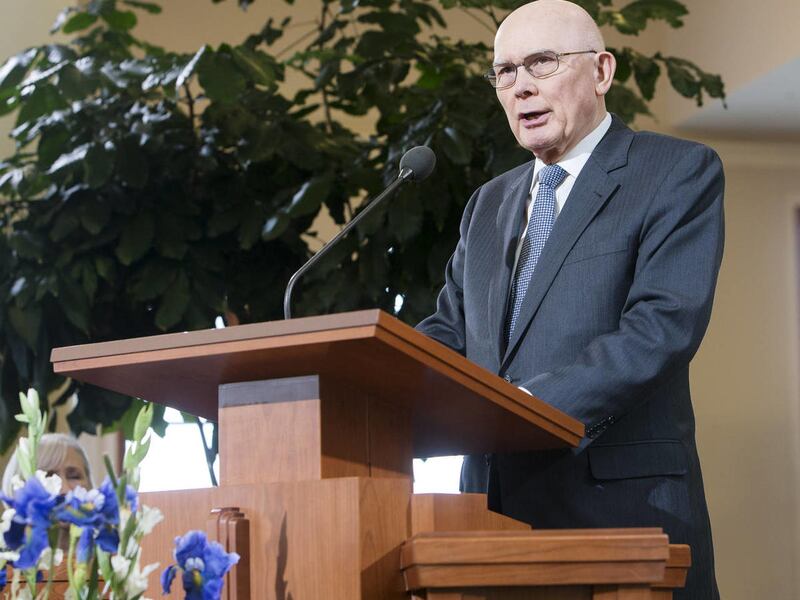
The maxim that no good deed goes unpunished has never been more true than exhibited in the attacks against Elder Dallin H. Oaks, a senior member of the Quorum of the Twelve Apostles of The Church of Jesus Christ of Latter-day Saints. He, with other church leaders, held a series of media events to promulgate guiding principles in an effort to mediate the intensely emotional clash between religious and sexual rights. For his efforts, he has been castigated locally and nationally, both in traditional and social media.
Elder Oaks has been accused of promoting religious freedom over non-discrimination protections. Claims have been made against him and the other church leaders that the guiding principles being promoted are a camouflaged strategy to legalize discrimination. Many have publicly criticized him for not apologizing for social expectations that encouraged gays and lesbians to overcome their homosexuality by marrying heterosexually. He has been called a bigot and much worse.
Neither Elder Oaks nor any other church leader needs me to come to their defense. However, it would be wrong if I did not speak up as a witness on behalf of Elder Oaks and the other apostles who are being accused of duplicitous motives, when I know better. I know firsthand that they earnestly want to find the “right way” to provide non-discrimination protections for gays and lesbians while securing certain rights for religion and its adherents.
While serving in the Utah State Senate, I prepared religious freedom legislation with the intent to protect religion and individual religious conscience, absent non-discrimination protections. The public was never made aware of my religious freedom legislation for one reason alone: Elder Oaks personally asked me not to advance it. He felt that if I introduced my legislation, it would disrupt efforts to discover common ground for each party to obtain rights without trampling on the rights of the other. Solely, because of his request, I “protected” my legislation from public access and withheld it for two successive legislative sessions from being introduced in the Senate.
In addition, last spring, Elder Oaks gave a seminal speech at Utah Valley University on the appropriate balance between religious freedom and non-discrimination protections. He boldly declared that certain protections and rights for the LGBT community should be accommodated. He humbly admonished that we all are obligated to care for our fellow beings with love and respect.
Frankly, I wondered how I was going to follow this counsel and accommodate that which I believed to be wrong. I contacted Elder Oaks to better understand. Suffice it to say, after our dialogue, I knew he was very sincere regarding his call for accommodation, but more than that, he was inspired in his admonition to that end.
Shortly thereafter, on May 4, 2014, the Deseret News published a commentary I wrote wherein I admitted I was wrong in my publicly expressed belief that religious and LGBT rights could not co-exist. Because of Elder Oaks, I publicly admitted I was wrong after speaking from one end of the state to the other in support of religious freedom and in opposition to non-discrimination legislation.
The sad irony in all of this is that Elder Oaks and other church leaders are now being attacked for the expressed principles and objectives that caused me to first withhold my religious freedom legislation that purposely would not have accommodated LGBT rights, and then to publicly admit I was wrong for my zero-sum approach in defense of religious freedom.
In my view, rather than being besmirched, Elder Oaks, along with his colleagues, should be applauded and honored for his extraordinary efforts to create a consensus and harmony among the various interests fighting over rights.
Stuart Reid is a former Utah state senator.