



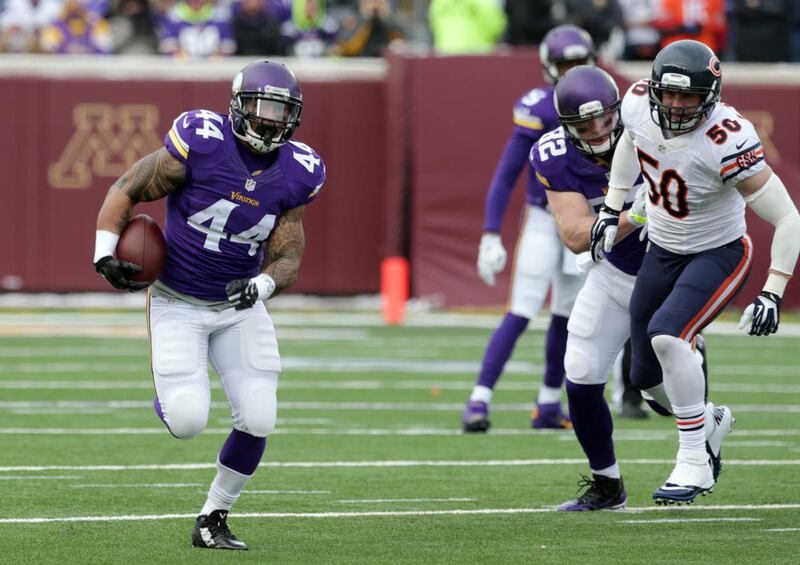


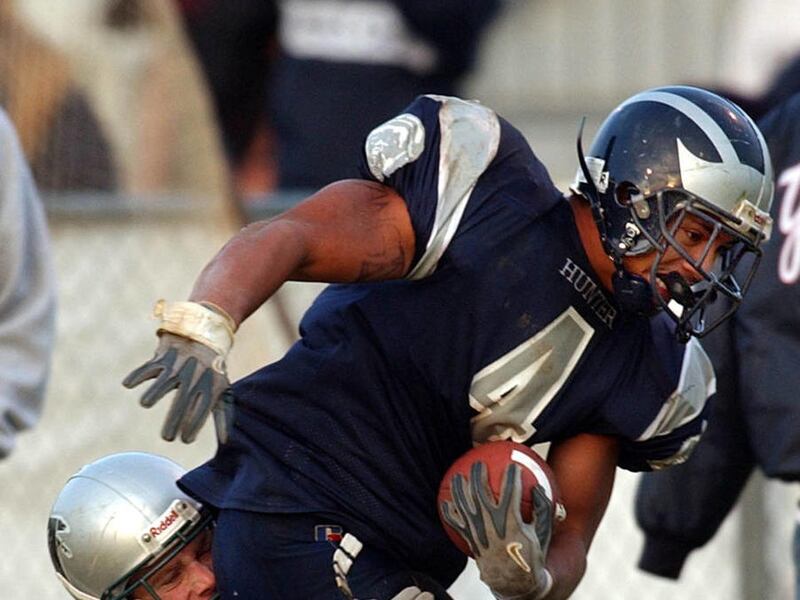


It’s so weird. I just didn’t think I’d ever get an award like this. – Matt Asiata
SALT LAKE CITY — Matt Asiata sat in a room by himself waiting for a phone call from an NFL team.
A few rounds into the 2011 draft, his phone rang. A man he’d never met told him a team was trying to decide between him and another player.
“I didn’t get chosen,” the 27-year-old Hunter High graduate said. “It was the other guy. The whole draft went by, and I didn’t get a call.”
Football has been both kind and cruel to Asiata.
He’s been the key to a team’s success and the injury-plagued player desperate to get back on the field. He’s suffered physical setbacks on the field and heartbreak off it. He’s felt his life’s aspirations slipping out of his grasp, and he’s reveled in the joy of realizing a childhood dream.
If anyone has ever had legitimate reasons to give up the too-often elusive NFL dream, it’s Asiata.
Instead of succumbing to situations many saw as hopeless, the athletically gifted son of Samoan immigrants proved that his unusual mix of confidence and humility allowed him to persevere long after common sense indicated it was time to throw in the towel.
Asiata said he never doubted he would earn a place in the NFL — even after untimely injuries in college and training camps hindered his ability to show scouts and coaches just what he was capable of delivering.
“I kept the faith,” Asiata said of being undrafted. “I believed I belonged in the league. I just had to showcase my talent. I just needed a chance.”
His father’s son
If there is one thing that family, friends and coaches say defines Asiata it’s his commitment to his family.
He met his wife, Tangi, in junior high and they married right after he graduated from Hunter High in 2005. They welcomed the first of their four, soon to be five, children later that year as Asiata started his collegiate football career at Snow College.
While being a teenage parent can be challenging, friends said Asiata embraced the role.
“Matt became a father at a young age, and since that day, I saw a change in him,” said high school teammate Landon Jensen. “His life was not about Matt Asiata anymore. It was about being the best father and husband, and to be able to provide the best life for his children. I believe that is why he never gave up. When times were hard and others would have given up, he saw his children and that gave him the extra motivation.”
Asiata said it was his own father who instilled in him a dedication to family that instilled in him a faith in his own potential.
“Just seeing him work, seeing how hard he worked,” he said of his dad, Pita Asiata. “In my heart, the way he worked to provide for his family, that dedication, that’s where my dedication to football comes from. I had to take it to another level, just show everyone that I belong in this league.”
When he suffered season-ending injuries that threatened to not only derail his collegiate career but also his dreams of playing professional football, he said he found motivation in the faces of his wife and children.
“In my first Division I game (at Utah), I broke my leg,” he said. “It was kind of discouraging at the moment. But just looking at my wife, my daughter and my son. …I couldn’t just quit there; I couldn’t stop trying to achieve my dreams. I had surgery the next week, started rehabbing and just trying to be a better father and husband.”
Success and adversity
Asiata’s athletic ability was never in question. In his junior year he helped Hunter High do what no Utah 5A high school had done at the time — win both a football and basketball state championship in the same season.
“At the end of Hunter’s basketball run to the title, Landon (said), ‘I might have just played alongside the greatest pure natural athlete to ever grace the halls of Hunter High School,’” said Brad Jensen, Landon’s father. “He continued, ‘I have no doubt, Dad, Matt will star at the next level (Division I), but not as a basketball player, in football.’ Of course, none of us could have ever imagined the successes he would enjoy as a four-year contributor in the National Football League.”
Asiata headed to Snow College in Ephraim, where he became the key to the Badgers' gridiron success.
“His sophomore year was my first year as the head coach,” said Steve Coburn, now the head coach at Wasatch High. “That was a really good team …and Matt was the cornerstone of the offense for us that year. We knew any time we were in a bind, we could just hand the ball off to him, and he’d get us what we needed.”
In fact, the team nicknamed him “The A-Train.”
“We knew he was going to run everybody over,” Coburn said. “And we also knew we could jump on and go for a ride. We knew he was going to carry us. I knew then that he had something special.”
In his sophomore year, Asiata set a new school record for single-season yards with 1,494. He rushed for 2,309 yards and 20 touchdowns in his two seasons at Snow. Utah offered him a scholarship, and he headed to the hill to make a name for himself.
His first collegiate contest as a Ute was memorable, but for all the wrong reasons. He broke his leg in the 2007 season-opener at Oregon State and ended up using a medical redshirt that year.
In 2008, he was the team’s leading rusher, playing in all 13 games and rushing for 707 yards and 12 touchdowns. He also completed 2 of 3 passes out of the “Asiata formation” which resulted in two touchdowns. He ended the season celebrating a perfect 13-0 season as the Utes upset Alabama in the Sugar Bowl.
“Matt Asiata is a fierce competitor,” said Utah head coach Kyle Whittingham. “I’m so proud of what he’s accomplished and the career he’s had so far in the NFL. It’s great to see the success he’s having.”
Whittingham said that as good as Asiata was on the football field, he was an even more impressive human being.
“He was one of our team leaders,” Whittingham said. “He’s respected by everybody, everybody that’s affiliated with our program.”
In Asiata’s senior season, he started the first four games before a season-ending knee injury forced him to ask the NCAA to give him one more year of eligibility.
“I was questioning myself,” he said of his mentality after the injury. “I was questioning the guy upstairs, which I don’t normally do. After surgery, it just, I don’t know, it was just another long process of rehabbing. The mental part was hard.”
While he struggled to come back from another serious injury, he found his footing by focusing on his faith and his family.
“My (LDS) faith became stronger,” he said. “My wife and I got sealed in the (Mormon) Temple that year, in November. …That was really big, really special. I was excited about that.”
He returned to Utah for his sixth season of college football and played in all 13 games, earning 695 yards on 155 carries. He finished his career ranked third all-time at Utah with 24 rushing touchdowns.
Shortly after the season ended, he received an invitation to the NFL combine.
“That blew my mind,” he said. “I thought, ‘They really like me. They like how I play. This is going to be my chance.’”
Disappointment met with determination
Sitting through the seven rounds of the NFL draft was agonizing.
“It was a long process,” he said. “I didn’t watch the first two days.”
His name was never called, but still, he didn’t give up hope.
“I believed I belonged in the league,” he said. “I had to showcase my talent. I waited for a call; this wasn’t the end of the draft.”
A few hours after the 2011 drafted ended, Asiata was making arrangements to head to Minnesota where he would try to win one of the 53 spots on the Vikings’ roster. He earned a spot on the team’s practice squad, but two weeks into fall camp, the team released him.
“I kind of got hurt in the preseason,” Asiata said. “The business side of the NFL is pretty tough. It’s really just whoever is available to them.”
With a wife and two young children to support, he moved home to Utah and got a job at the Industrial Supply Company in Salt Lake City. He moved boxes, made deliveries and tried to keep his NFL dreams from dying amid the monotony of a 9-to-5 grind.
That task was made easier because a coach kept in touch with him throughout the season.
“”He told me he liked me, told me he wanted me back,” Asiata said. “I believed his words.” Another invitation to the Vikings’ training camp came, and this time Asiata made the 53-man roster. He played mostly special teams in 2012 and most of 2013.
In December of 2013, Asiata got the start at running back as both Adrian Peterson and Toby Gerhart were sidelined with injuries. He carried the ball for just 51 yards, but he scored three touchdowns in a 48-30 victory over the Philadelphia Eagles.
The Vikings again turned to Asiata when Peterson was placed on the NFL commissioner’s exempt list after being charged with child abuse. He finished the season with nine touchdowns — including another hat trick against Atlanta.
Life-changing loss
Some may have doubted Asiata’s ability to play in the NFL, but his family never did.
“They were very supportive, every single one of them,” he said.
Of particular importance was the support of his father.
“We talked a lot, especially when he was on the road driving,” Asiata said. “He was always asking about how is my wife, how are my kids. Then it was how am I doing, how is my body holding up. He taught me to focus on my family, focus on church and just always do your best.”
On October 28, 2013, Asiata received a call from his mom that changed his world forever. His father had been killed in an accident after the bus he was driving to Wendover collided with a utility truck on I-80.
Asiata said he feels his father’s love and the influence of his life all around him. He said his father showed his family what mattered most with the way he lived his life every day.
“He always put us first,” Asiata said. “He was always gone by the time we got up in the morning, and he came home late every night. … He always preached, wherever you go, whatever you do, just always do your best. “
He finds comfort in his LDS faith, and in the support of his tight-knit family.
“I know I’m going to see him again,” he said. “It’s hard not seeing him, not talking to him. That’s the hardest part. My kids, my dad was close to my kids, and they miss him a lot.”
Resilience and recognition
While many have doubted Asiata’s ability to find a place in the NFL, those who know him best understand why he’s been able to succeed, even in the face of significant challenges.
“It didn’t surprise me,” Coburn said of Asiata’s NFL success. “He’d gone through a lot of adversity coming out of high school, and then when he got to Utah with injuries. But I knew he had that drive in him. All somebody had to do was give him a chance. I never doubted he’d continue on and overcome those stumbling blocks.”
Landon Jensen believes part of what’s helped Asiata persevere is his natural optimism.
“Matt has a special talent, quality or attribute to always find the positives in life, the best in situations and be happy,” Jensen said. “He is always positive, has a smile on his face and doesn’t ever want to talk about himself.”
A couple of months ago, Asiata received another shocking phone call.
This time it was his former Hunter High principal Mike Fraser informing him that he’d earned this year’s Distinguished American Award from the National Football Foundation and College Hall of Fame’s Utah Chapter.
“I was surprised,” Asiata said laughing. “It’s so weird. I just didn’t think I’d ever get an award like this.”
Asiata was chosen by the organization because he exemplifies the spirit of the game. His perseverance, work ethic and commitment to excellence were cited as examples of what makes him an inspiration, even more so than athletic ability or accomplishments.
Asiata will be honored at the 21st Annual Awards Banquet at UVU’s UCCU Center on Tuesday, April 14. Also being honored are two-time Super Bowl champion and former San Francisco 49ers coach George Seifert, who earns the Outstanding Contribution to Amateur Football award. Former North Summit football coach Jerre Holmes and former high school official Phil Leonard will receive awards for Outstanding Service to Amateur Football.
In addition, 14 senior football players will be recognized as scholar-athletes for their accomplishments on the field, in the classroom and their service to their communities.
Asiata said he’s honored, even if he doesn’t quite feel deserving.
“It’s been a long road,” he said. “It’s been tough. I’m very blessed to still be here. It’s a long process, but you just keep driving every day trying to get your name on the top of the list.”
Twitter: adonsports EMAIL: adonaldson@deseretnews.com