

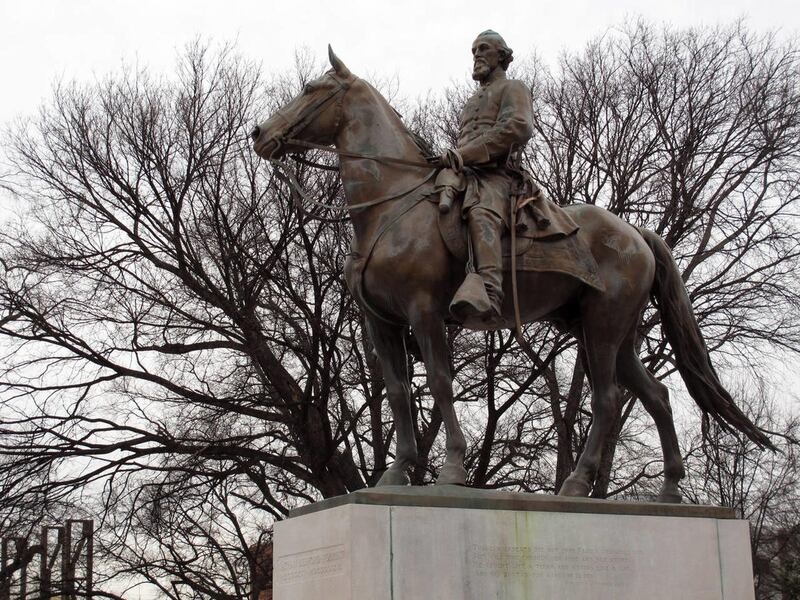
On April 12, 1864, forces under the command of Confederate Gen. Nathan Bedford Forrest participated in the Fort Pillow Massacre, the murder of nearly 200 to 300 Union troops, most of them black.
In 1862, Union Gen. Gideon Johnson Pillow ordered the construction of a fort along the Mississippi River in Henning, Tennessee. Fort Pillow sat high upon a bluff and fielded guns that commanded a significant stretch of the river. By the spring of 1864, the fort was garrisoned by roughly 600 Union soldiers, comprising black artillery and cavalry units, in addition to the fort's infantry garrison. Maj. Lionel F. Booth held command.
In March, Forrest began raiding into Tennessee and Kentucky with a cavalry force of several thousand. Wreaking havoc behind the Union lines, Forrest attacked Union Fort Anderson at Paducah, Kentucky, on March 25. The inconclusive action was notable for Forrest's warning to Fort Anderson's commander, Stephen G. Hicks. The Confederate general informed Hicks that should he be required to take the fort by force, “you may expect no quarter.” Hicks refused and continued the defense. Skirmishes between Union and Confederate forces continued for several more days.
Forrest separated his command, and took perhaps as many as 2,500 troops toward Fort Pillow. Forrest's force arrived at the fort on the morning of April 12 and immediately commenced the attack. The fighting was intense, and Forrest had three horses shot out from under him. Around 3 p.m. Forrest sent a note to Maj. William F. Bradford, who had assumed command after Booth had been shot and killed. Forrest demanded that Bradford surrender the fort and promised fair treatment for his men. Bradford refused.
In the historical novel “Fort Pillow,” author Harry Turtledove wrote in the historical note: “Of course, Forrest issued the same warning whenever he assaulted a U.S. garrison. The most compelling piece of evidence that he meant it this time was his decision to hang back from the fighting. In almost every engagement where men he commanded went into action, he fought at the fore. True, this time he was dazed and bruised after his horse fell on him when shot, but that seems too small a reason for a man who ignored gunshot wounds to stay out of the fray. More likely he understood what would happen if his men got into the fort.”
The rebel snipers and artillery assaulted the fort in a furious storm. Some of the fort's defenders broke and ran toward the river, where a Union gunboat approached, though it proved unready for combat and did not fire a single shot. Outside of the fort, Union solders were even more exposed, and many fell to Confederate bullets and grapeshot. The Union position in the fort proved untenable, and soon the rebels had taken it.
Writing in the 1880s, former Civil War general and U.S. President Ulysses S. Grant, who did not participate in the battle, noted in his memoirs that the garrison had fought with courage but proved too few in number to withstand Forrest's attack. Further, he quotes Forrest's account of the battle:
“ ‘The river was dyed’ he says, 'with the blood of the slaughtered for two hundred yards. The approximate loss was upward of five hundred killed, but few of the officers escaping. My loss was about twenty killed. It is hoped that these facts will demonstrate to the Northern people that negro soldiers cannot cope with southerners.' Subsequently Forrest made a report in which he left out the part which shocks humanity to read.”
What exactly followed remains unclear, with many accounts varying over exactly who was killed and how. Some claimed that the rebels began murdering Union soldiers indiscriminately, while others claim that the fort's black troops were specifically targeted and killed by the rebels. What is not disputed is that more than 200 and perhaps as many as 300 Union troops were killed while trying to surrender.
Prior to the outbreak of the Civil War, Forrest had made a fortune buying and selling human beings in the slave trade, despite the fact that he was virtually illiterate. Additionally, the Confederate government had warned the Union that African-American soldiers taken in combat would be turned into slaves. The institution of slavery itself, the cause and ultimate focal point of the Civil War, illustrates the contempt that most Confederates had for African-Americans in general. In short, it is not hard to imagine that Forrest's troops had been ordered, or at least given passive permission, to target and kill the black Union soldiers.
Several other instances of Confederates murdering black Union soldiers had occurred around the same time, but Fort Pillow graphically illustrated the rebel barbarity when it came to dealing with those troops they deemed racially inferior. This posed very real problems for President Abraham Lincoln. Civil War historian James McPherson wrote in his book, “Tried By War: Abraham Lincoln as Commander in Chief”:
“(The Fort Pillow massacre) presented the Lincoln administration with a dilemma. The president had threatened retaliation in his proclamation of July 30, 1863. 'The difficulty is not in stating the principle,' said Lincoln as reports about Fort Pillow were being investigated, 'but in practically applying it.’ ”
May 4 saw Lincoln holding a Cabinet meeting to discuss the problem. Gideon Welles, Lincoln's secretary of the Navy, stated that the Union could not murder Confederate POWs in retaliation for the massacre: “(We) cannot yield to any (such) inhuman scheme of retaliation.”
A decision was made that, if and when Forrest was captured, he would be held accountable for the massacre and, along with his men, charged with murder. Also, a statement was sent to the Confederate government that Southern officers would be executed if such massacres were repeated in the future.
In any event, Forrest was never brought to trial for his role in the Fort Pillow massacre, nor were Confederate officers executed after similar massacres against black Union soldiers occurred later. Forrest surrendered his troops to the Union in May 1865, one month after Robert E. Lee's surrender to Grant at Appomattox Courthouse. The former slave trader and general went on to play a key role in the formation of the Ku Klux Klan, though later distanced himself from the organization.
Turtledove wrote of the battle and massacre: “We remember Fort Pillow today because it is a microcosm of what the Civil War was all about. It showed that blacks could fight, could be men like any others, and it showed how determined white Southerners were not to give them the chance. It also showed that an inexperienced major (Bradford) was no match for the best cavalry commander on either side, even with earthworks and a gunboat to help him.”
Cody K. Carlson holds a master's in history from the University of Utah and teaches at Salt Lake Community College. An avid player of board games, he blogs at thediscriminatinggamer.com. Email: ckcarlson76@gmail.com