



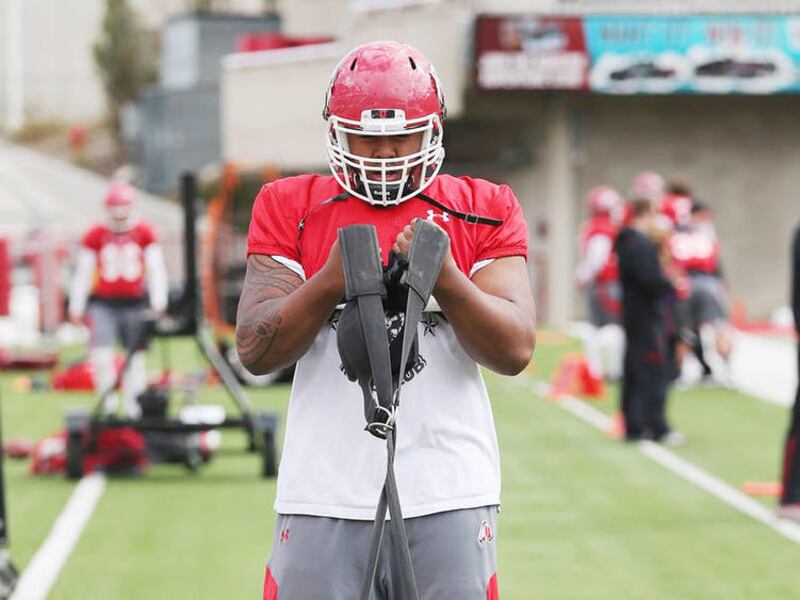

You don’t get a free pass here. Everybody works regardless of their circumstances. There is nothing I can’t stand more than watching a bunch of injured guys standing around just watching practice. Do something constructive. – Kyle Whittingham
SALT LAKE CITY – The Pit is one of the most important parts of the Utah football program.
It’s also the last place the most players want to spend any time.
“The Pit is the worst place you want to be in the program,” said senior wide receiver Kenneth Scott with a laugh. “It’s so hard in the Pit. It’s a weight room all over again, only two times harder.”
The Pit is not a singular place on the University of Utah campus. It is wherever Utah’s director of strength and conditioning Doug Elisaia sets up workouts for those who are injured and unable to participate in regular practices. Those workouts, sometimes unconventional and creative, always occur alongside the field where the rest of the team is running drills.
While the main purpose of the Pit is to help injured players maintain or gain body mass, stay in shape and continue to work hard, there are a lot of intangible benefits that come from the philosophy behind the Pit and how it works.
“When people see The Pit, the first thing that comes to their mind is, you don’t want to be in the Pit,” said Elisaia, who's been the program's strength coach for nine years. “What they don’t realize is the philosophy behind the Pit is just to make sure that our guys who are injured are working just as hard as the guys on the field. And the guys on the field see the guys working hard, and that’s why we work them out on the field and not in the weight room.”
Exactly why this exercise area became known as “The Pit” Elisaia isn’t sure.
“We had a sandpit back here, so I think that’s where the name came from,” he said, laughing. Regardless of how the mobile workout site got its name, there is no confusion over its purpose.
“But everybody understands the Pit. Nobody comes over there and complains. Obviously, they don’t want to be there because they’re injured. But you know as a strength coach, you’re working on guys that are injured.”
That means understanding what each player can do and what will help build their physical strength and mental toughness.
“There is some mental aspect,” he said. “But most of them just see the benefits of what we’re doing and how that will help them. And we kind of turn it into a challenge. Any time you take a young athlete and turn it into something that’s competitive, it’s another way for them to get their minds off their injuries.”
Elisaia doesn’t have guys dragging weighed down sleds, lifting rocks or shaking ropes to push or punish athletes. In fact, there is no punitive aspect to the workouts. Whatever the players are asked to do, it’s meant to help them develop physical strength and mental toughness.
“We talk about the fourth quarter aspect," Elisaia said. “Part of our philosophy is to put them in the fourth quarter every day. So when we arrive there on game day, we’ve been there and it’s common ground for those guys. …When their bodies want to quit, their minds just overcome what they’re doing and carries them through the tasks they’re facing.”
Each day Elisaia meets with his staff. With their expertise in nutrition, sports science and athletic training, the other staffers help Elisaia come up with plans for the players that will help them become the best athletes possible.
And while he’s capable of a pep-talk – or a stern lecture – he said it’s not really common for him to have to get after players or talk them into working hard.
“When guys realize you care about them, and what you’re doing every day is making them better, and you’re not degrading them, but you’re pushing them every day to become the person, the athlete they want to be, then they do what you want them to do,” he said. “It’s a fine line, but when you’re in the Pit, you understand my coaches aren’t there to be in your face and yell at you. If you watch them, they really don’t have to get after them.”
The one thing Elisaia doesn’t do is tailor workouts to the personalities of players.
“Whether you’re in meetings, whether you’re in the weight room, whether you’re in the training room, the mentality is that you’re going to conform to what we do, and we’re not going to conform to what you want us to be,” he said. “You’re going to quit or you’re going to do what the rest of the team is doing.”
There is also no class system among the players.
“Pretty much everyone is the same,” Elisaia said. “It doesn’t matter if you’re a starter or a guy who doesn’t get any reps. If you’re in the Pit, you’re in the Pit.”
In nearly a decade of coaching strength and conditioning, Elisaia has become an expert at determining who might be exaggerating an injury or ache.
“Usually it’s your young guys,” he said smiling. “They come to the Pit and realize they’re working just as hard as the guys on the field, so I might as well go on the field and try to gain a position.”
Head coach Kyle Whittingham said the Pit allows those injured players to demonstrate to their teammates that even though an injury has sidelined them, they are every bit as committed to the team and the team’s success as the guys on the field.
“That’s their way of demonstrating to the rest of the team that they’re working just as hard as everyone else,” Whittingham said. “You don’t get a free pass here. Everybody works regardless of their circumstances. There is nothing I can’t stand more than watching a bunch of injured guys standing around just watching practice. Do something constructive.”
One reason to worry about having guys standing around watching practices in which they can’t participate is that, in addition to losing the respect of their teammates, they lose their mental edge.
“When guys are just standing around watching practice, they kind of lose focus, lose just the mentality of what we’re trying to build, that blue-collar mentality, that hard work is the only way to your goal.”
And whether players are injured or operating at full-strength, Elisaia said what they learn in the weight room is more than just how to get stronger.
“It makes them better people,” he said. “If you push these guys as hard as we do, day after day, they’re going to understand how to work when they get out of here.”
Elisaia said he can tell which players will be successful after football just by watching how they work out in a weight room.
“Those guys who work hard are the guys who are most productive off the field, in life,” he said. “Nine times out of 10 you can predict who will be successful after football. At the end of the day, that’s our goal to see our athletes succeed. That’s our passion.”
Elisaia said playing collegiate sports is a complex experience that most people can’t understand.
”People don’t realize what these kids go through,” he said. “That’s why I feel like we train our guys to be mentally tough. When you get out in the world it’s the same way. When the bills pile up and relationships don’t go the way you want them to go, you have to be mentally tough to understand things are going to get better. Teaching them how to work hard goes far beyond the boundaries of that field and the four walls of this facility.”
Twitter: adonsports EMAIL: adonaldson@deseretnews.com