


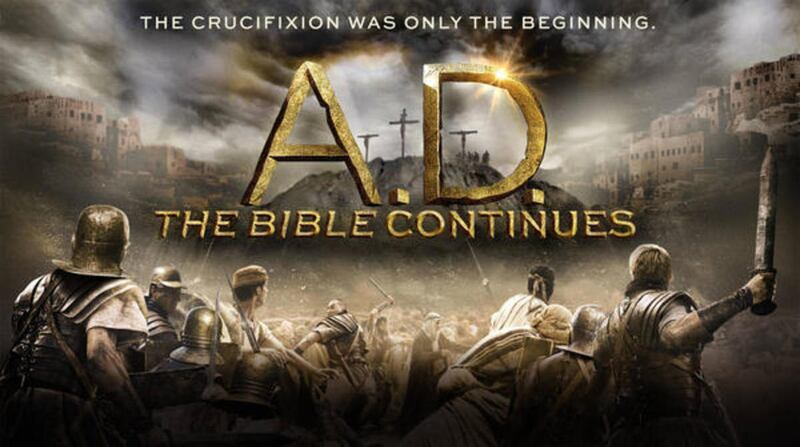
Editor's note: Produced by Mark Burnett and Roma Downey, "A.D.: The Bible Continues" is 12-part series on NBC that serves as a sequel to "The Bible" on the History Channel and the feature film "Son of God." A dramatization of the biblical text, it begins with the crucifixion and death of Jesus Christ and then traces the development of the apostolic church as portrayed in Acts 1–10.
The third episode of the Bible series "A.D." begins with Peter and John in Galilee discussing the risen Lord's direction that they wait at Jerusalem for the coming of the Spirit. All the action quickly shifts to Jerusalem where scenes alternate between storylines involving Caiaphas, Pilate, Herod Antipas (here, as in the Gospels, known simply as “Herod”), the disciples and zealots.
All of the scenes and dialogue are freely created, and there are no direct depictions of scriptural incidents until the end of the episode when the descent of the spirit at Pentecost (Acts 2:1–13), Peter’s healing of the lame man at the Gate Beautiful (Acts 3:1–11), a very truncated version his following speech (Acts 3:12–26) and Peter and John’s arrests (Acts 4:1–3) are at last depicted.
This follows the series’ established practice of using historical sources to expand freely upon the scriptural story, mostly through the medium of political and religious figures of the time period in order to set the Christian story in a wider Jewish and Roman context. However, inasmuch as the series has now moved into the story as it is told in Acts, this effort must necessarily become more creative. That is because Pilate never appears by name in the narrative or Acts, and Caiaphas is only mentioned once in Acts 4:6. Nor does the figure of Herod Antipas, tetrarch of Galilee and some territories across the Jordan River, who plays an important role in this episode.
Because all three of these figures held their positions during the period covered in the early chapters of Acts, their actions as portrayed here are possible. Nevertheless, none of them are directly suggested by any scriptural or historical sources and the creative liberties taken have resulted in some historical inaccuracies (see below).
As observed in our review of Episode 2, the balance between dramatized depictions of the scriptural story and freely created scenes has shifted heavily toward the latter. This is unfortunate for two reasons: First of all, the scriptural scenes carry the most power, yet at times they almost seem secondary. In the case of the otherwise well-done scene depicting the Spirit descending upon the disciples as fire, the scriptural scene is broken up and interwoven with scenes from the temple and the conspiracy of the zealots.
Second, there are good biblical scenes and speeches from the first four chapters of Acts that are missed because of the time given to fictionalized scenes.
"A.D." continues to be engaging, inspiring entertainment — better than so many things on network television — that is still worth watching. But as the series proceeds, it is becoming even more important for those interested in the Bible to spend time with the text itself to see what it is missing.
Characters, scenes and historical issues
Peter and his daughter, Maia: The opening scene between Peter and John also introduces the character of Peter's daughter, Maia. Though a totally created dramatic character, who oddly has a Greek rather than Jewish name, Peter’s daughter adds much to this episode. She provides another female voice to the story, serves to remind her father and the other disciples of what they have learned from Jesus, and gives the character of Peter more depth as a family man.
While Peter is known to have been married because of reference to his mother-in-law (Mark 1:29–31; parallels Matthew 8:14–15; Luke 4:38–39), it is unclear why he is portrayed as a widower here other than the later assumption that a church leader would not be married. In fact, 1 Corinthians 9:5 seems to suggest that Peter’s wife was still alive during his ministry.
Caiaphas and his motivations: As in earlier episodes, conversations between the high priest Caiaphas and his wife do much to portray the many competing political and religious interests that this Jewish leader was desperately trying to balance. In fact, he has increasingly become an almost sympathetic character as he regrets the death of temple guards, worries about the sanctity of the temple and tries to placate Pilate.
Widow of the temple guard: In Episode 2, Pilate had the guards, both Jewish and Roman, who had been guarding Jesus’ tomb, killed to put an end to the story of the disappearance of Jesus’ body. The plight of the wife of one of the Jewish temple guards illustrates how innocents are often the casualties of political machinations.
As Caiaphas’ wife shows concern for the widow, this softens the character of the woman who had seemed harsher and even more politically motivated than her husband.
Incidentally, Caiaphas repeatedly refers to his guards as “his priests.” While many of them may, in fact, have been Levites, it is doubtful that many of the men in the ranks other than their commander, the historically known “captain of the temple,” would have been priests themselves.
Herod Antipas’ role: Alone of the Gospels, Luke had introduced this son of Herod the Great into the story of Jesus’ trial (Luke 23:7–12). Antipas, who is known in the Gospels and in this episode simply as “Herod,” is not mentioned anywhere in Acts. Antipas never held the title of kind; his title was tetrarch, or ruler of a part of the original kingdom.
To flesh out his role, the screenwriters have borrowed heavily from the figure of his grandnephew, Herod Agrippa II, who appears in Acts 25–26. This results in some historical anachronism and inaccuracies. For instance, Agrippa II did have the right to appoint the high priest and help manage the temple. This right was first held by his father, Agrippa I, and another relative, Herod of Chalcis, but was never held by Antipas.
In fact, the Roman governors in this period were the ones who appointed the high priests and controlled them by keeping control of their sacred vestments. Nonetheless, creating a role for Antipas in this episode provides Caiaphas with a useful ally in trying to balance, and at times blunt, Roman power in Jerusalem.
Herod’s palace: One accurate choice made by the screenwriters and directors, however, was to make the former palace of Herod the Great be the residence of Pilate as Roman governor. This is the opinion of most archaeologists and historians today, even though tradition since the 17th century has assumed that the Fortress Antonia, the garrison next to the temple, was the seat of the governor.
Pilate’s attempt to attend the Pentecost Festival: Though Pilate, and the Romans generally, are often depicted as being violent and insensitive to Jewish religious feelings, historical sources give no hint of any kind of provocative action at a Jewish feast such as Shavuot or Pentecost. Pilate’s attempt to enter areas of the temple forbidden to Gentiles and the efforts of Herod Antipas and Caiaphas to redirect him certainly highlight the complex, competing political forces that needed to be balanced, but they are ahistorical.
Upper room scenes: The several scenes depicting the disciples — not just the apostles, but also women such as Mary the mother of Jesus, Mary Magdalene and now Peter’s daughter Maia — allow them to work through their struggles as they wait for the Spirit but also wonder what is going to happen next.
Some of Maia’s lines are among the most inspiring: “If he is alive, why aren’t you telling people?” she says soon after they tell her of seeing the risen Lord.
Later, on the roof with her father, she gently prompts Peter to pray, asking “What would Jesus have you do in this situation?” Completely missed, however, was the actual scriptural scene relating the selection of Matthias to take the apostolic position vacated by the perfidy and suicide of Judas.
Fire at Pentecost and healing of the lame man: The fervent prayer (the Lord’s Prayer repeated over and over again) of the disciples that leads to the miracle at Pentecost was quite powerful. While the xenoglossia, or speaking in foreign tongues, began in the room where they were, Acts 2:5–11, makes it clear that much of the speaking of different languages (and seemingly the purpose for it) was to the diverse crowds that gathered outside who could understand the words of the apostles.
Peter’s powerful speech (Acts 2:14–42) and the mass baptisms that followed it are omitted, apparently to directly connect it with the fictionalized scene of Pilate trying to enter the temple. Instead, the disciples march as a group to the temple, arriving right after Pilate had left. They are thus all present for Peter’s healing of the lame man, though Acts 3:1–11 only have Peter and John present for the miracle. Peter’s speech after the healing is considerably compressed, though all of Peter’s sermons could have been powerful material for this episode.
Sicarii again: As in earlier episodes, roles and activities for Jewish revolutionaries have been created that go beyond anything suggested by either scripture or historical sources. This is intended to illustrate the tumultuous political environment in which early Christianity arose, but it inadvertently links them with the disciples more than perhaps even the Jewish or Roman leaders may ever have thought.
Questions for consideration
1. How does the introduction of the character of Peter’s daughter Maia affect the way we view Peter? In what ways does she influence her father?
2. Consider the ongoing role of Caiaphas. Is he a sympathetic or unlikable character?
3. Why is Herod Antipas so interested in the temple and the Roman occupation of Jerusalem?
4. What is the connection between the disciples’ prayer and the miracle of Pentecost?
5. How are Peter and the disciples different after they receive the power of the Spirit?
Eric D. Huntsman, associate professor of ancient scripture, is an author of several books and is a member of the Mormon Tabernacle Choir.