
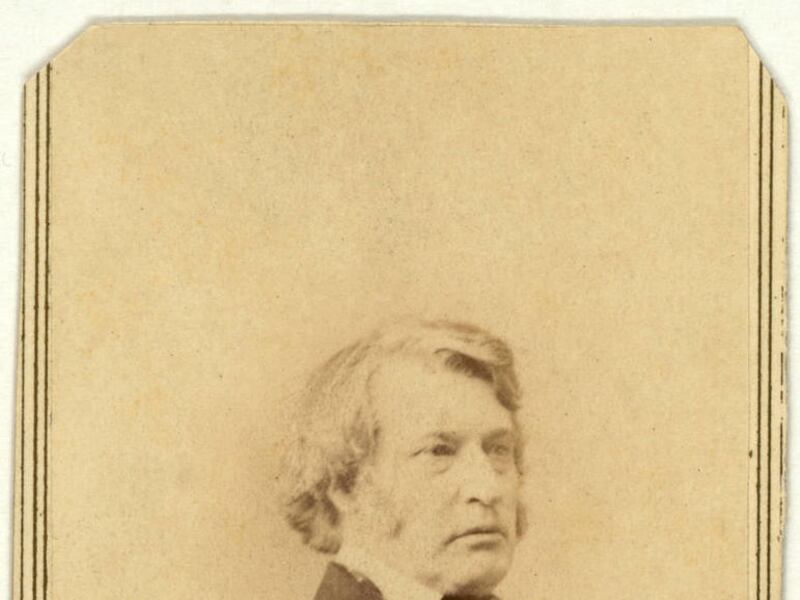
On May 22, 1856, amidst the tension stemming from “Bleeding Kansas,” Rep. Preston Brooks of South Carolina beat Massachusetts Sen. Charles Sumner with a cane on the floor of the United States Senate. The incident highlighted the growing divide between North and South, and foreshadowed the coming violence of the Civil War.
In 1820, in order to ensure that an equal balance of slave and free states existed in the Senate, Henry Clay brokered the Missouri Compromise. The Missouri Compromise, or Compromise of 1820, held that no one state could be admitted into the Union at one time. Rather, both a free Northern state and a slave Southern state needed to be admitted to the Union together. This way, no one sectional interest would gain too much power in the federal government. The compromise also held that, with the exception of the state of Missouri, no slave state exist north of the 36-degree, 30-foot line.
By the 1850s, however, things had changed. The United States was growing geographically, and many began to talk about the need for a transcontinental railroad that would link the heavily populated East with the burgeoning West. Northerners wanted the railroad line to begin in Chicago, while Southerners wanted it to begin in New Orleans.
In 1854, Illinois Sen. Stephen Douglas was eager to see the line begin in his home state, and soon proposed legislation that would confirm the honor for Chicago, but at the same time mollify the South. Douglas proposed an end to the Missouri Compromise, opening up territories north of the 36º 30' line for the possibility of becoming slave states. On May 30, 1854, President Franklin Pierce signed the bill into law.
The result was a disaster. Free state Northerners and slave state Southerners flocked to Kansas in droves, each with the intention of winning control of the state government through sheer numbers. When it was obvious that neither side was going to back down, violence ensued. A virtual mini-civil war erupted in Kansas as free staters and slave staters began murdering each other. One of the most notorious figures from the era soon dubbed “Bleeding Kansas” was John Brown, who together with his sons shot and killed five men at Pottawatomie Creek in May 1856.
Towns were raided and sacked, buildings burned, property destroyed and printing presses smashed. Perhaps as many as 200 men were killed. Bleeding Kansas represented a complete breakdown of law and order and highlighted the inability of the federal government to restore order. Many throughout the country watched on in horror as Kansas appeared to eat itself alive.
In Washington, 45-year-old Sumner shared in the nation's collective horror. Sumner, who had entered the Senate a Democrat with passionate anti-slavery views, had joined the fledgling Republican Party because of its hostility to the slave power in the South. He had opposed many of the provisions of the Compromise of 1850, including the creation of a strong Fugitive Slave Act, and blamed the slave power for the anarchy in Kansas.
On May 19-20, Sumner gave an hours long speech in the Senate titled “The Crime Against Kansas: The Apologies for the Crime; The True Remedy.” Sumner presented the events in Kansas as a problem unique in the history of the nation: “Against this Territory, thus fortunate in position and population, a Crime has been committed which is without example in the records of the Past. Not in plundered provinces or in the cruelties of selfish governors will you find its parallel. … The strife is no longer local, but national. Even now, while I speak, portents lower in the horizon, threatening to darken the land, which already palpitates with the mutterings of civil war …."
In the speech, Sumner attacked the South repeatedly, as well as Douglas for his creation of the Kansas-Nebraska Act. His most venomous attacks, however, were reserved for Sen. Andrew Butler of South Carolina:
“The Senator from South Carolina has read many books of chivalry, and believes himself a chivalrous knight, with sentiments of honor and courage. Of course he has chosen a mistress to whom he has made his vows, and who, though ugly to others, is always lovely to him, — though polluted in the sight of the world, is chaste in his sight: I mean the harlot Slavery. For her, his tongue is always profuse in words. Let her be impeached in character, or any proposition be made to shut her out from the extension of her wantonness, and no extravagance of manner or hardihood of assertion is then too great for this Senator.”
Sumner went on to state that the Southern states mocked the Constitution, with its emphasis on equality. He accused Butler of inflaming sectional passions, of having an “incapacity for accuracy” — in effect calling him a liar. He also called for Kansas to be immediately admitted to the Union as a free state, and thereby end the strife once and for all. It was a speech designed to inflame passions, and it lacked any sense of diplomatic subtlety.
In the book, “Battle Cry of Freedom: The Civil War Era,” historian James M. McPherson wrote: “Sumner's speech produced an uproar — in the Senate, where several Democrats rebuked him, and in the press, where even Republican praise was tempered by reservations about the Rhetoric. The only thing that prevented some Southerner from challenging Sumner to a duel was the knowledge that he would refuse. Besides, dueling was for social equals; someone as low as this Yankee blackguard deserved a horsewhipping — or a caning.”
One South Carolinian member of the House of Representatives took great exception to Sumner's speech and decided to act. Preston Brooks was a 36-year-old Democrat who had a history of dueling and hot-headed behavior. He was also a cousin of Butler.
Accompanied by some friends, Brooks entered the Senate chamber on May 22, and waited for the session to end. He then walked calmly to Sumner's desk and announced that the speech had been “a libel” upon South Carolina, and upon his cousin. He then held his gold-headed cane up and Sumner put his arms up to defend himself. Brooks then proceeded to beat the senator, and Sumner, trapped under the bolted down desk, tried unsuccessfully to ward off the blows.
Eventually, in desperation, Sumner pulled the desk free of its bolts and staggered out of his chair and up the aisle. Brooks followed him, continuing to rain blows down upon him. Finally, after he had been hit approximately 30 times, Sumner collapsed, covered in blood. Supposedly some of the other senators tried to intervene, though Brooks' accomplices produced their own canes and held them back. The cane broke into pieces, and Brooks took only the gold head with him when he left.
As expected, the assault met with different sentiment in the North and the South. McPherson notes that William Cullen Bryant of the New York Evening Post wrote: “Has it come to this, that we must speak with bated breath in the presence of our Southern masters?” Indeed, the whole incident confirmed for many in the North the violence and intolerance of the slave system. Many began to use the phrase “Bleeding Sumner” along with “Bleeding Kansas.”
In the book “Free Soil, Free Labor, Free Men: The Ideology of the Republican Party Before the Civil War,” historian Eric Foner wrote: “After the beating of Senator Sumner, (Sen.) Ben Wade announced in the Senate that he was ready to come 'armed for the combat' to future sessions, and he meant it. Wade, (Sen.) Zachariah Chandler, and (Sen.) Simon Cameron made a secret agreement to fight to the death, if necessary, to prevent any repetition of the assault.”
Despite some serious physical and emotional damage, Sumner eventually returned to the Senate, and the residents of Massachusetts continued to elect him through the Civil War years as a show of defiance to the South. A radical Republican, Sumner was heavily involved in key events in the Civil War and in the Reconstruction period. He died of natural causes in 1874.
Brooks was praised in the South as a champion of Southern rights and a man who had stood up for his family and his beliefs. He began to receive canes from admirers all over the South. A motion was introduced into the House to have Brooks expelled, though it was defeated. Brooks resigned soon after, wanting to give his constituents a chance to either approve or disapprove of his actions. He was re-elected, though he died of natural causes before he could take his seat once again.
Cody K. Carlson holds a master's in history from the University of Utah and teaches at Salt Lake Community College. An avid player of board games, he blogs at thediscriminatinggamer.com. Email: ckcarlson76@gmail.com