

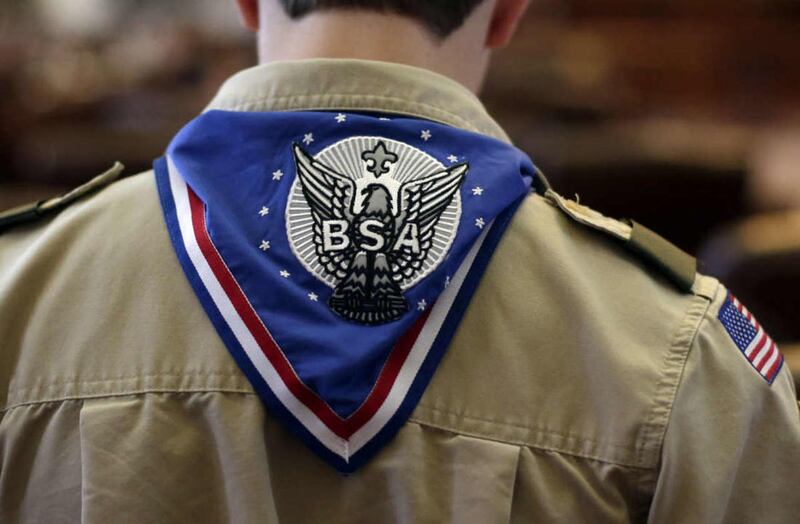

If a group chartered itself as the Catholic Scouts of America and devoted itself to instilling principles of honor, honoring duty to God and abiding by Catholic teachings, could anyone doubt its religious nature?
Ditto a hypothetical Mormon Scouts of America or a Methodist Scouts of America. Our nation claims to be governed by a Constitution and a First Amendment that permits the “free exercise of religion.” Therefore, is it conceivable that a religious-based organization might be ordered, by a secular court, to change its policies and admit Scout leaders who do not abide by church teachings about sexuality?
Furthermore, would the tax-exempt status of such a church be withdrawn because its boys youth group held fast to moral doctrines that differ from newly mainstream views?
Unfortunately, these are not merely hypothetical questions. The Boy Scouts of America is in very fact an amalgam of such organizations. It is entitled to First Amendment protections for its beliefs and has — in the past — successfully defended those beliefs before the Supreme Court.
Yet now, BSA national president Robert Gates has said he believes the Boy Scouts' ban on participation by openly gay adult Scouts is no longer sustainable. He’s cited new threats of litigation, the controversy over religious freedom laws in Indiana and Arkansas, and next month’s pending high court decision about whether the 14th Amendment requires states to redefine their marriage laws to include same-sex marriage.
As the Associated Press summarized: “In 2013, after bitter internal debate, the BSA decided to allow openly gay youth as scouts, but not gay adults as leaders. The change took effect in January 2014. Gates, who became the BSA's president in May 2014, said at the time that he personally would have favored ending the ban on gay adults, but he opposed any further debate after the Scouts' policymaking body upheld the ban. ... He said recent events ‘have confronted us with urgent challenges I did not foresee and which we cannot ignore.’”
The AP’s summary of the internal Boy Scout debate two years ago is a bit too shorthand. The “Membership Standards Resolution” makes clear that “Scouting is a youth program, and any sexual conduct, whether homosexual or heterosexual, by youth of Scouting age is contrary to the virtues of Scouting.” Further, it reads, “youth are still developing, learning about themselves and who they are, developing their sense of right and wrong, and understanding their duty to God to live a moral life.”
Therefore, in declaring that “no youth may be denied membership in the Boy Scouts of America on the basis of sexual orientation or preference alone,” the BSA resolution was not so much changing policies as reiterating the organization’s desire to be inclusive and not punitive. It wants all boys to participate in Scouts, but it also wants to ensure that the Scouting movement may remain true to the exercise of religious values inherent in Scouting.
Although not a church in its own right, BSA is built around a core of ethical values. These include the Scout Oath’s pledge to “do my duty to God and my country and to obey the Scout Law.” The Scout Law is compendium of 12 virtues that a still-quite-large percentage of boys can recite by memory.
A supermajority of BSA chartering institutions, or 71.5 percent, are faith-based entities, with 21.3 percent chartered to civic organizations and 7.2 percent chartered to educational institutions. The top five chartering organizations are Catholic, Lutheran, Methodist, Mormon and Presbyterian.
Gates said that — even though the Supreme Court in 2000 affirmed the Scouts’ ability to set its membership policies — a lawsuit striking downs its adult membership policy “could end up with a broad ruling that could forbid any kind of membership standard, including our foundational belief in our duty to God and our focus on serving the specific need of boys.”
This threat to religious freedom is unquestionably in the air. And that’s why so much hinges on the manner in which the Supreme Court resolves same-sex marriage next month.
Far from simply deciding whether to alter the definition of marriage to include homosexual couples, some advocates — including the Obama administration — are presuming to dictate issues as minute as standards for married-student housing at religious institutions.
Chief Justice John Roberts asked whether those religious colleges must change. Rather than minimizing the threat same-sex marriage might pose to religion, Solicitor General Donald Verrilli openly embraced the new hardship. “It’s certainly going to be an issue. I don’t deny that.”
Threats to our freedoms will come and they will go. But our nation will either hold true to First Amendment principles of religious freedom and association, or it will force people, religions, everyone — and here I include the Boy Scouts — to adopt standards with which they cannot, in good conscience, agree.
Drew Clark can be reached via email: drew@drewclark.com, or on Twitter @drewclark, or at www.utahbreakfast.com.