


Naturally, I am sad,” said Jan Dunbar. “It was a very nice tribute to my dad. And to mom, too, since she supported him in everything he ever did. Certainly we understand things are very different than they used to be. Time marches on. – Jan Dunbar, Dick Romney’s only living child
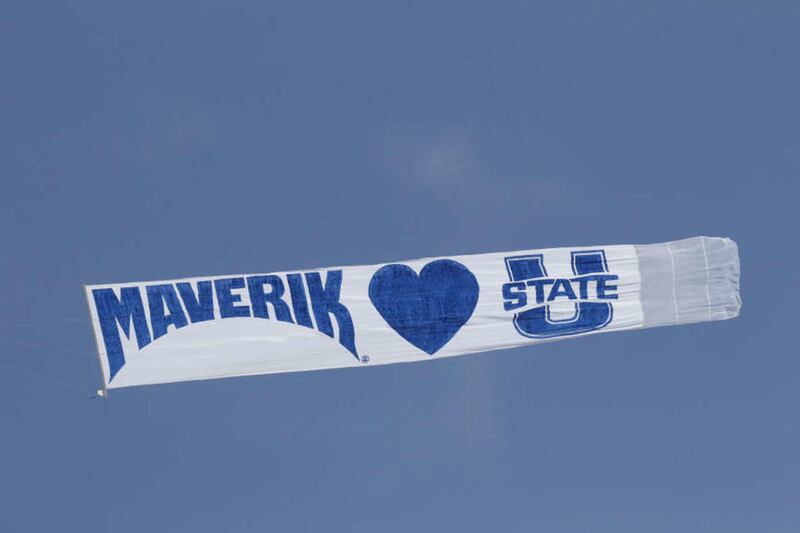
For an untold sum of money and who knows what else, Utah State turned its back on a legend and changed the name of its football stadium this spring from Romney Stadium to Maverik Stadium.
Dumping a beloved historical figure for a convenience store/gas station is bad enough, but now the Aggies want to keep the contractual arrangement with Maverik a secret.
This attempt at secrecy, of course, is wrong for a publicly funded school, and predictably it isn’t holding up. The Logan Herald Journal filed a formal request to view the contract under the Government Records Access Management Act, but the university said no, claiming Maverik had made confidentiality part of the deal (as if that makes it exempt from the law).
The Herald Journal filed an appeal through the State Records Committee, which agreed last Thursday the contract is a matter of public record. Maverik and USU have 30 days to file an appeal.
While USU and Maverik are being forced to do the right thing, you have to ask yourself this:
What are they hiding?
The public has a right to know how publicly funded schools spend their money. As Herald Journal managing editor Charles McCollom wrote, what if the latest deal with Maverik involves “provisions and perks that would be in the public’s interest and right to know … What if the stadium deal stipulates all gasoline purchased for university vehicles be from Maverik? … what if the pact provides USU scholarships to all the children of Maverik executives?”
This is not the first time these parties have tried to pull this stunt. The Aggies refused to disclose football coach John L. Smith’s contract in the 1990s until the Herald Journal forced them to make it public. Maverik and West Valley City struck a secret deal to change the name of the E Center to the Maverik Center in 2010.
From backroom dealing to erasing a legend’s name, the renaming of USU’s football stadium stinks. And, by the way, how do you name a stadium after a man and then take it away?
Maybe you’ve never heard of “Dick” Romney, especially if you: a) are under the age of 70; b) never followed Utah State athletics; c) never attended Utah State. Romney was Aggie athletics for decades. After his athletic career (he lettered in four sports at the University of Utah), he served as USU’s athletic director and head football coach for 29 seasons from 1919-1948, compiling a record of 128-91-16. He also was USU’s basketball coach for 22 seasons (225-157), the head track coach for 24 seasons and the head baseball coach for three years. Oh, and he also served as the commissioner of the Skyline Conference for 10 years.
No one knows when this man slept. What he did as a coach will never be repeated.
He was a legendary figure in Logan, which is why they named not one, but two stadiums ROMNEY STADIUM, the first one in 1927 and the second (and current) one in 1968. Romney died in 1969.
Everything has a price, and now the Aggies are selling out Romney’s memory. USU officials say his name will be in the stadium somewhere, but it’s a small gesture probably designed to assuage their guilt. Maybe Romney doesn’t mean much to current Aggie fans, but isn’t that why the stadium was named after him so that he wouldn’t be forgotten?
Is it right for future generations to undo the honors awarded by previous generations? Imagine BYU changing the name of LaVell Edwards Stadium 50 years from now, giving it to the highest bidder — Jell-O Stadium. If Romney had bought the right to put his name on the stadium, then it would be understandable if someone else bought the naming rights and changed it after the arrangement was finished, which was what happened when the Delta Center became EnergySolutions Arena. But the stadium was named after Romney to honor his memory and his contribution to the school.
Now the Aggies are betraying Romney so they can raise money to upgrade the press box. It will be Maverik Stadium, adjacent to Jim and Carol Laub Athletic-Academics Complex, high above Merlin Olsen Field (soon to be sold to the highest bidder?).
Craig Hislop, a former Utah State sports information director and current USU radio host/Herald Journal columnist, called Romney’s only living child to get her reaction. “Naturally, I am sad,” said Jan Dunbar. “It was a very nice tribute to my dad. And to mom, too, since she supported him in everything he ever did. Certainly we understand things are very different than they used to be. Time marches on.”
It didn’t have to be this way.
Doug Robinson's columns run on Tuesdays and Wednesdays. Email: drob@deseretnews.com