

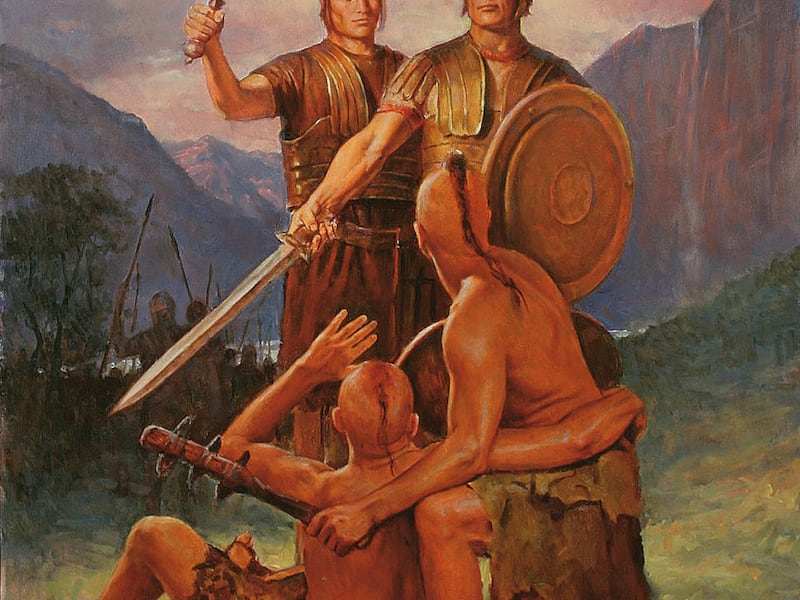
After many years of bloodshed between Lamanites and Nephites, reports Alma 62:41 in the Book of Mormon, “many had become hardened, because of the exceedingly great length of the war; and many were softened because of their afflictions, insomuch that they did humble themselves before God, even in the depth of humility.”
This passage is easy to miss. Nonetheless, it seems to me remarkably (though quietly) insightful: The experiences of the two groups are essentially identical, yet their reactions differ dramatically.
Likewise, the same angel appeared to Laman, Lemuel and Nephi when they went up to Jerusalem, but their responses, recorded in 1 Nephi 3:29-4:4, are fundamentally opposed.
Consider, too, the interaction between the Nephite commander Moroni and the Lamanite leader Zerahemnah, as recorded in Alma 44:3-9. The victorious Moroni addresses Zerahemnah, summoning him to recognize “that all-powerful God, who has strengthened our arms that we have gained power over you.”
“Ye behold,” Moroni said, “that the Lord is with us; and ye behold that he has delivered you into our hands. And now I would that ye should understand that this is done unto us because of our religion and our faith in Christ. … Yea, ye see that God will support, and keep, and preserve us, so long as we are faithful unto him.”
But Zerahemnah’s perspective differs entirely: “Behold, we are not of your faith; we do not believe that it is God that has delivered us into your hands; but we believe that it is your cunning that has preserved you from our swords. Behold, it is your breastplates and your shields that have preserved you.”
Zerahemnah rejects Moroni’s faithful religious explanation of the battlefield results in favor of a secular, naturalistic account. Yet both are commenting upon the same objective facts.
When, years ago, the old Foundation for Ancient Research and Mormon Studies, or FARMS, called attention to an article on shields-research.org arguing — very plausibly, in my judgment — that the plates of the Book of Mormon might have been made of a known pre-Columbian gold alloy called “tumbaga” rather than of the pure metal, one anti-Mormon “ministry” summarized the takeaway point in a headline reading “FARMS admits plates weren’t gold!”
Different people weigh the same facts differently. While I find the claims of the witnesses to the Book of Mormon compelling, some critics assure me that they mean nothing at all. Most who heard the testimony of Joseph Smith rejected it; most who heard Jesus Christ chose not to follow him.
We live in a world where answers to the question of whether to accept the claims of the Restoration or not, or even whether we should believe in God or not, are “underdetermined” by the publicly available evidence. Seeming evidence exists on either side, but there’s no agreed-upon proof, not enough evidence to force a decision.
Inescapably, though, we must still decide.
This is, I think, is deliberate. It’s vital to the divine design of mortality as a testing ground.
And, absent decisive proof one way or the other, we’re obliged to judge based on our subjective feelings as well as on our evaluation of whatever evidence we might have.
We should be accustomed to this, though, and not merely in religious matters. We routinely buy, invest, accept jobs and marry without all the facts we’d like. Most women have had the experience of knowing within a few minutes — and without waiting for his full sales pitch — that this or that guy wasn’t a serious marriage prospect. We’ve all declined ad campaigns and commercial proposals without giving them a full and detailed hearing. Many of our basic decisions are non-rational, although we may seek rational justification for them afterwards. (Reason, the philosopher David Hume said, is “the slave of the passions.”)
We decide on such matters, and, having no real alternative, on the existence and nature of God and the purpose of life, as whole people of flesh and blood, not as purely objective calculators or thinking machines.
In his book “A Conflict of Visions,” the economist and social philosopher Thomas Sowell considers how particular political opinions are impacted by our overall worldviews. So, too, in religious issues. But our circles of friends, our social networks and our desire for their approval also impact our judgments: Fellowship with those of The Church of Jesus Christ of Latter-day Saints tends to nurture and preserve faith. On the other hand, close association with critics and cynics, in person or online, will, over time, likely weaken faith and may even destroy it.
Daniel Peterson teaches Arabic studies, founded BYU’s Middle Eastern Texts Initiative, directs MormonScholarsTestify.org, chairs mormoninterpreter.com, blogs daily at patheos.com/blogs/danpeterson, and speaks only for himself.