

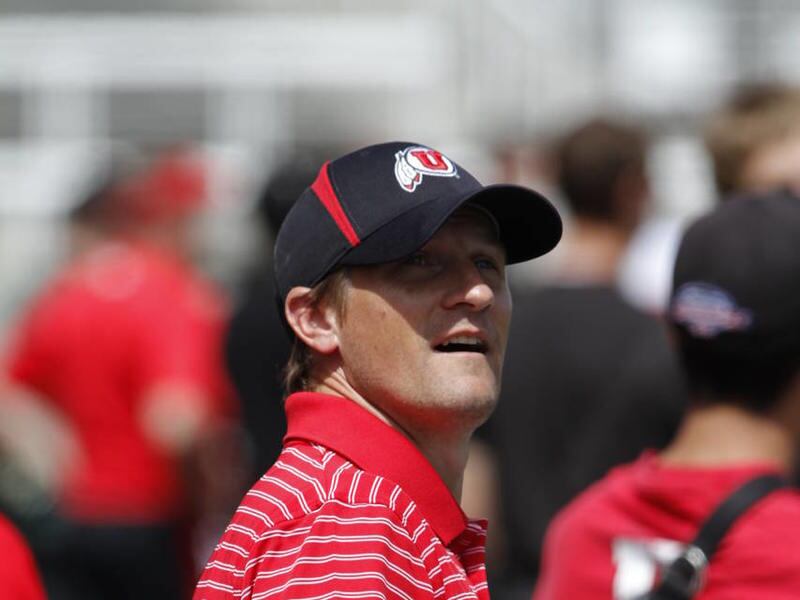
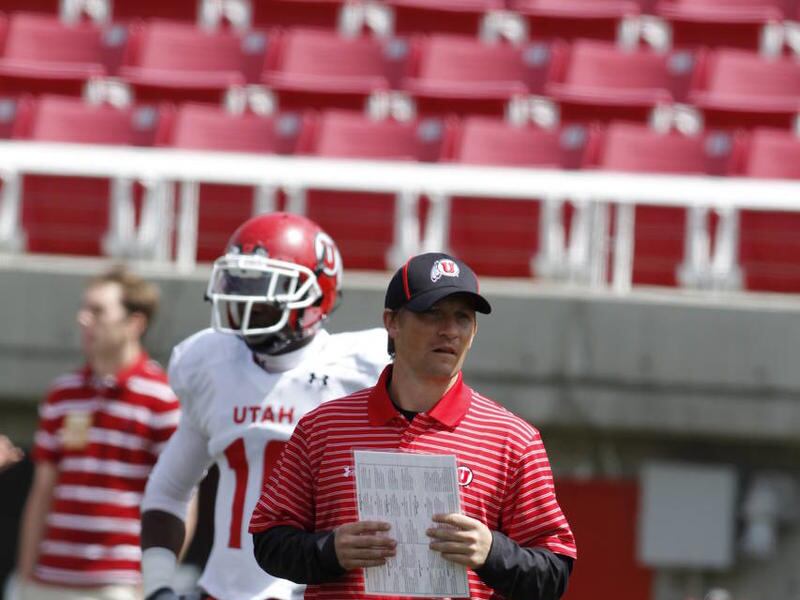
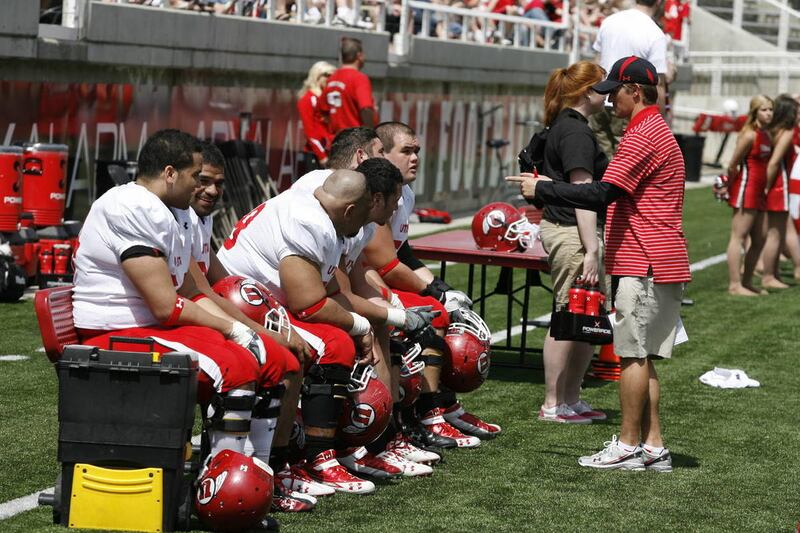
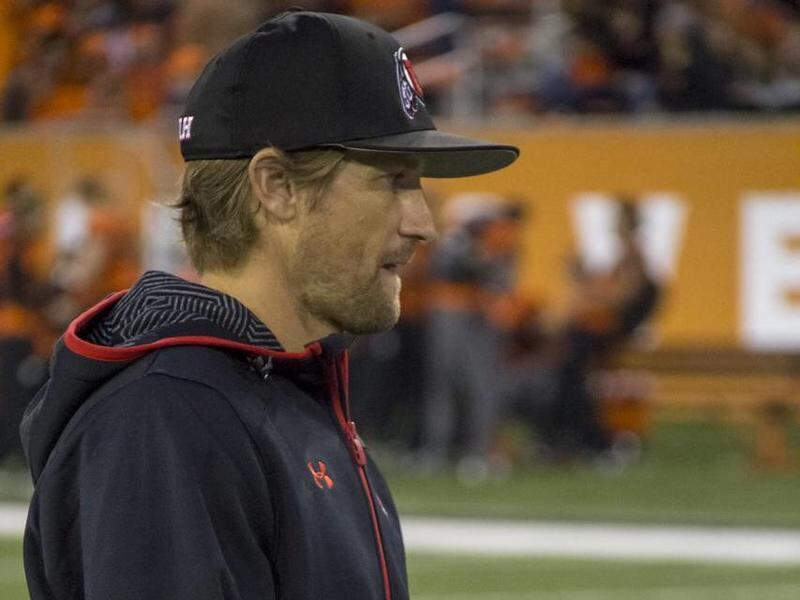
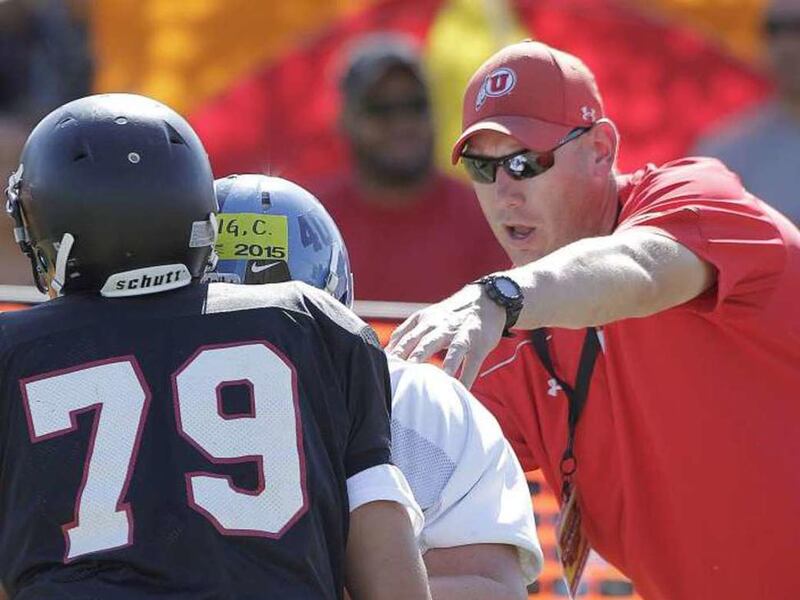
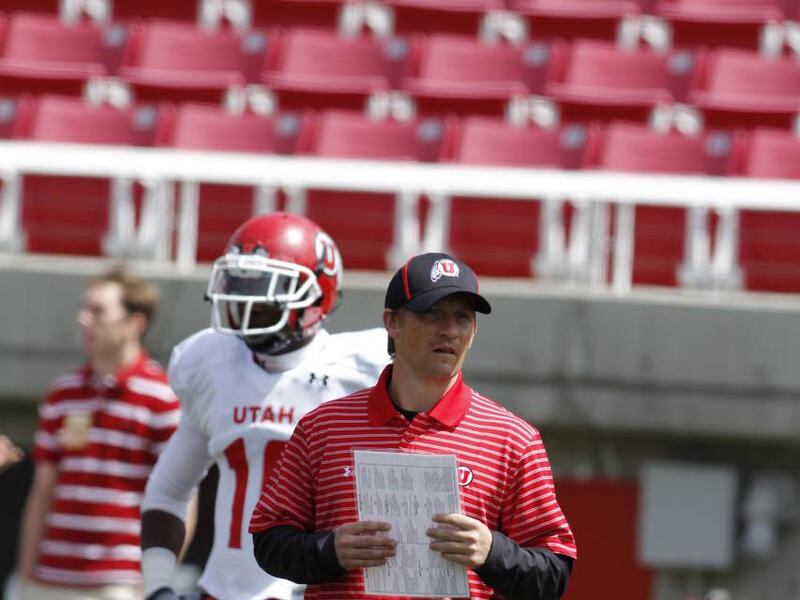
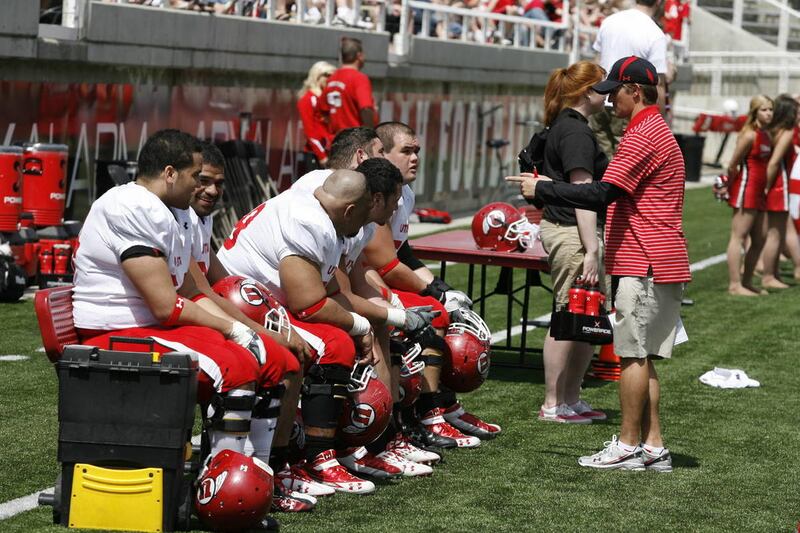
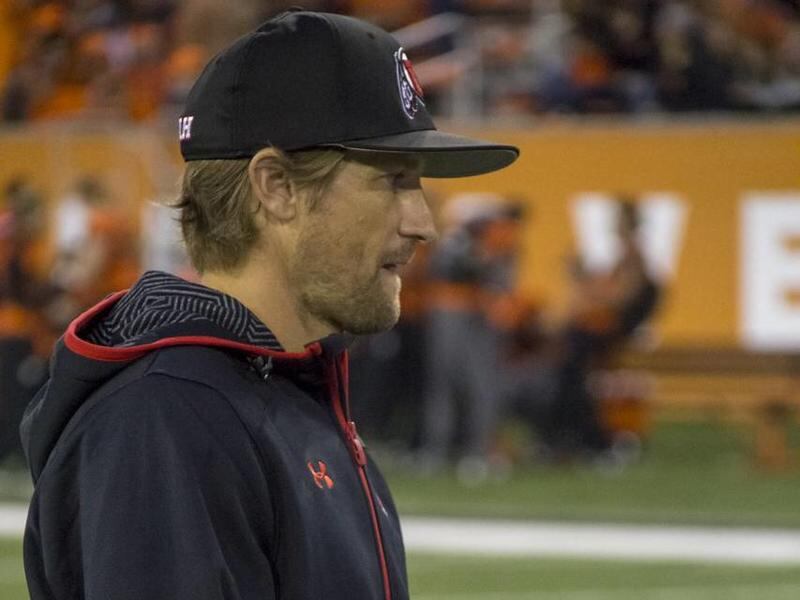

In their seemingly endless search for a more productive offense, the Utes are back to where they started a few years ago. Aaron Roderick, their former offensive coordinator, gets the job again.
Or part of it.
The Utes have again created one of those two-headed co-coordinator positions, which they tried previously. Roderick and Jim Harding will share the job. Harding will oversee the running game and pass protection and have the final word on the scheme. Roderick will call plays and oversee the passing game.
“It’s a hot seat,” says Roderick of the OC job.
That’s an understatement. For the record, this is Roderick’s third shot at the position in six years, which reveals a certain frustration with the offense. During Whittingham’s 10 seasons as head coach, he has had eight offensive coordinators, seven in the last seven years — Andy Ludwig, Dave Schramm, Schramm/Aaron Roderick, Norm Chow, Brian Johnson, Dennis Erickson, Dave Christensen and now Roderick/Harding. Ludwig and Chow were replaced only because they had another job offer. The rest lost the OC position because the offense sputtered.
Enter — or rather re-enter — Roderick. A thoughtful, articulate man, he is the staff’s good soldier. If he weren’t, he wouldn’t be here because he’s had plenty of reasons to pout or leave in a huff a la Brian Johnson, who was demoted after one year as the OC and went to another school. Maybe this is why Roderick is the last remaining coach from Kyle Whittingham’s original coaching staff, 11 years down the road.
In 2009, Roderick was named co-coordinator with Dave Schramm, but then Roderick suddenly left to take a job at the University of Washington. Three weeks later he returned to the Utes. He reclaimed his former position as receivers coach, but as OC. Roderick both left and returned to the Utes because of personal problems that had nothing to do with football, and no one who knows the reasons could fault him, but the Utes had moved on during his absence.
As it turned out, Roderick wound up calling plays for half the season anyway, and the following year Whittingham restored him as co-coordinator with Schramm. Once again, full-time play-calling duties were given to Roderick about midseason. The Utes finished 10-3 after losing three of their last five games, falling to heavyweights TCU, Notre Dame and Boise State. As for the offense, it ranks as the second best effort during the Whittingham era (23rd nationally in scoring).
But in the offseason Whittingham hired Chow to replace Roderick and Schramm as coordinators for the 2011 season.
“I’m competitive,” says Roderick. “I didn’t want to be demoted. And I’m still proud of the job I did in 2010. As I looked back I thought there were things I could’ve done better, but we were good on offense and won 10 games. I had no bad feelings about (the demotion), but I am anxious to prove myself again with Jim.”
Ask him why he was demoted, he says, “I don’t ask for reasons. (Whittingham) is in charge and I just do what he says. If he wants me to call plays, I do it. If he wants me to coach receivers, I do that. I learned a long time ago you can’t let ego get in the way or you’re going to set yourself up for disappointment. We ask our players to take on certain roles — we might ask a two-year starter to take a lesser role. How can I ask them to do it if I don’t? I’ve always felt another opportunity would come around. The best thing was to be prepared and be a better coach.”
So now he’s ready for another opportunity after a four-year wait. The change in the OC position will not require much adapting by the players and rarely has. There have been seven coordinators in seven years, but only three times were the offensive scheme and terminology really changed — 2011 (Chow), 2012 (Johnson), 2014 (Christensen).
“Aaron has an excellent football mind,” says Whittingham. “He’s good with the Xs and Os and he’s got imagination and creativity. He is also very good with fundamentals and technique.”
“Jim and I have a good relationship,” says Roderick. “He’s very professional, and the responsibilities are distributed well.
The 42-year-old Roderick, a Bountiful native, was an undersized wide receiver at BYU from 1996 to 1998, collecting 25 catches for 393 yards and 4 touchdowns. He believes his shortcomings in talent forced him to learn the nuances of the game to compete at that level and that this paid off later when he became a coach.
During his playing days at BYU, the Cougars had limited space for meetings, so all of the skill players met in the same room. “I don’t know if this was intentional,” says Roderick, “but I learned the whole offense. I would hear (quarterback Steve) Sarkisian coached and how (running back) Kalani Sitake was coached, and how our tight ends, Chad Lewis and Itula Mili, were coached and of course the wide receivers. By the time I was a senior I knew quarterback reads and the running backs’ assignments in the passing game and who tight ends block in the running game.”
He rose rapidly in the coaching ranks — three years as a graduate assistant at BYU were followed by one season at Snow College, two seasons at Southern Utah and then a position at Utah, where he has been ever since. As fate had it, he worked for three different coordinators in three years when he was a GA at BYU — Chow, Lance Reynolds and Gary Crowton.
“I can’t tell you how fortunate that was for me,” he says. “Instead of seeing the same thing done over and over for three years, I was able to learn from all these coaches.”
Looking ahead to the upcoming season, he and Harding will place much of the emphasis simply on cutting turnovers. He believes the last two seasons are instructional. In 2013, quarterback Travis Wilson threw 16 interceptions while winning just five games. Roderick met with Wilson after the season and asked him, “What would have happened if everything remained exactly the same (in 2013) — everyone plays exactly the same — except you cut your interceptions in half?” Wilson, after studying the 2013 schedule, told Roderick, “We probably would’ve won two more games, maybe three.” Heading into 2014, Roderick and the offensive staff emphasized that point with Wilson. The result: Despite having 76 more passing attempts, he cut his interceptions from 16 to 5, raised his completion percentage nearly five points and the Utes won nine games.
“Turnovers were a huge point of emphasis (at quarterback),” says Roderick. “Just don’t lose the game; take care of the ball. All our games are so close. If we can just be a little more efficient...”
As the Utes begin their fifth season in the Pac 12, Roderick will team with Harding to run an offense whose average national ranking in the past decade is 64th in yardage and 47th in scoring, which is why there has been a long procession of OCs.
Roderick and Harding are next to take on the challenge.
Doug Robinson's columns run on Tuesdays and Wednesdays. Email: drob@deseretnews.com