
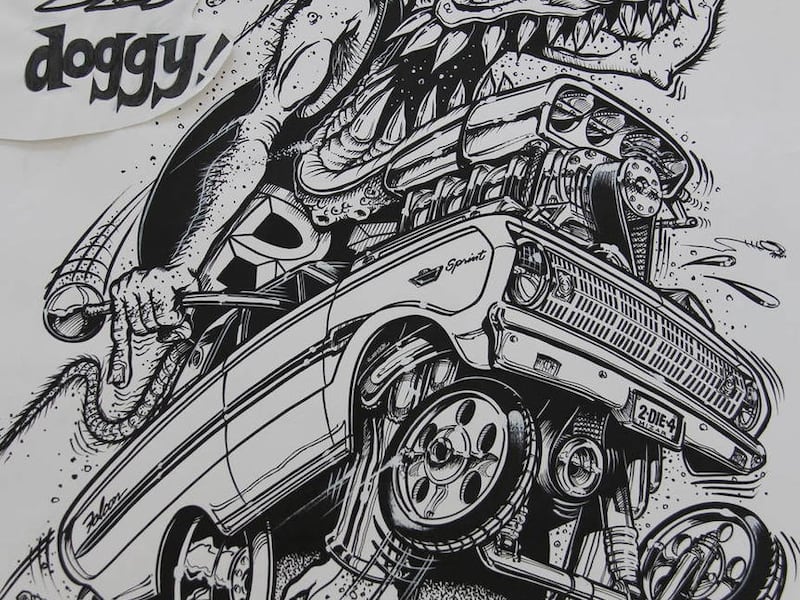
EPHRAIM, Utah — Granary Art Center’s current exhibition “Rat Fink!” is a far cry from what one generally encounters in a traditional art museum. Curated by Laura Allred Hurtado, the exhibition showcases the life and art of Ed “Big Daddy” Roth, a pioneer of California’s Custom Car movement of the 1960s, who later moved to Manti, Utah, after converting to The Church of Jesus Christ of Latter-day Saints.
Visitors will discover a wide selection of Roth’s art, such as sculptures, drawings, T-shirts and skateboards. The inclusion of such items broadens the parameters of traditional art exhibitions and paints a nuanced picture of an artist that relished in American counterculture.
Born in 1932, Roth was a California native whose diverse career included work as a cartoonist, custom car designer and pinstriper. Roth is considered an innovator in Southern California’s Kustom Kulture movement, a term used to designate the style and accessories of those who crafted and rode custom cars and motorcycles starting in the 1950s.
In 1963, Roth created the character Rat Fink, a figure that would serve as an icon of the hot rod movement.
According to Hurtado, “Conceived as an anti-Mickey Mouse, Rat Fink is a miscreant, a bulging-eyed, grotesque rodent with sharp teeth and a large mouth.” The character’s deliberately shocking appearance and grotesque green or gray color “became a poster symbol of an entire counterculture movement, summarizing, in his deviance, the ethos of outsider.”
So what was the motivation for Roth’s rebelliousness?
The answer can be found by examining the context of his creations. During the 1960s, pop art took the country by storm, introducing the American public to artists such as Andy Warhol, Roy Lichtenstein and Claes Oldenburg. Pop ushered in a new phase of art that eliminated the boundaries of high and low culture, using household items, advertisements and imagery from “popular” sources. This facet of pop, granting artistic legitimacy to lowbrow, functional items, indelibly influenced Roth’s work.
Hurtado, the global acquisitions art curator for the LDS Church History Museum, said, “I am continually on the hunt for talented and complex artists who are Mormon. Roth’s work is that in spades.”
In 1974, Roth converted to the LDS Church and moved to Manti to be closer to the town’s iconic temple. Hurtado recognizes a peculiarity in that action.
“As much as (Roth) stood for the counterculture that resisted the ubiquitous sameness of Fordism and the pristine squeaky cleanness of Disney … (in) much of his later work … he (was) dedicated to his Heavenly Father, which attests to his transformation,” Hurtado said.
Roth’s work and life — he died in April 2001 — speak to the complexity of artistic experience and how he retained his rebellion despite settling down in the small, sleepy town of Manti.
His move to Manti both continued and diversified his own artistic legacy, but it also contributed an entirely new facet to the local community. Since 1977, Manti has hosted the annual Rat Fink car show and reunion, which attracts local residents and outsiders alike. The Granary’s proximity to Manti makes it an ideal venue for such an exhibition.
If you go …
What: "Rat Fink!" art exhibit
When: 11 a.m.-6 p.m. Tuesday-Friday, noon-4 p.m. Saturday, through Sept. 18
Where: 86 N. Main, Ephraim
Phone: 435-283-5110
Web: granaryartcenter.org
Scotti Hill is an art historian based in Salt Lake City. She teaches art history at the University of Utah and Westminster College and works as a freelance curator and writer.