





Early in “Everest,” a group of seasoned mountaineers sit around trying to find an answer to the question that haunts their passion: Why?
The cliché answer — “because it’s there!” — is insufficient. Ultimately, each climber’s answer is personal, and as “Everest” unfolds, the validity of that answer underscores every moment of the tragedy that follows.
“Everest” is the big-screen rendering of the real-life tragedy that inspired Jon Krakauer’s best-selling novel "Into Thin Air." It’s spectacular, inspiring and, most importantly, heartbreaking. Consider it a spoiler alert if you will, but you should probably know that this story doesn’t end happily in typical Hollywood fashion.
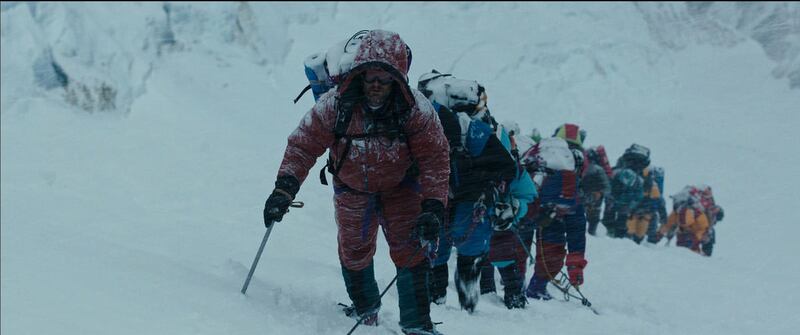
What it does do is pull you so deeply into a trek up the world’s tallest mountain that you often forget that you’re watching a movie. “Everest” is a sermon of intensity, a film built for IMAX and surround sound. It’s almost worth seeing for the incredible Himalayan visuals alone.
Its protagonist is Rob Hall (played by Jason Clarke), a longtime mountaineer who pioneered commercially guided ascents back in the 1990s. By the time we reach the events of “Everest” in 1996, Hall’s ambition has backfired, and the legendary Himalayan peak has become overrun with adventurers, all trying to cram their journeys into a narrow window of acceptable weather.
Hall’s party includes Krakauer (Michael Kelly), then writing for Outside magazine; longtime friend Doug Hansen (John Hawkes), who failed to summit on a previous ascent; and Yasuko Namba (Naoko Mori), a Japanese climber looking to cross Everest off her bucket list. The ensemble cast also includes Josh Brolin, who plays the Texan Beck Weathers, and Jake Gyllenhaal as Scott Fischer, the leader of a rival company.
The film builds at a gradual pace, schooling viewers on the grueling process climbers must go through to acclimate to the high elevations before even attempting their ascent. Director Baltasar Kormákur uses this time to flesh out his leads, as well as some peripheral characters, including Keira Knightley, who plays Hall’s pregnant wife, Jan.
The feeling of anticipation carries the audience through the slower build. Then, once Hall’s team begins its ascent, things begin to go wrong right away. Bickering among competing groups causes time-wasting holdups, and equipment gaffes involving ropes and ladders lead to more problems. In spite of all this, Hall and co. make it to the top of the mountain, but that’s where the clash between man and nature goes from inconvenience to tragedy.
Clarke is well suited to his role as a man torn between feelings of compassion and duty. You could argue that some poor decisions led to the events on the mountain, but here we see the struggle behind them. Brolin is also strong as Weathers, who realizes too late that he’s in over his head.
Kormákur gives us just enough about his various characters to care about them, and immerses his audience so fully in the experience that it’s easy to sympathize even without a lot of character development.
The cinematography and staging are so impressive, so incredible, that you can’t help but wonder how the filmmakers put it together. But in a way, worrying too much about how much is CGI or how much is on location would ruin the experience. “Everest” gives you every reason to believe it is real. And heartbreaking as it may be, it's a movie experience well worth having.
“Everest” is rated PG-13 for sustained sequences of peril, as well as some frostbite-related gore.
Joshua Terry is a freelance writer and photojournalist who appears weekly on "The KJZZ Movie Show" and also teaches English composition for Salt Lake Community College. Find him online at facebook.com/joshterryreviews.