

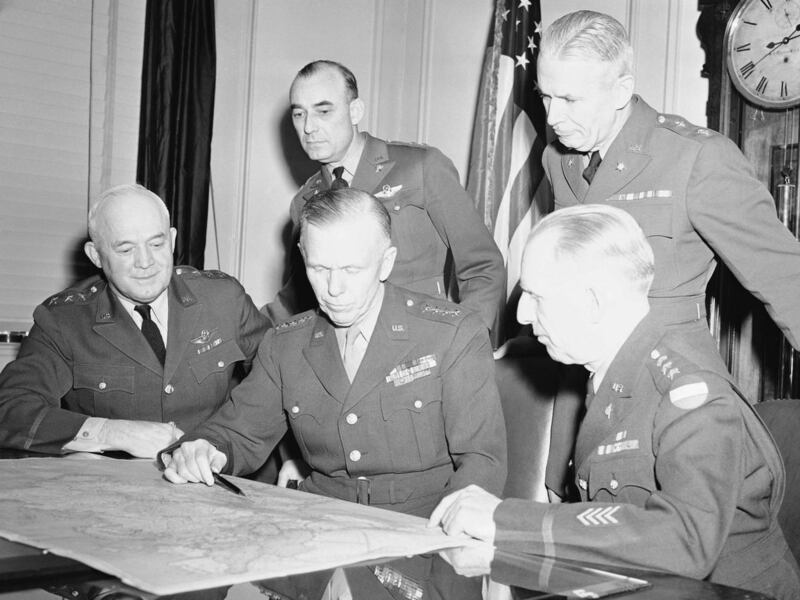
On Sept. 1, 1939, President Franklin Delano Roosevelt appointed Gen. George C. Marshall as chief of staff of the United States Army. Marshall had been a career military man, and his leadership in World War II contributed much to the Allied victory.
George Catlett Marshall Jr. was born in Pennsylvania in 1880 and attended the Virginia Military Academy, graduating in 1901. Less than 40 years had passed since Robert E. Lee and Ulysses S. Grant had met at Appomattox Court House, and Marshall's military curriculum required detailed study of the Civil War and its leaders. The next year, he received an Army commission as a second lieutenant and soon served in postings around the country and in the Philippines.
After America entered World War I in 1917, Marshall received a promotion to captain and helped in the logistical planning that landed over a million soldiers in France within a year. His talent for logistics served him well, and by the end of the war he served directly under Gen. John J. “Blackjack” Pershing, the commander-in-chief of the American Expeditionary Force in Europe.
In the book “Partners in Command: George Marshall and Dwight Eisenhower in War and Peace,” historian Mark Perry noted Marshall's particular approach to command:
“Marshall's leadership style was designed to make subordinates feel that they had a stake in their chief's success. There is no record that he ever publicly upbraided anyone who worked with him, but in private his remarks could be chilling. When a fellow officer he had known for many years told him that he would have to delay his departure for Europe because his wife was gone and the furniture was not yet packed, Marshall was dumbfounded. The officer was suddenly apologetic. 'I'm sorry,' he said, to which Marshall responded, 'I'm sorry, too, but you will be retired tomorrow.’”
Marshall continued to hold a number of posts after World War I. The conflict had taught the value and potential of armored warfare, and Marshall proved a proponent of new tactics and planning. After working in the War Department, the Army War College and commanding posts around the country and in China, Marshall finally earned his general's star in 1936.
While serving as commander of the Vancouver Army barracks in Washington state, Marshall began to work with Roosevelt's New Deal trouble shooter, Harry Hopkins. Money allocated for New Deal programs was often used to help out the military when it was short on funds, and the two men got to know each other well while dealing with these issues.
At Hopkins' urging, Roosevelt promoted Marshall to the post of assistant chief of staff for the War Plans Division in Washington, D.C., in 1938. Marshall first met the president at a meeting in November. The meeting was called to discuss the possibility of a major increase in future aircraft production and how such a large budget increase could be sold to Congress. When Roosevelt asked Marshall if he thought, as most present did, including the president, that the plan was good, the general replied in the negative. The proposal addressed only aircraft production. It said nothing about increased expenses for pilot training and support personnel.
In April 1939, Malin Craig, the chief of staff of the United States Army, retired after nearly four years in the office. While still only a brigadier general, Marshall was promoted to acting chief of staff of the United States Army in April. This left no doubt — Roosevelt was grooming him for the job on a permanent basis. Though 33 officers outranked him, Roosevelt felt that Marshall was the only officer with the proven logistical ability, political astuteness, relative youth and drive needed for the job. Roosevelt also admired Marshall's willingness to disagree with him.
Shortly after this appointment, Perry noted in his book, Marshall's wife Katherine wrote a letter to the president: “Ever since your appointment of my husband — as your next Chief-of-Staff — I have wanted to write you. It is difficult for me to put into words what I really feel. For years I have feared that his brilliant mind, and unusual opinion, were hopelessly caught in more or less of a tread-mill. That you should recognize his ability and place in him your confidence gives me all I have dreamed of and hoped for. I realize the great responsibility that is his. I know that his loyalty to you and this trust will be unfailing.”
Marshall's appointment to acting chief of staff came at an critical time. Events were unfolding on the world stage that made war seem more and more likely, and it was by no means certain that the United States could sit out the coming conflict indefinitely. In Europe, Adolf Hitler's Nazi army had conquered Austria and Czechoslovakia by threat of force, and now the German dictator was threatening Poland. Britain and France, who had backed down the previous September when Hitler gobbled up the Czech Sudetenland, now pledged to defend Poland's borders.
In Asia, Japanese forces continued their attempts to subdue China, a nation friendly to the United States. In December 1937, Japanese forces had gone wild in the Chinese capital of Nanking, raping and murdering hundreds of thousands of Chinese civilians. There was the looming question of whether Germany and Japan would continue their aggressive actions or back down in order to avert war. It was not a time for timid officers to be deciding U.S. military policy.
Roosevelt finally made Marshall's position as chief of staff official on Sept. 1, 1939 — the very day Hitler's panzer armies rolled into Poland and began the second World War. Because the position required the authority to order any officer in the U.S. military, Marshall was immediately elevated to full general and boasted four stars on his shoulders. His pay jumped from $7,500 a year to just under $10,000, plus other allowances.
In the book, “15 Stars: Eisenhower, MacArthur, Marshall: Three Generals Who Saved the American Century,” historian Stanley Weintraub wrote: “Hundreds of congratulatory letters and telegrams flooded his office in the Old Post Office Building on Pennsylvania Avenue from which he would soon relocate. One declared the signers' 'great pleasure to have our association during my official tour of duty in your country. Please be good enough to extend to us your courtesies officially as well as privately.' It was from Major General Masafumi Yamauti, military attaché at the Japanese embassy.”
As America's highest ranking Army officer during World War II, Marshall's contributions to victory are incalculable. He was instrumental in organizing the Allied war effort once America had joined the war in 1941 and oversaw the integration of American and British staffs. He never commanded an army in the field. Rather, he waged his war from behind a desk. Though he personally desired to command the 1944 D-Day invasion of Normandy, he believed his talents were better used in Washington and deferred to his subordinate, Dwight D. Eisenhower. Together with Eisenhower and Douglas MacArthur, Marshall ended the war a five star general.
After the war, while serving as Harry Truman's secretary of state, the president called Marshall “The man who won the war.”
Cody K. Carlson holds a master's in history from the University of Utah and teaches at Salt Lake Community College. An avid player of board games, he blogs at thediscriminatinggamer.com. Email: ckcarlson76@gmail.com