

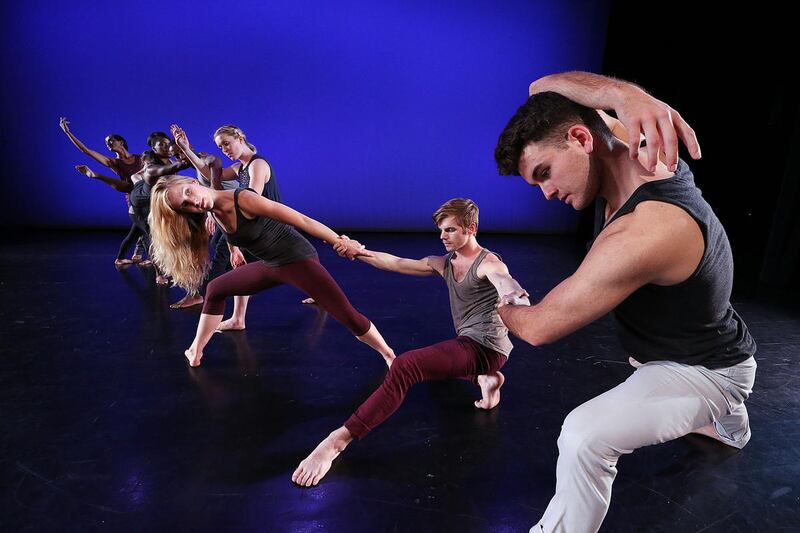
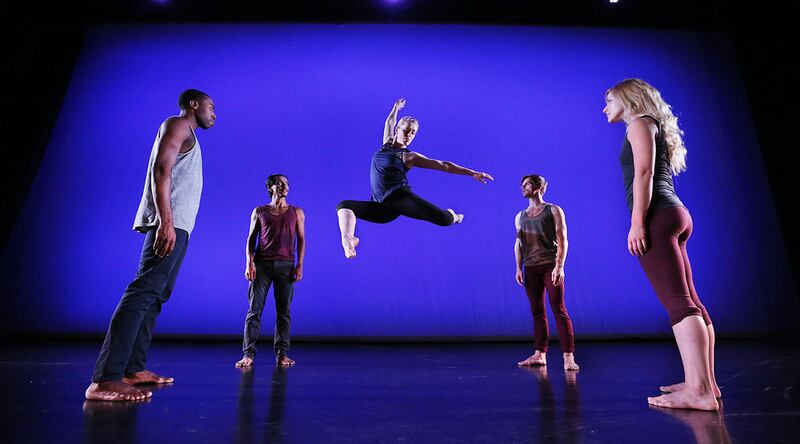
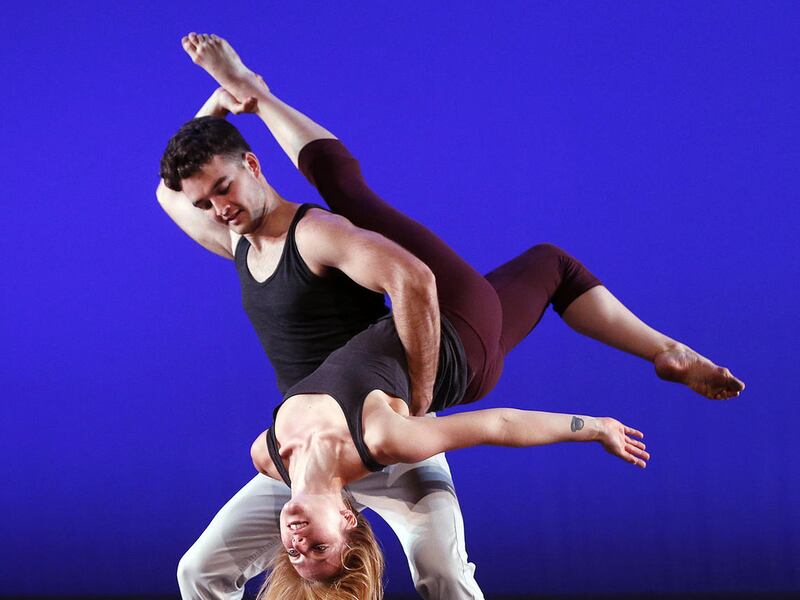
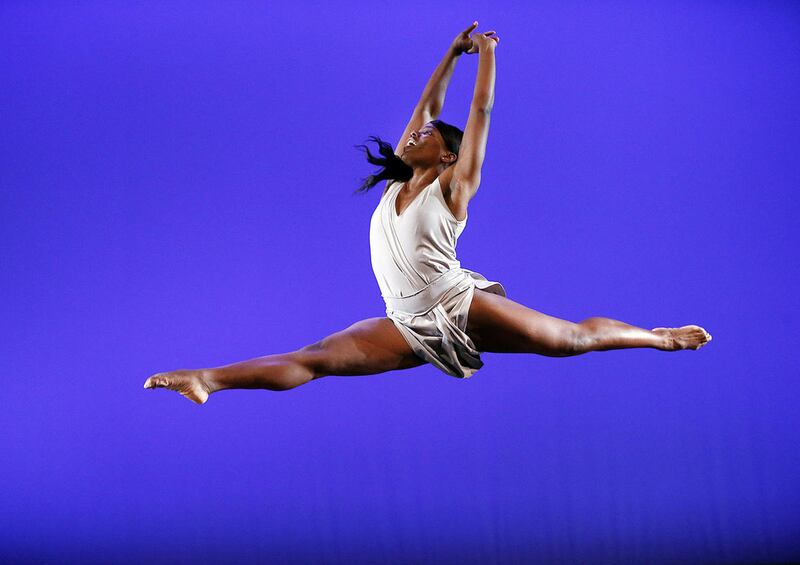
SALT LAKE CITY — Repertory Dance Theatre dancer Jaclyn Brown thrives on energy from the audience.
She remembers one instance when the company was performing a piece called “Styrofoam Olympics.” A men’s trio was onstage, the dancers throwing a soccer ball between them as part of the performance, when one of them missed and the ball rolled off the stage.
They continued with their moves, pretending they still had the ball, when suddenly the ball flew from the black abyss of the crowd toward the stage.
Despite the fact that he couldn’t see anything beyond what was lit by the bright stage lights, Efren Corado Garcia caught the ball.
“I will never forget the look on his face when he caught the ball,” Brown said with wide eyes and a laugh. “Those little magical moments are what’s so special about being onstage, when you really feel a response from the audience. Whether it’s an emotional piece or something silly like that, it’s creating magic and not even meaning to. It just happens because people coming here are open and willing to make it happen.”
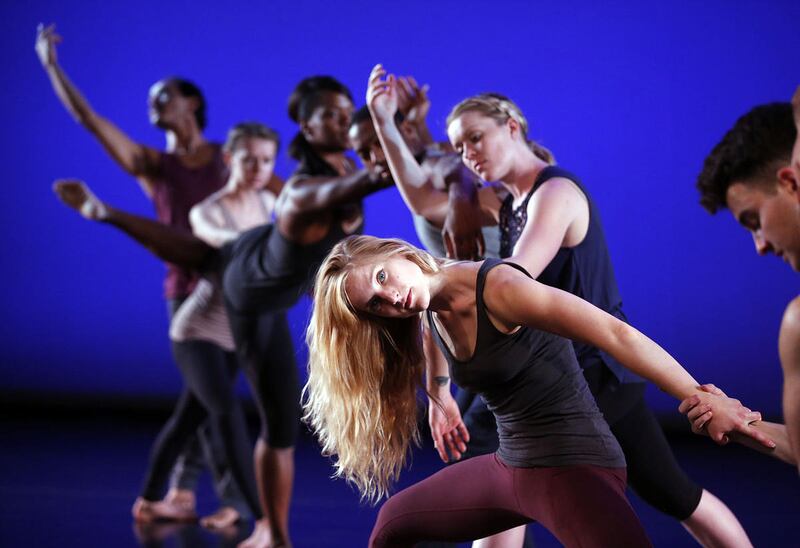
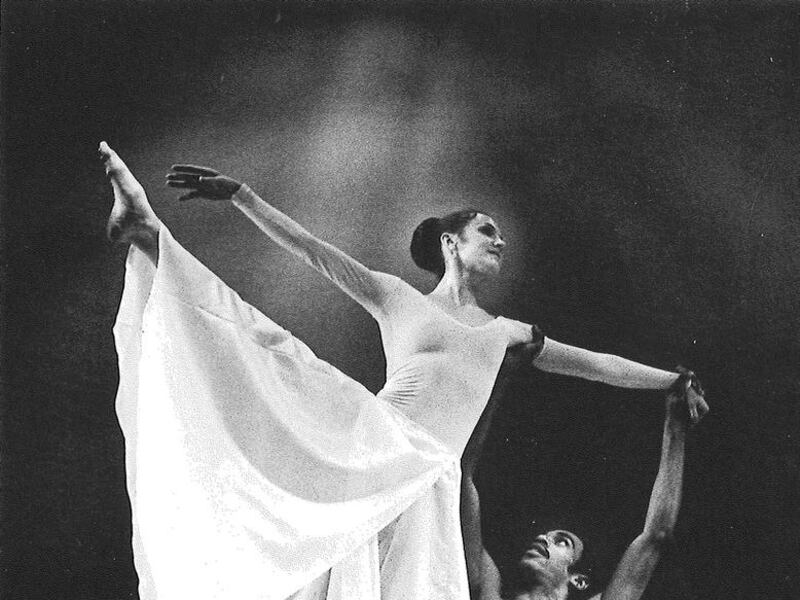
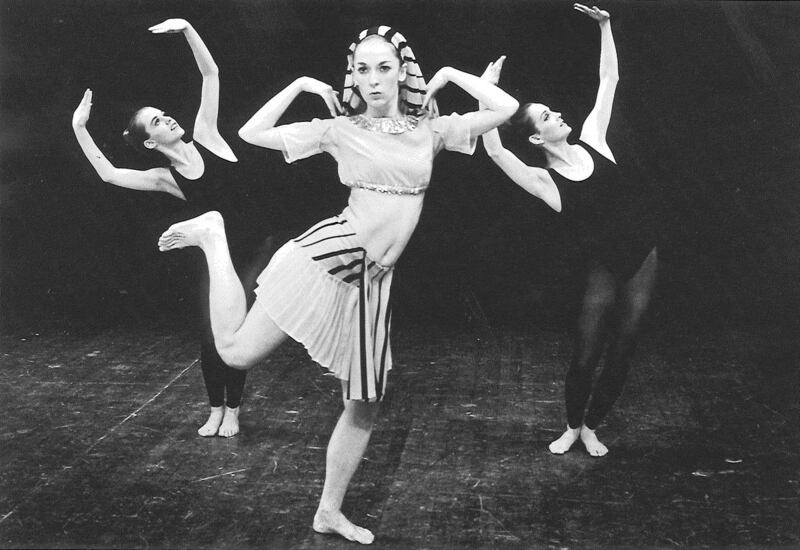
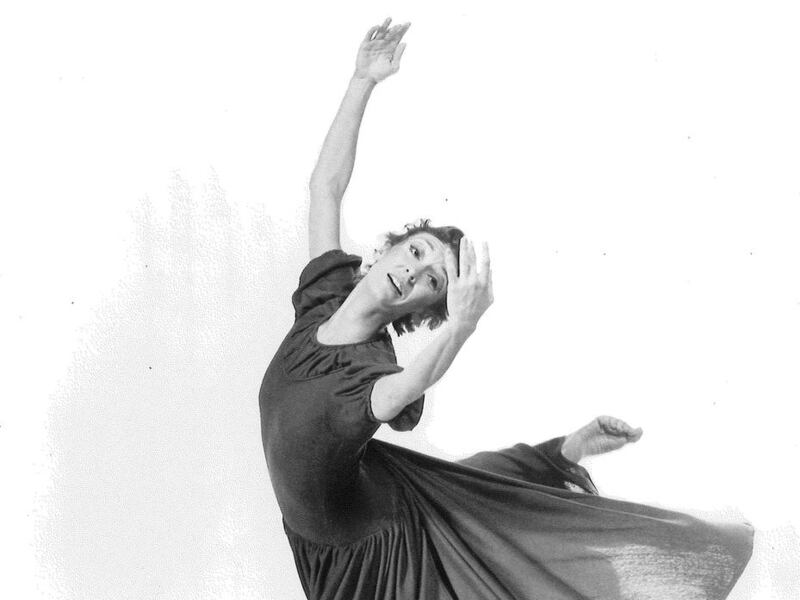
Moments such as this make RDT’s history a rich tapestry of memories. Through hundreds of performances over the course of five decades, RDT has molded itself into “the nation’s oldest and most successful repertory dance company,” according to its website.
“We value (dance) as a universal form of communication that can be used to document history and culture, inspire change, increase learning, create a path toward a healthier society and people,” said Linda C. Smith, RDT’s executive/artistic director, in a previous interview with the Deseret News.
As RDT celebrates its 50th anniversary during the 2015-16 season, the modern dance company is reflecting on its influence on the world of dance, on the community at its home in Utah and on the individuals who allow RDT’s concerts to change them.
“When you go to a modern dance concert, you see your life,” Garcia said. “You see regular movement that is abstracted, and it allows the general public to have a moment of reflection.”
A ‘magic formula’
Growing up in Utah, Smith found her passion for dance early in life.
“My fire got lit when I was 4½ years old, dancing with Virginia Tanner,” she said.
Tanner, the founder of Children’s Dance Theatre, now Tanner Dance, in Salt Lake City, was an influential dance educator for decades. But her impact in Smith’s life and on the dance community in Utah went beyond youth dance programs: It was her encouragement that got the ball rolling for RDT.
In the 1960s, the Rockefeller Foundation, a philanthropic organization, recognized a need to spread cultural experiences and performing arts beyond large cities such as New York, Smith said, and began giving grants throughout the country to promote the development of art.
“Virginia went to the Rockefeller Foundation and asked for funding for their children’s programs, and they told her they don’t fund children’s programs and asked if she had any other ideas,” Smith said. “She said, ‘I think we deserve to have a professional dance company in Utah.’ They loved the idea.”
The foundation gave an initial grant of more than $300,000 to develop a professional dance company that would be in residence at the University of Utah.
“We weren’t to be students; we weren’t to be faculty members,” Smith said. “We were to be a professional organization in residence — a satellite group.”
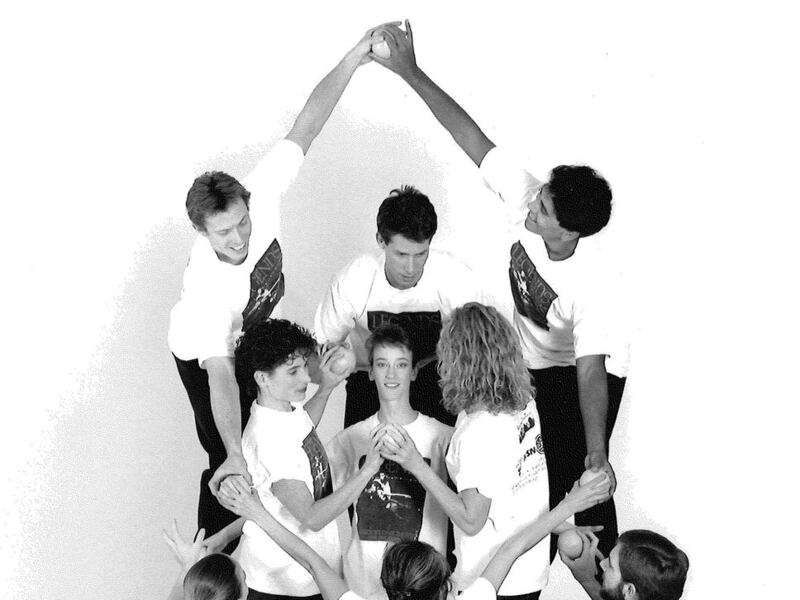
Eight dancers, each with a personal connection to Utah, became the founding members of the company in 1966 and formed an “artistic democracy,” where all the dancers worked together to make artistic decisions. It was an unusual concept at the time, and many in the arts community didn’t expect the company to last long, let alone five decades.
“We were determined not to fail,” Smith said in a recent interview. “We just thought we had been given this enormous gift but also an enormous responsibility to try to make this work.”
The dancers were given the charge from the foundation to be a repertory dance company, one that would preserve modern dance’s rich history and also create new works.
“That’s part of the mission of RDT: to keep those pieces alive,” Smith said. “We have an obligation to learn from history and remember our history and be proud of our history.”
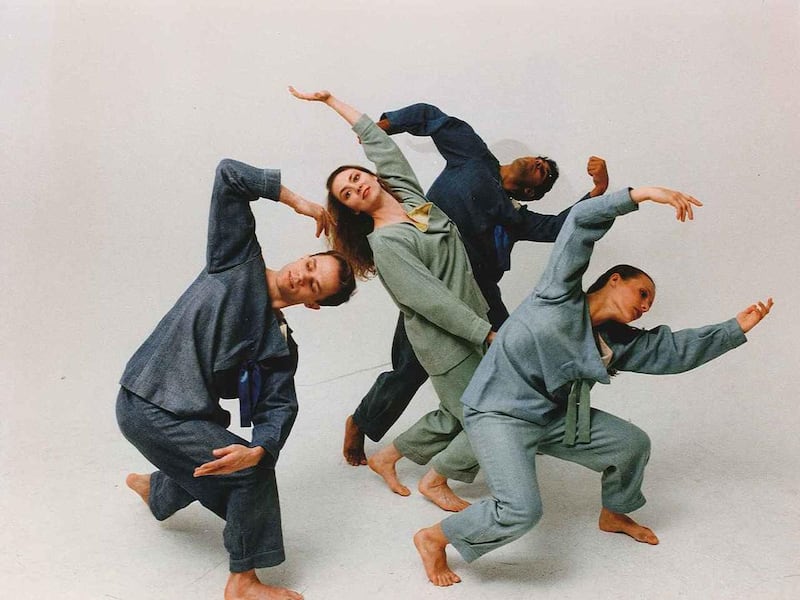
While many dance companies focus on the work of a single choreographer, RDT maintains a rich repertory of both old and new work.
“I don’t think anyone would want to stay painting the same painting of the same person every day,” said Justin Bass, one of the company’s current dancers, making an analogy between painting and dancing. “You want to mix up the colors, you want to use (charcoal) one day, you want to use crayons the next day, and we do that all in one studio.”
The eight original dancers forged a legacy of total dedication to the art and sharing their passion with the community.
“(We) weren’t just 9-to-5 dancers,” Smith said. “We all know that we had to put our hearts and souls and blood and sweat and tears and creativity into building something. We were committed to it. … (Being) given the responsibility to make it work was part of the magic formula.”
After the company’s initial success, the Rockefeller Foundation provided an additional grant. But after about 10 years, RDT was on its own. Smith and her fellow dancers found success through summer workshops and touring, two aspects that remain deeply ingrained in the company’s fabric.
In 1977, the company saw a need to have a few of its dancers oversee the longer-range goals of the company and moved away from the concept of an artistic democracy. Smith became co-artistic director with Kay Clark until 1983, when Smith was appointed as the company’s sole artistic director.
Although she’s been there for every step of RDT’s history, Smith is quick to spread the credit for the company’s success.
“It’s not my company,” she said. “I just have the responsibility and the desire to help make this company live on. We have staff members who help the company, we have board members who help the company … but the real meat and potatoes are the dancers.”
‘Changing lives’
RDT has always maintained a commitment to sharing dance with the community, and Lynne Larson, artistic associate/education director and former dancer for the company, has seen firsthand the benefit of sharing the art.
She was working with a fourth-grade class last year and asked the students to break into groups and create a shape, providing only loose instructions and leaving much of the interpretation to the students.
“One little boy came up and said, ‘Do you mean we get to choose how we want to do it?’” Larson said. “It was like he had won the lottery. … It’s that freedom to be creative within parameters that they don’t get so often that I think provides a different energy.”
RDT’s arts in education services use “dance as a way to help people become more connected, compassionate, aware, inspired, original, focused, courageous, passionate and human,” according to the company’s website. RDT staff members and dancers execute the programs on top of preparing for regular performances. Larson said it often feels as if the dancers work two jobs — teaching and dancing — but she believes it makes the dancers “well-rounded” and gives them valuable teaching experience.
The company runs multiple education opportunities for schools and reaches approximately 25,000 students a year, according to Larson. The programs include lecture demonstrations, or assembly-type performances reflecting the history of modern dance; movement classes “designed to help students build strength, flexibility, endurance, coordination and awareness while developing an understanding of the elements of dance”; and professional development workshops intended to help teachers learn how to integrate movement into their teaching. Additional opportunities are available for dance students in junior high and high school to give them the chance to work with and learn from dance professionals.
RDT also offers 10-12 in-depth residencies to elementary schools in the Salt Lake Valley, according to information from the company. These residencies provide the schools with extended instruction as RDT dancers return on multiple occasions to offer several movement classes, a lecture demonstration and professional development workshops for the teachers. Larson said the company is also starting an in-depth program for junior high schools.
“We take dance and use that as an education form to teach them cooperative skills, leadership skills, and then you get to even implement math and reading, some of these types of things, with a form of movement to maybe reach out to kids that learn in different ways,” said Tyler Orcutt, one of the company’s current dancers. “It kind of reminds us why dance is such an important art form in our daily lives. We’re not (just) dancing; we are changing lives.”
In addition to providing education opportunities in the schools, RDT runs a community dance school for people of varying skill levels.
“Many of them have come because they danced in college and they danced as a child and now that’s their creative outlet,” Larson said.
It’s all a way to give back to the community they have called home for the past 50 years.
“I think we couldn’t have survived if we didn’t have that value,” Smith said.
Pushing the envelope
With 50 years now behind them, the staff members and dancers at RDT see great potential for a continued future.
“I don’t see an end,” Smith said. “I see exciting things that keep emerging for us to try — continually responding to what’s going on in the world.”
She said the company’s future will rest on its past as it continues to preserve and perpetuate modern dance history for audiences of the future, but also that it will continue to seek ways to use new techniques and technology.
“There’s always an envelope to push and a new idea to explore,” Smith said. “There are some things about our company that are still unfolding, and we’re excited to go into the 51st and beyond.”
This season is intended to be a celebration of those ideas. Each of the four concerts — “Ritual,” “Revel,” “Regalia” and “Revere” — begins with the letter R as a reflection of the company’s name. Smith said the programming for each concert includes “brand-new pieces, and we have contemporary classics, and they’re performed side by side.”
One of the pieces in the opening concert, “Pigs and Fishes” by Elisa Monte, is back by popular demand. Smith said the company asked audience members for some of their favorite pieces in RDT’s repertory, and many cited Monte’s piece. Smith said the piece doesn’t have anything to do with pigs and fishes but instead derives its name from a line in the “I Ching,” a Chinese book of wisdom. According to Smith’s artistic statement about the season, it’s “a symbol for perseverance and good fortune both in what you sow and tend to, and also in what simply comes to you when you place your nets wisely.”
Smith believes it’s a fitting piece to celebrate RDT’s 50th anniversary, its legacy and its future.
“We have ‘placed our nets wisely,’” Smith said.
If you go …
What: Repertory Dance Theatre’s “Ritual”
When: Oct. 1-3, 7:30 p.m.
Where: Rose Wagner Performing Arts Center, 138 W. 300 South
How much: $30
Phone: 801-355-2787
Web: rdtutah.org
Email: wbutters@deseretnews.com, Twitter: WhitneyButters