

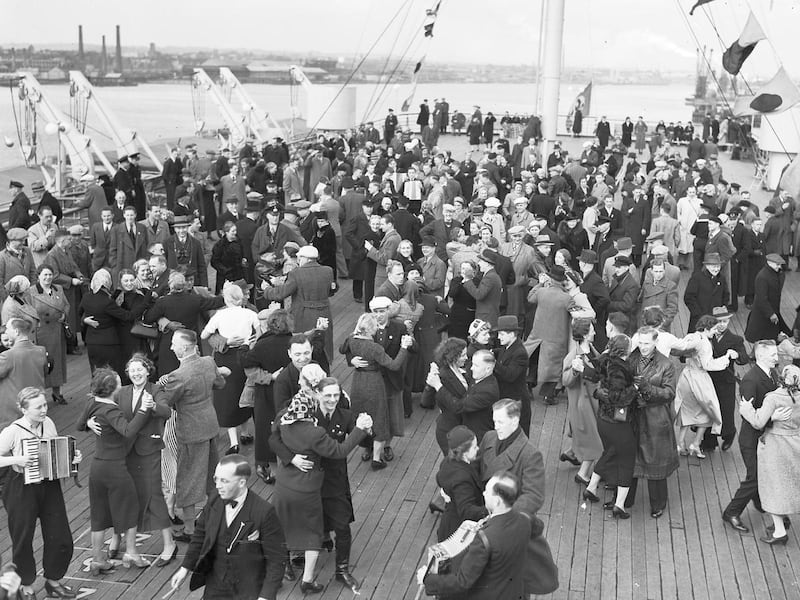

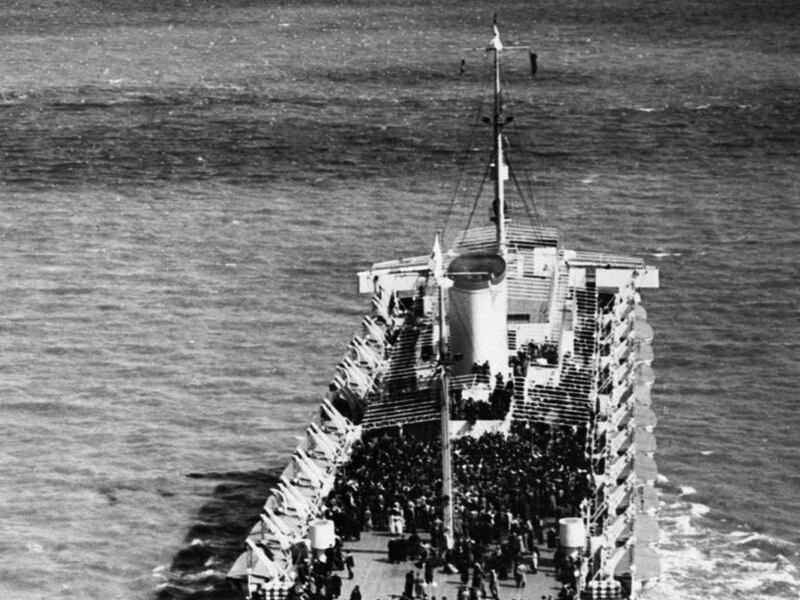
On Jan. 30, 1945, the MV Wilhelm Gustloff, a German military transport carrying refugees, was torpedoed by a Soviet submarine and sank in the Baltic Sea. The exact number of deaths is debated, but historians agree that the event is the worst maritime disaster in history in terms of lives lost.
Since Adolf Hitler had banned virtually all trade unions in Germany after he came to power, the Nazi regime created the German Labor Front not long after. Led by fanatical Nazi Robert Ley, the German Labor Front acted as a sort of catchall labor union for workers throughout the Reich. In order to popularize the new organization, and by extent the entire Nazi regime, the German Labor Front created a program called Strength Through Joy, (Kraft durch Freude), or KdF.
The stated mission of KdF was to provide leisure activities and other incentives for Germany's workers that otherwise they could not afford. KdF organized ski trips, mountain hikes, tickets to concerts and the theater, and other activities. The automobile that would later become the Volkswagen Beetle was originally created as a KdF project, though no Germans actually received the cars they paid for under the Nazi regime.
One project that Nazi leaders felt would show off Germany's wealth and dedication to its people was the commission of a new cruise ship specifically for the KdF program. The cruise ship, which was designed to carry 2,000 workers on holiday cruises throughout the Baltic and North Sea, was completed in 1937 and weighed about 25,500 tons and included five decks.
Originally, the ship was going to be named the Adolf Hitler, in honor of the Fuhrer. Hitler, however, had been uneasy with the idea of a ship named after him. If such a ship were to sink, what would that say about him? So, in 1936 Hitler had proposed that the ship be named in honor of Wilhelm Gustloff, who founded the Swiss branch of the Nazi Party and had been assassinated earlier that year. The Fuhrer's wish was obeyed, and the ship was officially named the MV Wilhelm Gustloff.
In 1939, the ship was appropriated by Hitler's navy, the Kriegsmarine, and redesignated as a troop transport. It aided in transporting German troops back to the Reich after their service in the Spanish Civil War. Soon after World War II began that September, the ship was designated a hospital ship. Since it was largely confined to its port due to the British blockade, it essentially served as a floating barracks for officers and troops at various ports in Baltic Sea.
In 1945, however, the MV Wilhelm Gustloff was pressed back into service. As the Red Army plowed through Hitler's Wehrmacht in Russia and Poland, many German military personnel and civilians found themselves cut off from Germany in Courland, East Prussia. The only way to get these people back to Reich would be by sea.
Historian Ian Kershaw wrote in his book, “The End: The Defiance and Destruction of Hitler's Germany, 1944-1945”: “From mid-January onward, the area became the temporary destination of countless thousands fleeing northward from the path of (Soviet Gen. Konstantin) Rokossovsky's armies and pouring westwards from East Prussia as the province was cut off. … By the end of the month, the area was teeming with close to a million refugees to add to its 3 million population.”
Operation Hannibal had been the brainchild of Grand Admiral Karl Donitz, and the entire effort lasted from Jan. 13 to May 8, 1945. In total, over 2,022,000 people were evacuated by sea from Courland and other areas along the Baltic coast that the Russians did not overrun. Given the stories of Soviet atrocities committed against German civilians and military, which mirrored the atrocities committed by the Nazis against the Soviets, the refugees were eager to flee the oncoming Red Army onslaught. Though the operation was generally successful, the MV Wilhelm Gustloff's role was not.
In the book “Absolute War: Soviet Russia in the Second World War,” historian Chris Bellamy wrote that the refugees boarding the former cruise ship included “1,200 wounded submarine cadets being evacuated as part of Operation Hannibal to save precious U-boat personnel, and a large contingent of young female Luftwaffe staff. To get everyone in, they had drained the swimming pool, which is where the Luftwaffe girls were settling down for the night on what they hoped would be a swift run to safety.”
Aleksandr Marinesko captained the Soviet submarine S-13, stationed in the Finnish port of Hango. Not long before, the captain had been drunk in public, and the NKVD (forerunner of the KGB) wanted to arrest him. Also, it was suspected that he was engaging in an affair with a foreign woman, and his loyalty to Josef Stalin was suspect. His superiors, however, respected his naval ability and convinced the secret police to back off. Now, Operation Hannibal provided the captain with many opportunities to hurt the German war effort, and Marinesko couldn't resist taking a chance at bringing down the lumbering MV Wilhelm Gustloff.
Just after 11 p.m. on the night of Jan. 30, Marinesko fired two torpedoes into the MV Wilhelm Gustloff, which took nearly an hour to sink. One of the torpedoes had the words “for Leningrad” written across it, a mark of vengeance for the German 1,000-day siege of the city that had ended a year earlier and saw many of its citizens reduced to cannibalism in order to survive.
When the Germans protested that the ship had been carrying mostly civilians (which it had), the Soviets publicly stated that they had made a mistake. If the Soviets really wanted to punish Marinesko, however, they had more than enough reasons to do so in their twisted totalitarian logic. But the fact that he was responsible for an atrocity against Germany did nothing to hurt his career. In fact, in 1990 Marinesko was granted the title “Hero of the Soviet Union” posthumously.
So just how many people died as a result of the sinking? Bellamy wrote: “Some 996 people survived, rescued from the icy Baltic. It was widely believed that more than 5,000, possibly 6,000 perished, unable to escape from the grossly overcrowded ship. However, new analysis, using computer modeling in concert with the very detailed blueprints of the ship, tells a different story. Based on analysis of photographs, the Gustloff was carrying 8,000 people more than it was designed to do. … It looks as if there were 10,600 or so people on board. A death toll, in other words, of 9,618.”
To put these numbers into perspective, when the RMS Lusitania was sunk during World War I, the death count was 1,198. When the RMS Titanic sunk in 1912, the death count was roughly 1,500. No matter what the exact numbers for the death count of the MV Wilhelm Gustloff actually were, it was undoubtedly the deadliest naval disaster in world history.
Interestingly, the sinking of the ship that was to be called “Adolf Hitler” occurred 12 years to the day after Adolf Hitler came to power in Germany.
Cody K. Carlson holds a master's in history from the University of Utah and has taught at SLCC. He is currently a salesperson at Doug Smith Subaru in American Fork. Email: ckcarlson76@gmail.com