


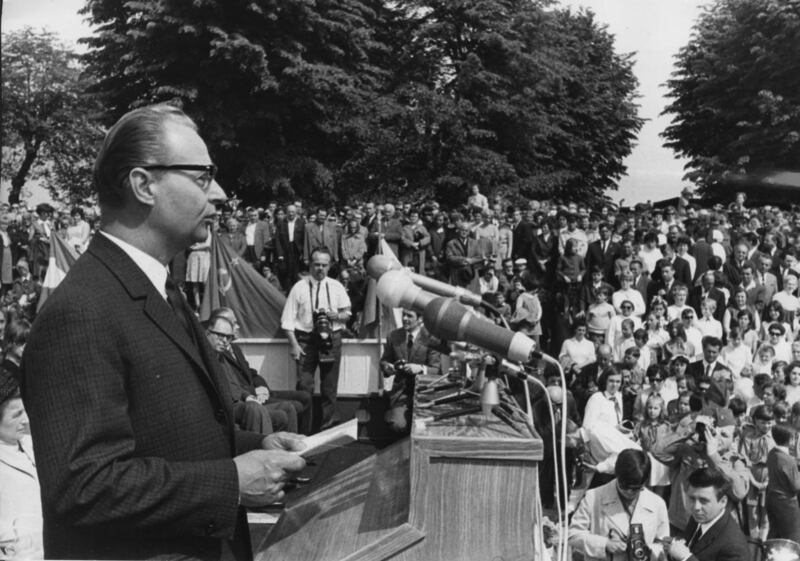
On Jan. 5, 1968, Alexander Dubcek became the first secretary of the Communist Party of Czechoslovakia, replacing his predecessor, Antonin Novotny. The advent of Dubcek began a period of reform in the communist state known as the Prague Spring.
Since 1953, Novotny had been the communist leader of Czechoslovakia and had ruled the country along Stalinist lines. His policies had led to increased centralization of power to the communist government in Prague, the intensification of state propaganda and coercion, and absolute intolerance for dissent. Just like most communist regimes in Europe at the time, Czechoslovakia had a hard time competing economically with the West, and the government had a difficult time getting consumer goods to the people, leading to a stagnant standard of living.
Further, by the 1960s, there was a growing ethnic divide in the country between Czechs and Slovaks. When international diplomats had carved the state of Czechoslovakia out of the Austro-Hungarian empire at the Paris Peace Conference in 1919, they essentially tried to paste two very different ethnicities together as one political unit. As Novotny, a Czech, called for more of what he called “bureaucratic centralism,” more and more Slovaks felt alienated, as though they had increasingly less of a political voice as more and more power concentrated in Prague.
In late 1967, things began to come to a head. Dubcek, the leader of the Slovak faction of the Czechoslovak Communist Party, began to challenge Novotny on his policies. This signaled a real division within the communist leadership of the country. However, could the ethnic division question really lead to a change in party leadership?
Further troubles plagued Novotny. In late October, students from Technical University in Prague demonstrated against the fact that the government cut the number of hours their dorms could keep the lights on in the evenings. The students, who shouted “More lights!” as they marched through the streets, were attacked by the state's security forces and the demonstrations disbanded. Still, it was a wake-up call for the communist leadership, which had thought such student protests only happened in America and Western Europe.
In Moscow, the Soviet leadership looked upon events in Prague with concern and soon decided to investigate the situation. After all, Czechoslovakia was one of the USSR's most important satellite states in Eastern Europe, considering that it bordered the West.
In the book “The Rise and Fall of Communism,” historian Archie Brown wrote, “Leonid Brezhnev, concerned about the division within a Communist Party which had given the Soviet Union little trouble hitherto, came to Prague and attended a meeting of the Presidium on 9 December 1967. He tried to support Novotny without, however, attempting to impose either him or any particular alternative candidate for first secretaryship on the Czechoslovak party.”
In fact, Novotny had hoped for a sure sign of support from the Soviet leader. Had he received Brezhnev's blessing, it is likely he could have weathered the storm of opposition. Brezhnev, however, backed no horse. When Novotny asked him specifically for help, Brezhnev told him to handle his problems however he saw fit. “It's your business,” he told the Czechoslovak leader.
Novotny was now naked before the wolves. The fact that the Soviet leader had so clearly and publicly refused to offer his support was like a signal flare to Novotny's enemies, and soon they began plotting. The reformers and the Slovaks now had their chance. The plenum of the party's central committee convened Jan. 3-5, 1968, and voted to remove Novotny from his position as general secretary of the party. The long-serving leader was allowed to retain his position as president of Czechoslovakia, however.
The plenum voted for Dubcek to become the new general secretary. Sixteen years younger than Novotny, Dubcek had joined the communist resistance to the Nazis in World War II and had been wounded in combat, and his brother had been killed.
In the book “Postwar: A History of Europe Since 1945,” historian Tony Judt wrote, “As leader of the Slovak Communist Party for the past three years, he appeared to many to be a credible compromise candidate: a longstanding Communist apparatchik who would nevertheless support reforms and appease Slovak resentments.”
Dubcek's true politics, however, remained obscure. How far would he support the reformers and Slovaks, and how far would he uphold Novonty's Stalinist state? The Czechoslovak people, however, were optimistic about this new figure, and he enjoyed wide popular support immediately. When the people called for an easing of censorship, Dubcek agreed. When they asked that all of Novotny's followers be purged from the government, Dubcek consented.
The new regime soon coined a phrase to describe their liberalization, “Socialism with a human face” — words that those in Moscow and leaders of other communist states in Eastern Europe couldn't help but bristle at. By March, Novotny himself was more or less forced to resign his position as president. Still, for all of their efforts at reform, Dubcek and his followers remained committed communists.
In the book “The Red Flag: A History of Communism,” historian David Priestland wrote, “Unlike the Hungarian reformers of 1956, the reformers had no intention of dismantling the party-state, or leaving the Soviet bloc. Dubcek had spent much of his childhood in the Soviet Union, and was deeply attached to his Russian elder brothers.”
Within a few months, Dubcek and his faction had crafted a new policy, “Action Programme,” which specifically addressed more freedoms of the press, speech and movement within the Czechoslovak state. It called for more accountability for the police and political security apparatus, and it called for both the Czechs and the Slovaks to enjoy equal political footing within the state. The reformers also sought to introduce limited free markets into the Czechoslovak system, echoing the New Economic Policy under Lenin in Russia and anticipating the reforms of Mikhail Gorbachev in the Soviet Union and Deng Xiaoping in China.
All of this tampering with the tried and true methods adopted by communist states in the preceding decades made the Soviet leadership uneasy. Specifically, they objected to the possibility of multiparty elections in Czechoslovakia that Dubcek had theoretically endorsed. The next several months saw Czechoslovak dignitaries meeting with Soviet officials and representatives from other Eastern European regimes, attempting to explain their reforms within the context of Marxism and affirming their loyalty to the Warsaw Pact and Moscow.
By August, however, Soviet patience ran out. Military forces from the Soviet Union, Bulgaria, East Germany, Hungary and Poland invaded Czechoslovakia with a force of over 200,000 men. Roughly 70 Czechs and Slovaks perished in the action, while many more were wounded. Dubcek and the government reformers were taken into Soviet custody and flown back to Moscow where they were berated for their lack of communist convictions. Dubcek, however, was soon returned to Prague and allowed to retain his post — with widely curtailed powers and influence — for a few more months. Eventually, he was expelled from the Czechoslovak Communist Party.
Dubcek returned to lead the Czechoslovak parliament during the 1989 Velvet Revolution, the movement that toppled the state's communist regime for good. He died in 1992. Brezhnev continued to lead the Soviet Union until his death in 1982, though the last few years he held little practical power due to age and illness. Novotny died in 1975.
Cody K. Carlson holds a master's in history from the University of Utah and teaches at Salt Lake Community College. An avid player of board games, he blogs at thediscriminatinggamer.com. Email: ckcarlson76@gmail.com