
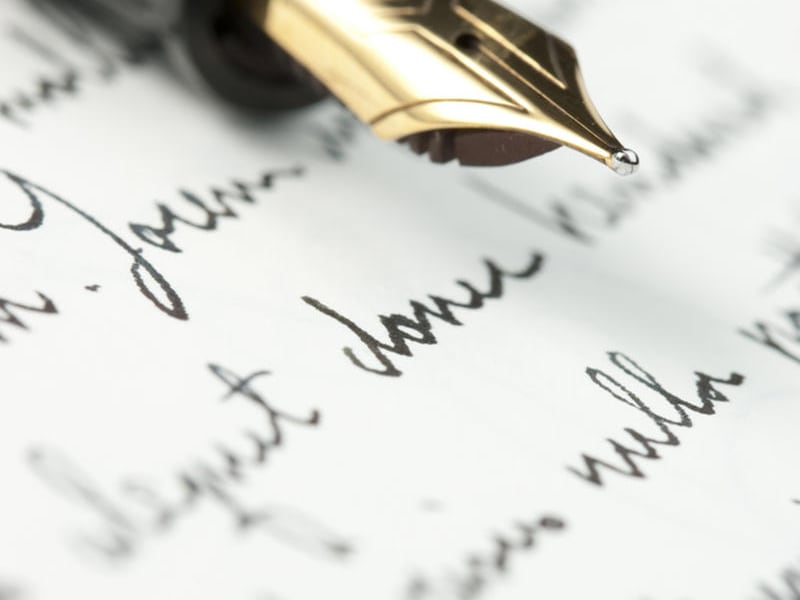
My great-grandfather was known for his wonderful handwriting. And as a missionary in 19th-century Montana, he put that skill to good use. His journal is laced with poetic descriptions of Flathead Lake, poems about home and funny stories about the fleas.
My grandkids will never read any of it.
They can’t read cursive writing.
My mother wrote and received hundreds of letters during her lifetime. When she passed away, we found a secret stash of love letters she’d kept — letters written by my father during the war. He wrote to her about getting married. She had told him she feared giving birth, so — to ease her mind — dad wrote he’d be willing to give birth to all the babies.
My grandkids will never laugh at the joke.
They can’t read it.
I’m happy that some grade schools have returned to teaching cursive writing. But it’s not the writing that matters. It’s the reading.
And here’s why.
When teenagers learn to drive, they often focus on the white lines in front of the car. They must be taught to take the long view. They must learn to not only look far ahead, but to use the rearview mirror as well.
And learning to live is like learning to drive.
You must look ahead. You must see daily trials in a bigger context. But you also need to look behind you. That's where you get your perspective on things. And for the “long view” behind us in life, almost everything — from letters and journal entries to minutes of meetings and talks in church — was written in cursive.
But more than mere information, the writing itself can reveal a departed personality.
In cursive writing, I believe, a person’s soul hovers in the ink.
Years ago, a widower in our ward fell in love. His handwriting was so atrocious, however, that he came by the house to ask my dad to pen a handwritten note to his beloved. My father’s handwriting was strong and manly, filled with flourishes and flamboyance. He wielded his pen the same way he wielded his chorister’s baton. Both embodied who he was.
But before my father could write anything down for the man, my mother jumped in.
“My handwriting’s easier to read than Earl’s,” she said. “I’ll write the note for you.”
And with that, she took her robin-blue ink and penned a note in perfect Palmer method handwriting as the man dictated it to her. Then she proudly handed it to the widower.
He looked at it and shook his head.
“Beautiful,” he said. “Just beautiful. It's like a note from my third grade teacher."
I said earlier, I’m glad some schools are now teaching cursive reading.
As for those students who aren’t being taught the technique, well, that might be a good spot for parents to pick up the slack.
Email: jerjohn@deseretnews.com