

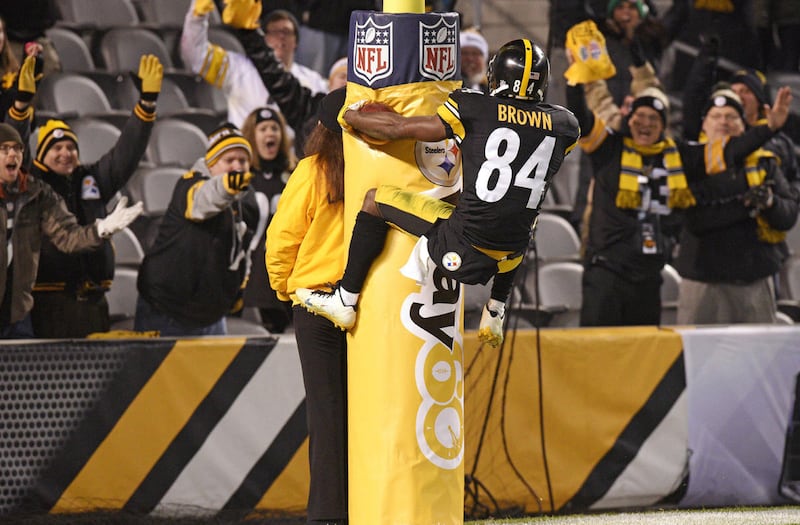

Fans love them. Players love them.
Heck, even the cynical, burned-out, gimme-a-quote-cuz-I-gotta-make-deadline media enjoys them.
In fact, it seems the only people who find post-scoring celebrations an abomination are some NFL coaches and owners who are continually finding ways to reduce the way players celebrate on the field, especially after scoring.
The logic behind the rules is well-intentioned but misguided.
The goal is to eliminate unsportsmanlike behavior – taunting, mocking or just being an arrogant show-off. A lot of coaches and owners see post-scoring celebrations as a distraction to the team concept of football.
Unfortunately, like most rules that attempt to make a subjective call clear and consistent, it fails.
The rules don’t forbid any celebration.
It simply tries to define or limit. Which leaves a lot of gray area for game referees to navigate.
The rules allow some celebration – spikes, dances, and even dunks on the cross bars. The famed tradition of Lambeau Leaps is exempted, as is anything else deemed as a “simple celebration.”
What’s forbidden? Any “delayed, excessive, prolonged or choreographed act by which a player (or players) attempts to focus attention on himself (or themselves).”
Setting aside my desire to debate the fact that football’s very design teaches teamwork, the problem is what sounds reasonable in the boardroom becomes seriously problematic in the field. There are a number of reasons for this, but first and foremost, what coaches and owners see as excessive will probably be completely different than what players see as over the top.
Add to this effort the vastly different personalities charged with enforcing those rules, and it can become downright ridiculous.
For example, Pittsburgh wide receiver Antonio Brown was flagged for twerking (which is a dance move) after catching a pass in the first game of the season. He was fined more than $12,000 and the team was penalized 15 yards on the ensuing kickoff. And while many players said they don’t mind paying to have a little fun, they hate the idea of hurting their team.
On the other hand, officials didn’t penalize Dallas running back Ezekiel Elliott for jumping into an oversized Salvation Army pot after scoring, which, according to league rules, he should have been penalized as he used a prop in his celebration.
While Elliott made a donation as debate flared about his impromptu decision, the video spurred thousands to donate to the charity.
There can be honest disagreement as to whether celebrations are unsportsmanlike or create rifts in team chemistry. But there is no doubt that creative celebrations boost the profile of the player, the team and the sport.
Take for instance the videos of a soccer team in Iceland and their quite elaborate scoring celebration, including one where one player pretends he’s fishing, catches a teammate who flops on the ground like a fish, after which the rest of the players scoop him up and pose for a picture with their prize-winning catch.
It understandably thrilled fans, and of course, encouraged even more creative and elaborate celebrations. Celebrations are mostly meant to entertain and inspire fans, which is why the rules around them miss the mark.
Carolina quarterback Cam Newton, whose never been flagged despite dabbin’, a dance move where he puts his face into his bent elbow (like he’s sneezing), frequently. In fact, he made the move a pop culture craze, which speaks to two things – how much influence players have and how much fans enjoy a good-natured display of joy.
“We all know football is an extremely hard sport to play,” he said a few weeks ago of the apparent crackdown this season. “And I think it’s a reward as a player. …I’m going to stay out of it, but I think we need to keep doing things that will make us celebrate.” I think that’s what bothers me most about the penalties for excessive celebration, which have outpaced last season significantly, is that it’s unintentionally penalizing players for being proud, joyful and exuberant. Limiting and banning them constrict the connection between players and fans, between those who play the game and those who take joy, pride and solace in those efforts.
Professional sports are a job that shouldn’t feel like a job if you want anyone to watch. I would take Newton’s thought and expand it to spectators.
As the league asks fans to pay more money for tickets, to deal with longer games due to more advertising and replay, to put up with mishandling real issues like domestic violence and league discipline, they should be willing to let them enjoy celebrations.
They can still penalize taunting. They can forbid obscene or rude behavior. But shaking hands, dancing, even performing CPR on a football or making a snow angel should be displays of excitement and joy in which we should simply revel.