

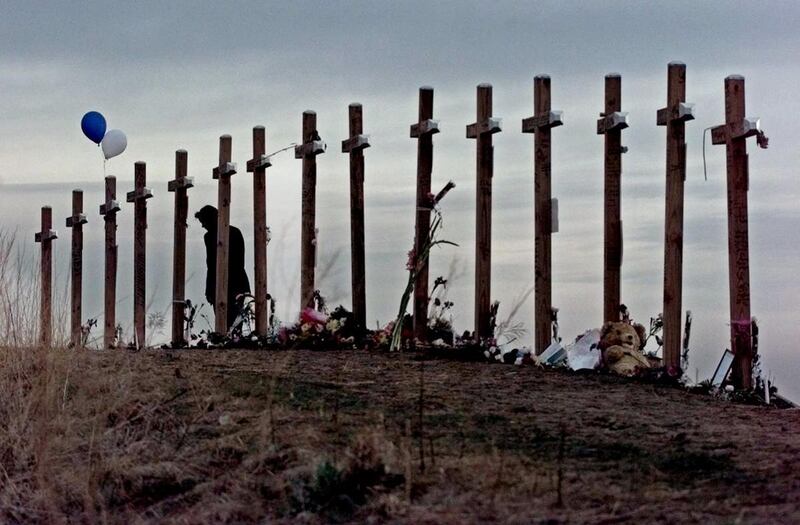

When parents of students at Columbine High School first began to learn a mass shooting was unfolding in April 1999, Sue Klebold was worried that her son might have been injured.
That was followed by word he might be one of the killers, which was followed by confusion, denial, shame, fear and more, according to her memoir of the journey since her son and another student killed 12 students and a teacher and wounded 24 others.
Proceeds from "A Mother's Reckoning: Living in the Aftermath of Tragedy" will go directly to programs and research dealing with mental illness.
"Dylan was never diagnosed with a mental illness when he was alive, but experts, like Dr. Peter Langman, who Klebold interviewed for her book, have studied his journals and video recordings posthumously and said that he was depressed and possibly had schizotypal personality disorder," according to an article in Marie Claire. "Eric, who did go to therapy and was never diagnosed with mental illness during those sessions, is now believed to have had personality traits of a psychopath, writing extensively in his journals about wanting to kill and torture others."
Klebold has been interviewed, second-guessed, lambasted and praised for her look back at what she knew and didn't know before the massacre. And when one digs through all the interviews and headlines, one question emerges every time: Can parents trust their perceptions of their children?
Writes Susan Dominus in a New York Times Sunday Book Review article, "If there is one single, painful, recurring message in Klebold’s memoir, it is that she did not truly know her son — that they were in fact living in parallel universes, one of which was constructed with the elaborate machinery of serious mental illness, or as Klebold prefers to characterize it, 'brain illness.' … When the horror of that day was over, and all the facts had emerged, Klebold had lost both the son she thought she had raised, as well as the person he had actually become."
The disconnect between the life the young Klebold was living and what his parents saw is clear — now. As Dominus describes it, "Dylan, who had plenty of friends — who went to the prom just days before the attack, who still laughed over old movies with his parents — had nonetheless fallen off an emotional cliff; his parents never even saw the ledge. They did not know that he drank, or thought obsessively of ending his life, or was madly in love with a girl whom he wrote about in creepy, mystical terms, ominously declaring: 'It is time. It is time.'
"They did not know that he and his co-conspirator, Eric Harris — who was charismatic, persuasive and, according to the psychological research she cites, most likely psychopathic — had been stockpiling weapons. The crime of which Klebold convicts herself is ignorance, and for that, she feels bottomless guilt. She recalls being dumbfounded when someone asked her if she could ever forgive her son. '‘Forgive Dylan?’ I said. ‘My work is to forgive myself.’"
According to NPR's Terry Gross, "For a long time, Sue was in denial about her son's role in the massacre. She told herself that Dylan had been brainwashed or coerced into the plan — or that he hadn't really shot anyone. But then she saw the "Basement Tapes," a set of videos Dylan and Harris had made in which they brandished guns and bragged about the destruction they were planning, and her understanding of Dylan's role in the rampage changed."
Klebold told Gross that "seeing those tapes was one of the most shocking, dramatically traumatic things that happened in the aftermath of this, because I had been living with such a different construct to try to cope with what I believed to be true."
In the NPR interview, Klebold speaks of guilt: "I felt for a very long time that it must've been something I did, and I went back to ridiculous detail into our past, and I remember at one point sobbing because when Dylan turned 3, I had only put sprinkles on his birthday cake, but when his brother turned 3, I had decorated the cake with icing, thinking, 'It must've been something like that, where he didn't feel equally loved.'"
Ultimately, through time and research, Klebold concluded that "I might've in some way inadvertently contributed to his perception of something at a given moment, but I did not believe and still don't believe that I caused this or caused him to have this perception of himself and his worldview."
In her descriptions of the past 17 years, it's clear that fear has been a strong emotion, too. "In the aftermath of the attacks, the Klebolds and the Harrises kept quiet. (The Harrises have still never spoken publicly.) Sue describes both she and her husband meeting with their lawyer the night of the shootings in the darkness of a convenience store parking lot, fearful for their own safety," writes Marie Claire's Kate Storey. "There were lawsuits against their families within days. And the media immediately began questioning their parenting. How could they have missed something so huge?"
Although she and her husband Tom have not spoken publicly before about Columbine, in its immediate aftermath they wrote letters to those who were injured and to the families of those who were killed. The book's publicity led one of the survivors, Anne Marie Hochhalter, to post a response that has been tweeted and repeated all over the digital world. Hochhalter was partially paralyzed when a bullet hit her spine. She was among those who received a letter from Tom and Sue Klebold, apologizing for Dylan's actions and wishing her healing. It's been published in multiple places, including Self magazine.
Wrote Hochhalter, "I have no ill-will towards you. Just as I wouldn't want to be judged by the sins of my family members, I hold you in that same regard. It's been a rough road for me, with many medical issues because of my spinal cord injury and intense nerve pain, but I choose not to be bitter towards you. A good friend once told me, 'Bitterness is like swallowing a poison pill and expecting the other person to die.' It only harms yourself. I have forgiven you and only wish you the best."
Notes Self's Nina Bahadur: "Hochhalter’s post has gone viral, with over 28,000 likes at the time of writing. Many commenters commended her for her bravery, but others were less charitable. In a follow-up Facebook post, Hochhalter clarified her comments about forgiveness and asked that people keep their negativity to themselves. 'I don’t judge anyone else on their life journey, so I ask that you (strangers) please don’t judge me on mine."
Email: lois@deseretnews.com, Twitter: Loisco