


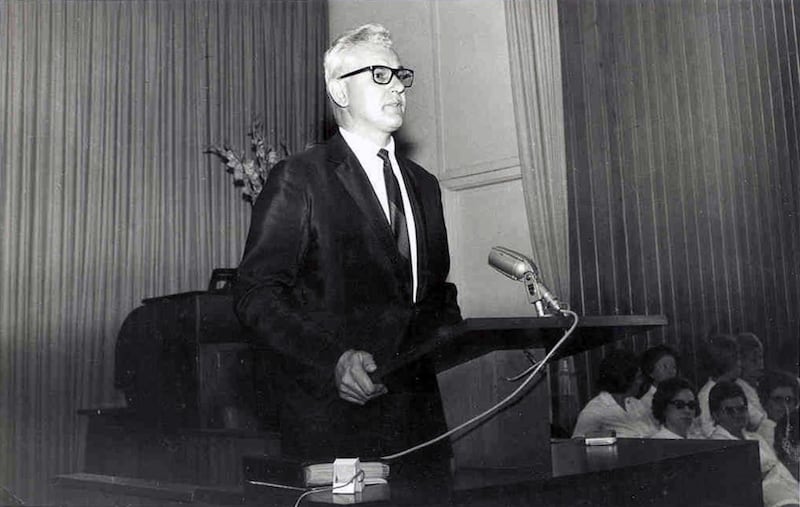


A half century has passed since Antonio Camargo received an urgent, unexpected message to report immediately to the LDS Church's mission home in Sao Paulo, Brazil.
“Put on your best clothes,” the note instructed.
A short time later, a well-dressed Camargo found himself sitting across from Elder Spencer W. Kimball, then of The Church of Jesus Christ of Latter-day Saints' Quorum of the Twelve Apostles. Elder Kimball told the young convert that Brazil's first stake would be organized the next morning — a stake being a grouping of six to 10 local congregations, which are called wards in LDS terminology. Then he asked Camargo to serve as a counselor in the new stake presidency. He accepted the call.
“It was a very humbling experience for me,” admitted Camargo.
For the LDS Church, the May 1, 1966, organization of the Sao Paulo Stake was a truly historic experience. For the first time a “stake of Zion” was operating in a South America.
The story of the church in Brazil — and, to a degree, the entire continent — can aptly be divided as “before” and “after” the forming of the Sao Paulo Stake. Missionaries labored for almost four decades in the country before a single stake was created. Today, a month shy of exactly 50 years after that creation, there are 260 stakes in Brazil.
An apostle's prophesy
Many Latter-day Saints believe Brazil's first stake and the attendant church growth across South America was envisioned by another Mormon apostle, Elder Melvin J. Ballard.
In 1925 Elder Ballard was living in Argentina, working to establish church roots in the region. Only a handful of members from Europe could be counted in all of South America, and his time in Argentina had been largely unfruitful. Still, he envisioned a prolific future, uttering these words:
“The work [in South America] will go forth slowly for a time just as the oak grows slowly from an acorn. It will not shoot up in a day as does the sunflower that grows quickly and thus dies. Thousands will join here... .The South American Mission will become a power in the Church.”
About a year after Elder Ballard's prophesy a small group of missionaries arrived in Brazil. They found a mostly barren field of labor. Five years after a mission was established in Sao Paulo in 1935 there were fewer than 200 members in Brazil.
Counted among that first generation of missionaries was 19-year-old James E. Faust, who would later serve in the church's First Presidency. During one particularly slow year of Elder Faust's three-year mission, there were only three convert baptisms among the 70 missionaries serving in Brazil.
"At the time, our labors were unfruitful and difficult," said President Faust of his mission during the October 2000 general conference. "We could not envision the great outpouring of the Spirit of the Lord which has come in (Brazil) and its neighboring countries in South America, Central America and Mexico in the intervening years."
Despite scant early conversion numbers there was hope. Those who joined the church proved to be among the elect in its early days in Brazil. Future leaders such as Camargo — who was baptized in 1947 — would utilize equal measures of faith and hard work. They worked closely with the missionaries and shared their testimonies with their friends and neighbors. The church began to grow.
Julie B. Beck moved from her Utah home to Sao Paulo in 1958 when she was four years old. Her father, William Grant Bangerter, had been called to serve as a mission president years after laboring as a young elder in Brazil.
Sister Beck, who has served as the church's Relief Society general president, remembers the proselytizing spirit found in the country: “We didn't play school or house like other children — we played missionary.”
President Bangerter's wife, Geraldine, wrote a monthly letter to the Brazilian Relief Society sisters. She ended each letter with the same promise: Vamos Crescer ("we will grow").
By the end of the 1950's membership was approaching 4,000.
Mission leaders such as President Bangerter and, later, President Wayne Beck focused much of their efforts training and developing local priesthood and Relief Society leaders who would direct future stakes and wards in Brazil.
An apostle's visits
In 1964, Elder Kimball and his wife, Sister Camilla Kimball, landed in Brazil. Some 2,000 church members greeted them at the Sao Paulo airport. Banners welcomed the Kimballs and the members sang “Come, Come Ye Saints.”
“When Elder Kimball came through the door of the plane and saw the people and the banner welcoming them his mouth dropped,” wrote President Beck's wife, Evelyn. “It was an impressive sight.”
That memorable airport welcome, along with the apostle's subsequent meetings with hundreds of local leaders and members, perhaps signaled that Brazil was prepared for a stake.
Two years later, Elder Kimball returned. After interviewing dozens of priesthood holders, he called Walter Spat to be South America's first stake president. Osiris Cabral Tavares and Antonio Camargo would be his first and second counselors, respectively.
On Sunday, May 1, 1966, over 1,500 people squeezed into a church meetinghouse to witness Elder Kimball formally organize the Sao Paulo Stake.”There wasn't room inside,” wrote Evelyn Beck. “It was a thrilling site to see so many Saints together.”
Elder Kimball, who would later serve as the church's 12th president, earnestly read some of the proposals for the new stake in Portuguese.
“The people,” she added, “loved him for it.”
A prophesy fulfilled
Brazil's second stake — the Sao Paulo East Stake — would be organized just two years later. Soon additional stake were formed in Campinas, Curitiba, Sao Carlos and Rio de Janeiro.
Elder Claudio R.M. Costa, a member of the church's First Quorum of the Seventy and president of the Brazil Area, joined the church in his native land several years after the Sao Paulo Stake was organized. He and other new members benefited from those locally led, homegrown units.
The Brazil stakes, he said, “provided us with local leaders, better training and access to patriarchal blessings.”
Church history was again made when the Sao Paulo Brazil Temple — South America's first temple — was dedicated on Oct. 30, 1978, by President Spencer W. Kimball. That same year the church president received a revelation that allowed all worthy men to hold the priesthood. His revelation forever changed missionary work and church membership in Brazil, a nation with a large population of African descent.
The 2014 World Cup soccer tournament brought Brazil unprecedented attention. The city of Rio will host the upcoming Olympic Games. Through it all, the church continues to grow. There are over 1.3 million members and 34 missions in Brazil
Even as Elder Costa prepares to celebrate the 50th anniversary of Brazil's first stake on May 1, he eagerly anticipates the next half century in his country.
“My vision for the church in Brazil in 50 years is 1,000 stakes and hundreds of missions.”
jswensen@deseretnews.com @JNSwensen