

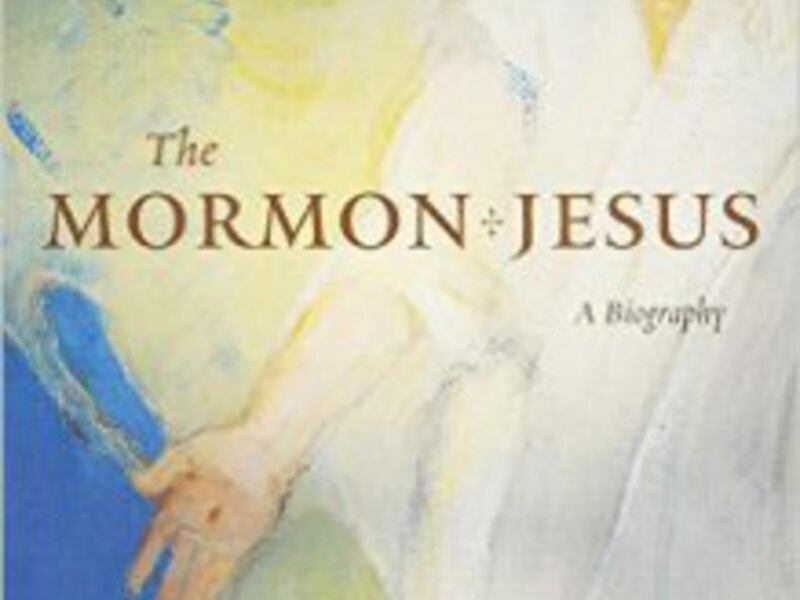
When a book features the word “Harvard” on its spine, expect an important book.
When the other words are “The Mormon Jesus,” expect an important book for members of The Church of Jesus Christ of Latter-day Saints.
And with “The Mormon Jesus: A Biography,” John G. Turner, a religion scholar at George Mason Univeristy and author of “Brigham Young: Pioneer Prophet,” has worked fervently to deliver on that promise.
Richard Bushman, author of the Joseph Smith biography “Rough Stone Rolling,” called Turner’s book “… a lively cultural history of how Mormons have thought of Christ from the Book of Mormon to the Hill Cumorah Pageant.”
Other reviews may be more mixed. “The Mormon Jesus” isn't for everyone.
Early in his introduction, Turner quotes LDS author Terryl Givens: “Mormons insist on the need for gospel restoration,” Givens writes, “but then feel the sting of being excluded from the fold of Christendom they have just dismissed as irredeemably apostate.” Turner, who isn't LDS, adds, “Mormons want to have it both ways. Indeed, the church’s coherence and growth depend on having it both ways.”
The statement does ring true.
I know those members of the church do like to have their cake and also take a bite.
Also there are those who want to be unique but hope to blend in.
Others embrace supernatural thinking but also revere the scientific method.
The list of examples goes on. In fact, the list could include Turner’s book.
With “The Mormon Jesus,” he apparently hopes to be rigorous enough to win favor with secularists, but not so confrontational as to annoy hard-shell members of the church. Needless to say, some scholars will feel he has pulled his punches, while some Mormons may feel offended by his candor. And watching the author try to thread that needle is just one fascinating sidelight to chapters with provocative titles such as “Elder Brother,” “The Jehovah of the Temple” and “The Great White God.”
I realize a newspaper column is just long enough to offer a frustrating synopsis. So, cutting to the chase, you should know this book is driven by information, not flair. If you’re looking to be dazzled, look elsewhere. What keeps the reader engaged here is how candidly and carefully Turner treats topics such as the temple (he calls Mormonism “Temple Christianity” and — echoing Thomas à Kempis — sees the rites there as “a distinctively Mormon imitation of Christ.”) Turner also offers startling quotes from unexpected sources. (It was the first time I’ve read preacher Billy Sunday’s prayer that God save the nation from “… weak-kneed, thin-skinned, pliable, plastic, spineless, effeminate, ossified, three-carat Christianity.”)
Some of Turner’s findings, in fact, can be bracing and even startling. He’s a thorough scholar who sweeps out the corners.
So, would I recommend such a book? Yes. But then, I’m willing to recommend most books. Ideas should never be intimidating. And honest facts are seldom lethal.
In the end, I was especially touched by Turner’s choice of a cover painting. It’s a portrait of Jesus by LDS artist Minerva Teichert, a woman he singles out for special mention and applause in his text. Teichert presents the Savior in soft focus, his face holding ambiguous emotions. He’s not a superhero, not a twin to the fellow up the street or a knockoff of some ancient depiction. He’s a man of mystery and depth; approachable, to a degree; knowable, to a point. In Teichert’s painting, the Savior seems to be slowly making himself known — much like the Savior in Turner’s “The Mormon Jesus.”
Email: jerjohn@deseretnews.com