

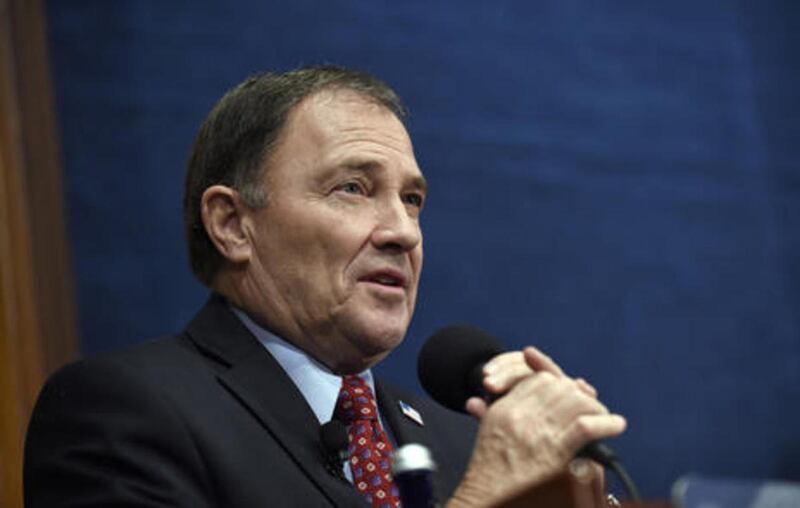

Last week, Gov. Gary Herbert’s re-election campaign unveiled a new fundraising technique — speed-dating for dollars. As the plan was explained, the governor would meet one-on-one with large donors to his campaign. The governor stressed there would be no quid pro quo, but no one really believed that.
Campaign finance has never been pure in American politics. Many people look back at the founders’ day as idyllic. Not so. The biggest expense for campaigning in the late 1700s was the cost of alcohol. When a farmer approached the voting table, he announced his vote (no secret ballot) and then walked over to the candidate’s table to get his reward — liquor.
Campaign costs — broadcast ads, consultants, direct mail, etc. — have mushroomed since those days. The rising costs of campaigning have produced two types of candidates. One is the candidate like the governor who begs for money from rich individuals and corporations. As a former Utah County Realtor, the governor is not super-wealthy. His campaign would argue that he needs to find novel ways to raise cash because he is running against a super-wealthy candidate, Jonathan Johnson, for the GOP primary. And if he makes it through the primary, he faces another super-wealthy candidate, Mike Weinholtz, in the general election.
The other type, however, is, like Johnson and Weinholtz, independently wealthy and does not need to beg for money. Many people view that candidate as “pure” because he or she does not need to beg for money from various special interests. Donald Trump is an example of such a candidate. In fact, he trumpets his lack of reliance on anyone else for funding his presidential campaign.
Yet, the second type is no less problematic. First, there are relatively few super-wealthy individuals. If those people are the only practically eligible candidates, then the nation is poorer because many better-qualified individuals who lack such resources are automatically eliminated from the competition.
Secondly, our campaign finance system means those who actually serve in public office are out of touch with the lives of ordinary Americans. Our elected officials are far wealthier than we are. The Center for Responsive Politics found that it would take the combined wealth of 18 households to equal the net worth of the average member of Congress. The median net worth of a member of Congress is over $1 million. For the average American household, it is under $60,000. This problem is of recent vintage. In 1984, the net worth of the median household and the median member of Congress was about the same.
Much of that change has to do with who runs for office today. Millionaires and billionaires increasingly enter electoral politics because they know they begin with a huge resource advantage — piles of money. Political parties today seek such candidates because they know fundraising won’t be an issue.
Whether we have candidates who must beg others for cash or candidates who are woefully distant from the average American, our system is reinforcing the wrong values. We need a system that gives us elected officials who don’t have to spend a large proportion of their time raising money from interest groups, as well as individuals who don’t need to be super-wealthy.
What is the solution? One reform is to limit the total amount that a candidate can spend on his or her campaign, regardless of the candidate’s personal wealth. That would restrain candidates from requesting large amounts from interest groups, since such transfers would be illegal. It would make the race more competitive since a super-wealthy individual would not enjoy a significant advantage. Unfortunately, such a change needs to come from the U.S. Supreme Court because it has wrongly equated money with free speech. Simultaneously, we should reinstate tax credits for campaign contributions, but cap tax credit-eligible political contributions to $100. That would encourage giving by small donors rather than the rich.
There are ways for us to change our campaign finance system. Until we do, our choices will be limited to the super-wealthy and beggar-candidates expected to provide something in return for money.
Richard Davis is a professor of political science at Brigham Young University. He is the author of "The Liberal Soul: Applying the Gospel of Jesus Christ in Politics." His opinions do not necessarily reflect those of BYU.