



Ever wonder how a baby giraffe survives a 6-foot fall? Or why their tongues are purple? Kids submitted questions for Hogle Zoo giraffe keepers Holly Peterson and Lisa Ellison.
Q. Why do they have horns?
A. They are not true horns. They are called ossicones and males use them for sparring. Males will have much more pronounced ossicones and knobs on their forehead. The fighting causes more calcium to build up so they can look like they have three or four or five horns. That is one way to tell the males apart. If they have big gnarly knobs, then it is probably a male. Females will do play sparring, but it is not as intense.
Q. Why is there hair on their horns?
A. It’s on the rest of their body. Males will rub the fur off.
Q. Why is their skin polka dot?
A. For camouflage. When they are in the trees, it takes several minutes to see them. Once they are moving amongst the trees, it is more dangerous because they don’t see the predators coming as easily. Each sub-species has a unique pattern.
Q. If you shave a giraffe, will the same spot pattern be on their skin?
A. I don’t know. I think if you gave them a buzz, then yeah.
Q. Do giraffes vomit?
A. Yes. They are ruminates — like cows. Their stomachs have four compartments. Their food is regurgitated — it is part of their process
Q. Is there reason their back legs are shorter?
A. It is more of a visual — optical illusion with the sloped back. They are only about 10 percent shorter.
Q. How much do they weigh?
A. Males can run about 2,000 pounds. I think Riley, our only male, is 2,200 pounds. He is over 17 feet tall. The last weight we got on Kipenzi was around 1,400 pounds. Females are around 1,200-1,400 pounds. They can gain about 200 pounds during pregnancy. Willow, our baby giraffe, is 302 pounds at 3 months.
Q. How tall are they?
A. Willow was 6 feet at birth and is 8 feet now. Males are usually 17 feet tall, females around 14-15 feet. I think the record is over 19 feet.
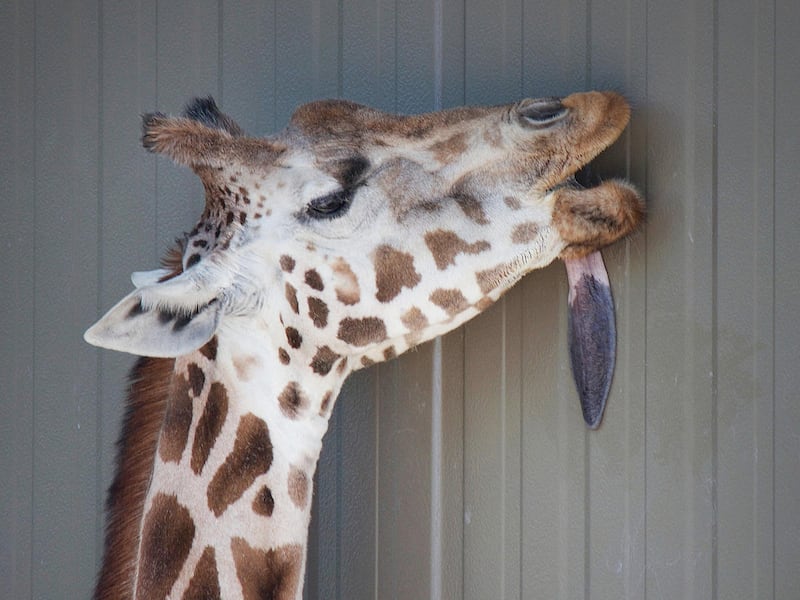
Q. How long are their tongues and why are they purple?
A. That is like a natural sunscreen because in the wild they are constantly sticking their tongues out to get leaves off trees. So if they had pink colored tongues, like us, they would get sunburned. Their tongues are 18-20 inches long. It’s just the bottom 4 inches that is dark.
A giraffe's tongue is rough like a cat's tongue, and they have a really thick saliva that coats everything. Their favorite tree is the acacia tree, which has really long thorns, so they have this sticky, thick saliva that protects their tongues. If they eat one of these thorns, the saliva coats it and that protects when they swallow it too.
Q. Why do they lick?
A. Giraffes are just lickers, but they think it helps produce saliva, which helps with the whole rumination process.
In the wild, they eat all day long. They use those tongues all day long. They wrap their tongues around the tree branch and strip the leaves off.
Q. Do they hunt prey or are they just leaf eaters?
A. Just leaf eaters, but they have been known to pick up bones and suck on them. Some zoos will provide bones for enrichment.
Q. What is their favorite thing to eat?
A. Trees. We give them a pellet that is like cereal that has extra vitamins and minerals in it.
Q. How much do they eat in a day?
A. They eat 75 pounds of leaves in the wild. We give them a bale of alfalfa between all of them, which weighs between 85-100 pounds, and probably 30 pounds of pellets per day.
Q. Do giraffes like to eat flowers?
A. We don’t intentionally feed them, because some flowers can be toxic. I would think yes. Like the flowers from an apple tree or pear tree.
Q. How can a baby giraffe survive a 7-foot drop when it’s born?
A. The umbilical cord on a giraffe is three feet so they have to break that when they fall. A baby giraffe is about 6 feet tall when it is born so it doesn’t come flying out of mom. They don’t come shooting out. It is a gradual thing. They only falling a few feet — maybe 3 feet. The impact helps initiate breathing. Like a doctor slapping a baby on the butt. We provide a birthing stall so they are not falling on a hard surface.
Q. What’s the gestation period for a giraffe?
A. It's 15 months.
Q. How do they sleep? Standing up? Leaning against the fence?
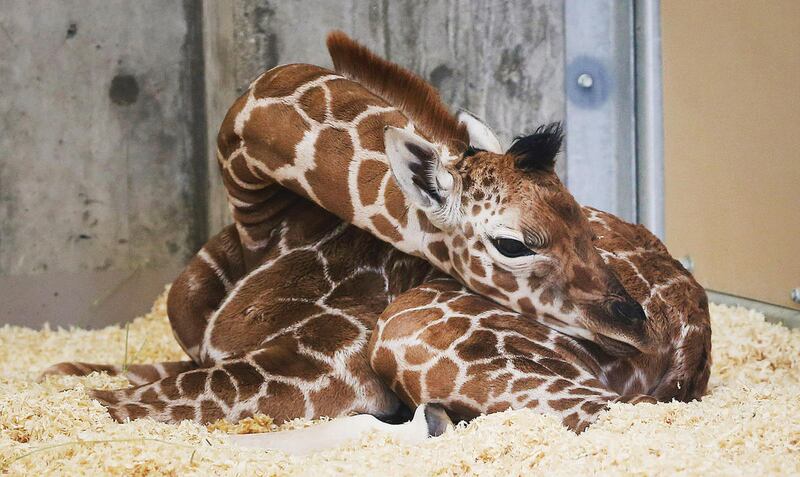
Giraffes have one of the shortest sleep times of most mammals. They sleep maybe a total of two hours. They take short naps. In a zoo setting you will see giraffes lying down a lot more than you would in the wild. When they are sleeping they curl their head and their neck and rest it on their hip so that is how you know they are sleeping. Sometimes we see them standing and they are zoned out, so they are awake, but zoned out.
Daphne (Hogle’s oldest giraffe) is 31 and is leaning more.
Q. Do baby giraffes need more sleep?
A. Willow, a female born Jan. 13, 2016, to mother Pogo and father Riley is growing a lot. Baby giraffes want to conserve their energy, because that’s what a predator is going to hunt — a calf. They are easier to take down than an adult giraffe that can kill them by kicking them. So baby giraffes will lie down a whole bunch to conserve energy and push it all toward growing.
Q. How does it drink without getting a blood rush to its head?
A. They have special valves that control blood flow so their brains don’t explode from blood rush.
In a zoo setting it can make it challenging because one of the easiest places to draw blood from an animal is their jugular, but if you’ve got valves that pinch things off, it is challenging to train a giraffe for blood draw. We have to use a jokingly small needle to do a blood draw.
Q. Can giraffes swim?
A. No. They can wade.
Q. What sound do they make?
A. They don’t make a lot of sound that we hear. They can scream, they can moo or make a bleating noise. You mostly hear it when they are distressed.
Q. What is their top predator?
A. Lions — besides people. But if you ask Riley, our male giraffe, it is ostrich and zebras.
Q. Can you have a giraffe for a pet?
A. No. Please don’t.
Q. I’ve heard that giraffes don’t sweat. Is that true?
A. Not like in human terms, no. Their surface area is huge, so they are built to give off heat. Their skin is pretty oily and greasy.
Q. Do giraffes smell bad?
A. Males will give off a musky odor.
Q. How fast can they run?
A. Thirty-five miles per hour in short bursts.
Q. How long do they live in the wild vs. zoo?
A. Fifteen to 20 years in the wild, 25 in a zoo. So Daphne turning 31 is a pretty big deal.
It is hard out in the wild. A drought will impact them. Habitat loss limits food supply.
Q. Are they endangered?
A. Rothschild is listed as endangered. It is expected that all giraffes will be. In the past years they have gone from 140,000 to about 40,000.
Q. How do giraffes mostly act?
A. Typically they are pretty calm. They’re just standing there chewing their cud. That’s how I know they are doing OK.
Q. Is it fun taking care of giraffes?
A. Yes. Absolutely. Sometimes I wish they could speak English so I can say, “What is going on here?” It is different every day.
They are a nice pace. These guys are a little slower (than the monkeys or sea lions) so when you are training them you don’t have to be so fast.
Q. Did you always want to work with giraffes when you started?
Lisa Ellison: I just wanted to work in a zoo. When they wanted me to train over here, I thought, I don’t want to train a giraffe. I was happy doing hoof stock and the SAB (small animal building). You quickly fall in love with them.
Ellison has worked at Hogle Zoo for 17 years.
Holly Peterson: I wanted to work with the big cats. Everyone wants to work with cats. I started in giraffes with the previous primary before me and I loved it. Then I got trained in cats and thought, their poop just stinks! You know, you look at those big brown eyes and ... ahhhh.
Peterson has worked at Hogle Zoo for 11 years.
Feed a giraffe:
Starting this summer you can feed a giraffe at Hogle Zoo.
COST: $5 for nonmembers, $4 for members at Twiga Terrace.
VIP EXPERIENCE: Longer encounter with a keeper and giraffe: $175 for four people.