

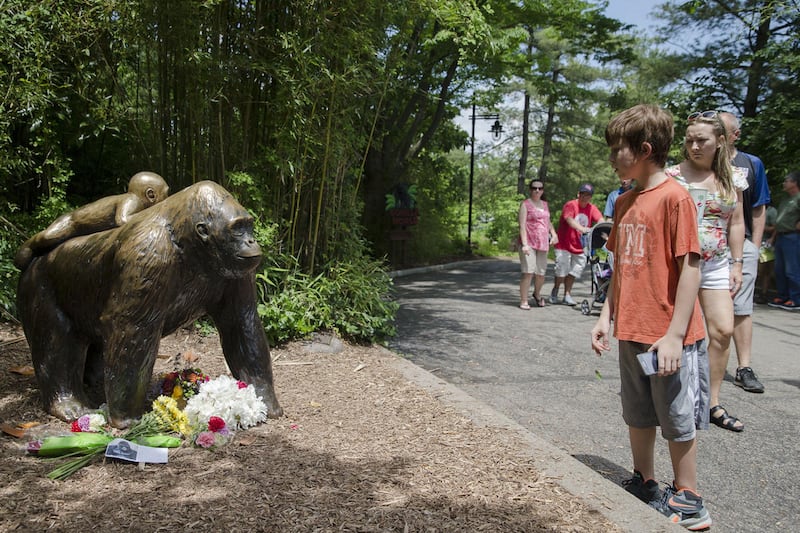
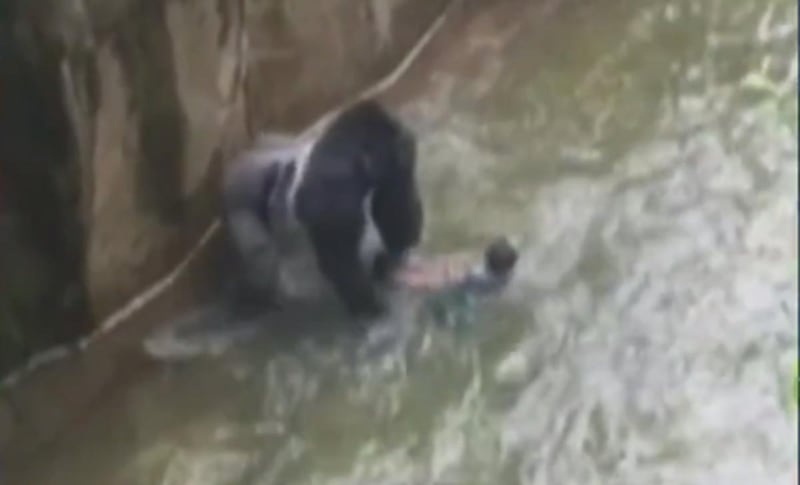
It’s been over three months since Harambe the gorilla was shot and killed by a Cincinnati zoo worker in order to protect a 3-year-old child who climbed into the animal’s enclosure. But we’re still talking about it.
The seeming immortality of Harambe the dead gorilla has caused many to speculate on what has made the meme so enduring and pervasive.
The Boston Globe reported that the internet’s interest in Harambe, as measured by Google searches for the gorilla's name, initially peaked May 31, three days after his death, and then quickly dropped off. However, the name’s popularity began to rise again in mid-July, with searches of “Harambe” steadily increasing throughout August.
The New York Times also commented on the Harambe incident’s popularity, explaining that in actuality, “the meme’s life span is not so unusual (the Rickroll turned 9 years old this year, and the Crying Jordan meme just won’t die) — but the sheer mainstream scope of it is.” Many have documented the astounding variety of conversations Harambe has entered from political to darkly humorous to completely absurd.
As the Deseret News previously reported, Harambe’s death sparked initial controversy between animal rights activist groups and empathetic parents. Some blamed the gorilla’s death on the child’s parents while others claimed the zoo acted appropriately and that the child’s parents should not be implicated.
But the debate quickly became about so much more. Vox.com noted that several outlets labeled the national reaction to Harambe “sexist and racist” because “the public seemed to value the life of a gorilla more than the life of the endangered child or the safety of his mother, both of whom are black.”
And it didn’t take long for the conversation to move far afield from the actual incident itself, sparking memes that place Harambe at the center of a variety of current events. For instance, the Boston Globe depicted an “I’m with Harambe” logo in the style of Hillary’s campaign posters as well as a Photoshopped image of Olympic gold medal swimmer Michael Phelps raising a sign that proclaims Harambe’s innocence.
Moreover, Vox also reported that “currently there are online petitions to erect a White House statue of Harambe, make him a Pokemon, put his face on the $50 bill and change the name of Cincinnati ... to Harambe City.”
Why have our prolonged conversations about a dead gorilla continued into this absurd realm?
Vox hypothosized that the unresolved ethical questions underlying Harambe’s death eventually lead to “outrage fatigue.” When the internet became drained by the difficulty of maintaining such heavy conversations, they shifted their focus to more lighthearted (and non-sensical) contexts. This ultimately created what The Atlantic recently called, “the perfect meme” because it became a symbol capable of conveying any meaning in any situation, be it sincere and political or tongue-in-cheek.
Should we still be talking about Harambe? That appears to be one more debate surrounding the topic. The New York Magazine insisted there is nothing funny about dead animals and the Cincinnati Zoo itself urged people to “stop making memes of our dead gorilla.” But The Atlantic suggested that any “substantive and creative collective response,” no matter how weird, is worth celebrating.
EMAIL: lfields@deseretnews.com; Twitter: @lorann89