





ELBERTA, Utah County — When he gambled on getting into the dairy business in 1972 with 130 cows, Wayne Bateman never expected to see his farm get so big.
"Not in the least; I had no idea," Bateman said as he gazed across hundreds of acres of corn growing on the west side of Utah Lake.
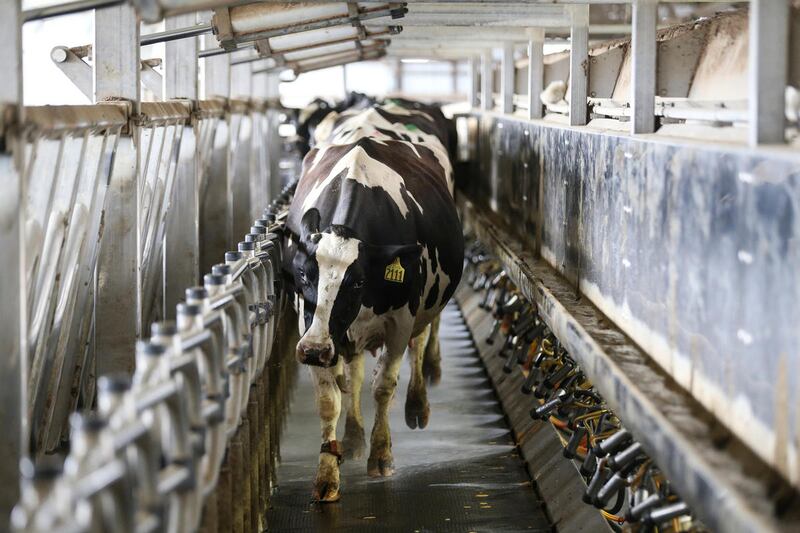
Bateman's Mosida Farms now has 16,000 cows. Seven-thousand of them get milked every day, churning out a daily deluge of 92,000 gallons of milk — about 18 percent of all the milk sold in Utah.
The little family farm has turned into the biggest dairy operation in the state.
Now, with the flip of a switch in early August, Bateman's farm has gone solar in a very big way. An array of solar panels almost twice the size of a football field will provide power that Bateman hopes will save money and keep the huge family business in operation for future generations.
"It's not just a farm," he said. "It's our family. It's a way of life."
Here's the thing: All that milk needs a lot of juice — electricity, that is. And it's not cheap.
"We spend upward of almost three-quarters of a million dollars a year to run the farm and the dairy," said Wayne's son, Lance Bateman.
In the middle of the farm's growing cornfields, Lance Bateman pointed out the biggest kilowatt guzzler. It's a nest of huge groundwater pumps that feed the irrigation system. The pumps pull water from deep underground and put it on the crops that feed the cows.
"This is what makes all the green grow," he said.
In the computer-controlled milking barn — where milk is collected, monitored electronically and chilled instantly from 102.5 degrees to about 37 degrees — electrical systems use enormous amounts of power. It's one of the farm's essential ingredients.
"It's very important," Lance Bateman said. "That's what makes everything work and flow."
The Batemans have tried to save energy over the years. The milk-cooling system, for example, spills so much waste heat that employees informally use it to dry their clothes.
In the wintertime, that waste heat gets put to good use: Fans blow it back into the milking barn to keep the cows warm without any additional heating.
The latest innovation, a 600-kilowatt solar energy array, is impressive for a family business.
"Yeah, this is very good-sized for the state of Utah," said Billy Sorenson of RS Energy, the company that installed the solar panels. "It's probably the largest one, agricultural one, for the state of Utah."
The panels are expected to generate 950,000 kilowatt-hours per year. That's enough juice to power nearly 200 family homes. Instead of powering homes, it will provide about 20 percent of the Bateman farm's annual electricity demand. The family hopes it will be a hedge against rising electricity costs.
"You have to look to the future," Wayne Bateman said. "If we want to survive here, if we want to do what we do, if we want to have children, bring children in, you have to look to ways you can do things better."
The total cost of the solar project is about $1.4 million, but two-thirds of that is covered by tax incentives and grants from the state and federal governments, and from Rocky Mountain Power. The Batemans' move to solar power wouldn't have happened without those incentives.
"We couldn't have made it," Wayne Bateman said. "It wouldn't have penciled out."
Sorenson pointed out the obvious: The tax incentives have been great for the solar energy business.
"This is a perfect example of tax credits building something," he said, "and being used properly and efficiently, too."
The Batemans hope to eventually add even more solar power if the first project works out as they expect.
Even with government help, it was a big investment. But the family thinks it will pay off in the future, just like that initial gamble Wayne Bateman took nearly a half-century ago.