



Most secular as well as sacred history seems to be told in cycles. People and cultures achieve a certain degree of affluence and become prideful and selfish, causing their inevitable decline. But with the decline often comes a humility that spurs a new cycle of hard work and initiative leading back up to success.
It is a cycle that happens with individuals and with families as well as with whole cultures.
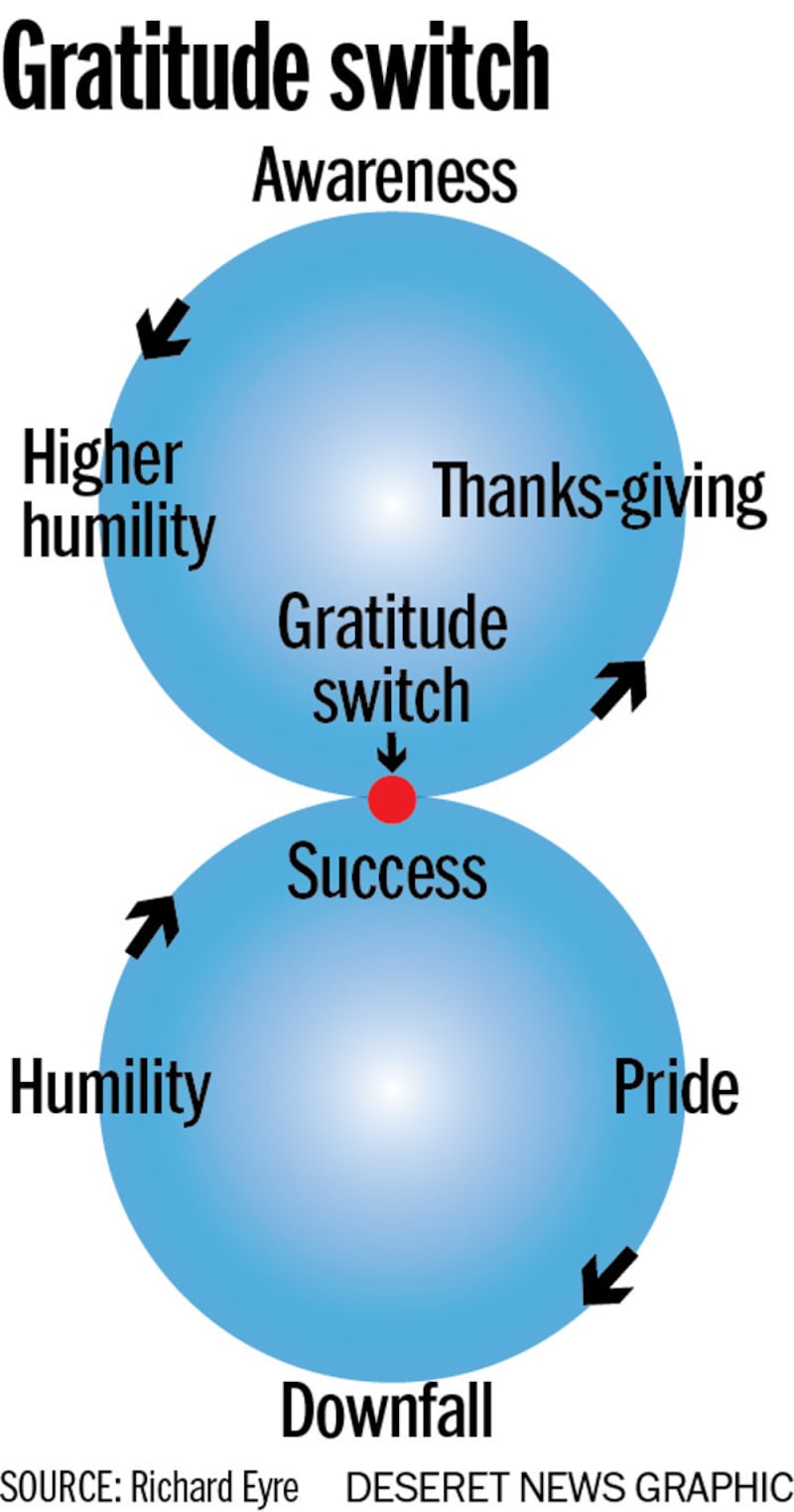
Particularly in the Bible and in the Book of Mormon, we read again and again about a group of people rising to success and prosperity only to have that abundance precipitate the pride that leads to downfall and failure, which in turn finally produces the humility that allows a turn-around back to hard work and additional growth and success. The cycle looks something like this:
Sometimes the cycle takes years, and sometimes it can happen very quickly. One busy mom of young children told us she sometimes goes through the whole cycle in one day.
The question is, can this seemingly inevitable cycle be broken? Or is it destined to repeat itself over and over in the life of a nation, of a society or of an individual family? And from a parent’s standpoint the question is, can we raise kids who are motivated and live up to their potential but who also learn humility so that they do not become affected or prideful or entitled by their successes?
One intriguing scripture says, “because ye were compelled to be humble, ye were blessed, do ye not suppose that they are more blessed who truly humble themselves. …” (Alma 32:14).
How do we choose to be humble? How do we humble ourselves before we are humbled by the downfall that always follows pride? How do we bring ourselves down before we are knocked down? And how do we teach our children to develop a more humble attitude as they grow and achieve rather than developing the entitlement attitude that affects so many kids today? How do we help them feel blessed rather than proud?
The scripture says we can humble ourselves through God’s word, and for what it is worth, we think there is an antidote to pride and entitlement, which also serves as a seedbed for humility. It is a simple quality, and one that we give lip service to all the time but one that has to be worked on if it is to grow and stay with us.
The antidote and seedbed is gratitude. Simple, basic thankfulness can be developed by everyone. It can be practiced. It can be taught. It can be exemplified. And it can be contagious.
And in its genuine form, gratitude always leads to humility. And humility, as suggested in the cycle diagram, almost always pulls us up and toward hard work and success in worthy endeavors.
Here is one way to conceptualize it. Think of gratitude as the track-switching mechanism in a railroad track. By pulling a big lever, you can slide the switching rails from one position to another so that the train goes left rather than right.
If you pull that gratitude lever at just the right time — right at the blessed, happy and successful part of the track, your train can turn up toward thankfulness and on around to a higher humility rather than going down and around to pride. Then you get yourself on a new, higher loop — a positive cycle where more blessings produce more gratitude, which breeds greater humility and which leads to more true success and blessings.
We feel that gratitude is an art and a skill. And it can become, with practice, a beautiful habit. During this fall, and leading up to the Thanksgiving holiday, we are planning to write more on thankfulness and on gratitude and thinking with you about how we can each honor and preserve this favorite holiday of ours and keep it from getting lost between Halloween and Christmas. And also about how we can all be better at using the word as a verb: thanks-giving.
Richard and Linda Eyre are New York Times No. 1 best-selling authors and founders of JoySchools.com who speak worldwide on family issues. Their new books are “The Thankful Heart” and “Life in Full.” See valuesparenting.com or eyrea