



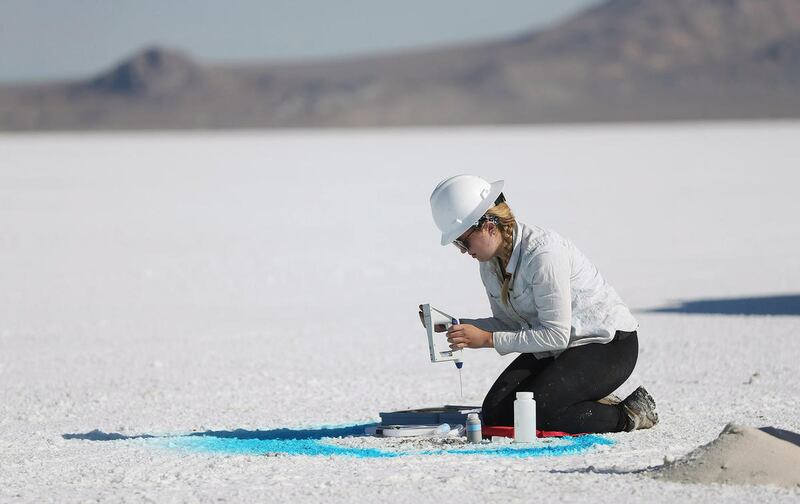


WENDOVER — From the speed racers who fear the clock is ticking for Utah's famed Bonneville Salt Flats to Bureau of Land Management officials seeking new ways to better preserve the worldwide destination, Brenda Bowen knows "all eyes" are on her research.
"It's exciting. It makes us aware that the science we're doing matters to a lot of people," the University of Utah geologist said. "But it's also a lot of pressure, so we're being as careful as we can."
While satellite images analyzed by U. researchers show the white plains have receded over the last 30 years, they only tell a "2-D story," the professor said, and there's little scientific knowledge of what could be contributing to the flat's transformation.
It's been nearly 15 years since the thickness of the flats' salty crusts has been measured — so BLM officials say more data is needed to delve deeper into the issue.
That's why Bowen and her team of about a dozen students began their field work Monday, aiming to drill out core samples at 70 different sites throughout the flats this week. Tuesday marked day two.
Their work is due to be completed in 2018 — a report BLM officials hope will answer unanswered questions about the salt flats' complex geological and chemical system and how to keep it an economic and recreational boon in Utah for generations to come.
"There's so much we don't know, so the more science we can have at the table, the better off we'll be," said Matt Preston, manager of the BLM's Salt Lake field office. "We want to make sure anything we're permitting is supporting the vision of what future generations need to continue to recreate out here."
But speed racers like Dennis Sullivan, chairman of the Utah Alliance to Save the Salt, say BLM officials have already taken too long to mitigate the Salt Flats' demise, and the flats simply can't wait until 2018.
"By then there won't be any salt left," Sullivan said. "The salt's so thin. We're literally scraping to find a course."
After two years of canceled races due to thin courses and wet conditions, Speed Week returned to the Salt Flats last month — but it was a bittersweet return, Sullivan said.
"It was a horrible course," he said, adding that some areas were so rough that they damaged suspensions, broke nose pieces off streamliners, and even sent some racers packing, reluctant to risk damage to their vehicles.
On Saturday, World of Speed will also be returning to the Salt Flats, but Sullivan worried "this may be the last year you see any activity on the salt."
He said the life is literally being sucked out of the Salt Flats by Intrepid Potash, a mining company that extracts potassium from brine beneath the flats.
Even though the company has pumped over 5.3 million tons of salt brine back onto the flats since 1998 as part of yearly mitigation efforts, according to BLM records, Sullivan believes it's not enough. He added that the BLM shouldn't need any more studies to realize more mitigation needs to happen, noting geologists in 1997 concluded racer's worries — that the Salt Flats were shrinking.
"How many studies do you need to do before you do something?" Sullivan asked. "Having study on top of study and nothing being done is a waste — a waste of money, a waste of manpower, and it's stall tactics as far as we're concerned."
But Preston said Intrepid is already pumping more salt-infused water back into the Salt Flats than it uses, plus it's limited by the amount of water it can pump from its wells. Not to mention, he said, a problem can't truly be fixed if it's not fully understood.
Bowen said the Bonneville Salt Flats are a dynamic system likely affected by a combination of factors, including resource extraction like mining, or weather, since rainy summers — like the past two years — can stifle salt buildup.
"The salt lay down project might be adding a lot of value to the Salt Flats, but it might even be hurting the salt, we don't know," Preston said, noting that the water being used to transport the salt could also be dissolving the crusts.
"Sometimes it's an obvious answer, but sometimes it's not. We're still trying to figure out what else we can do."
Email: kmckellar@deseretnews.com
Twitter: KatieMcKellar1