

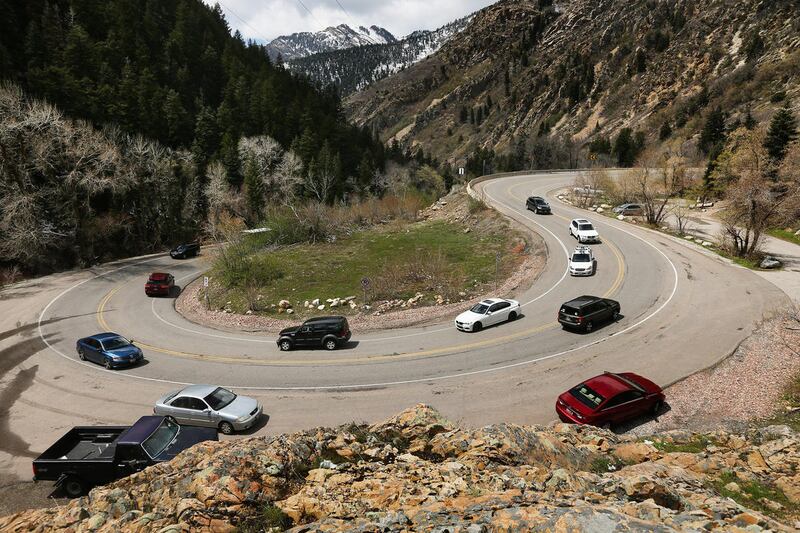
We call on political leaders to put parochial concerns aside and implement solutions to solve the traffic problems plaguing Big Cottonwood Canyon.
When a team of engineering students at the University of Utah was commissioned to look into ways to better manage traffic in Big Cottonwood Canyon, faculty advisors instructed them to ignore “political barriers.” The students came up with a compelling and well-thought-out argument for the use of variable tolls and increased mass transit — proposals that have certainly been floated before. There are of course other worthwhile ideas to alleviate the bottleneck. But in the real world, where political barriers exist en masse, good ideas get stuck in traffic and progress is frustratingly slow.
Even after decades of analysis and planning and the formation of commissions and coalitions and the signing of various agreements and accords — all aimed at addressing congestion in the canyons — the road and traffic conditions are still getting worse. The impressive work of the engineering students at this point only offers more evidence that solutions are much easier to come up with than to actually implement.
The Mountain Accord, a sweeping agreement forged among about two dozen entities to settle conflicts over management of the Central Wasatch Mountains, was signed in the summer of 2015. It called for the creation of an interjurisdictional government agency called the Central Wasatch Commission to begin implementing plans emanating from objectives outlined in the Mountain Accord. That commission is yet to be formed, as the various local governments and other parties involved continue deliberations.
We had hoped that the signing of the accord would help transition discussion into decision-making. But as the students in the traffic management project discovered, the labyrinth of competing and overlapping interests is, in itself, a formidable roadblock to even simple changes. As one of the faculty advisers asked, “Isn’t it amazing how many practical things are squashed by political considerations?”
The student project was commissioned by the Big Cottonwood Canyon Community Council, a coalition of private interests acutely concerned with preservation of the canyon. It is a group, however, that has no actual authority to implement any policies. Just who has that authority is a question without a clear answer as we await the creation of a commission or some other entity that actually will be given such authority. Beyond that, it’s not a certainty that such a commission will be able to forge agreement on land-use policies and other directives among competing constituents and stakeholders.
Nevertheless, the work of the engineering students is impressive. It outlines the beneficial impact on traffic and use patterns that variable tolls would have and it documents the benefits of increasing mass transit service in the canyon. The students assigned to the task are pursuing engineering degrees with an emphasis on environmental studies. Given their experience in the canyon study, a minor in political science may have also come in handy.
Moving forward, however, community-driven solutions need to take a front seat to prolonged political maneuverings.