

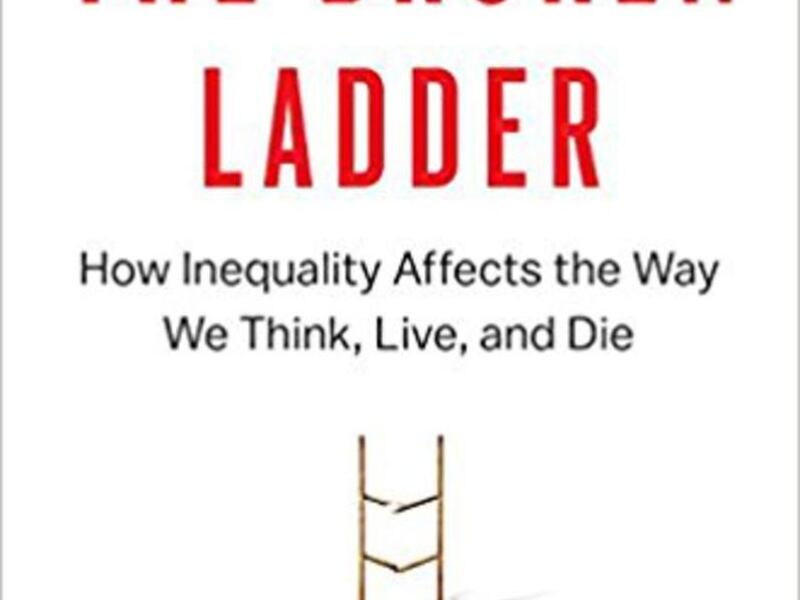

"The Broken Ladder: How Inequality Affects the Way We Think, Live, and Die," by Keith Payne, $28, 256 pages (nf)
Utah is an outlier in almost every measure of inequality detailed in psychologist Keith Payne's new book, "The Broken Ladder: How Inequality Affects the Way We Think, Live, and Die."
Compared with the rest of the county, Utahns have lower health and social problems, such as violent crime, teenage births, infant mortality, obesity and mental illness, as well as higher life expectancies. The reason? Utahs also have lower income inequality than most states, which, Payne argues, is a buffer against many of society's most polarizing contemporary issues.
But Payne's book isn't about Utah. Rather, it's an in-depth look at inequality in America and beyond, and even more importantly, the effects of how people perceive that inequality.
Payne argues that the mere perception of inequality — feeling lower on the social ladder than another person, regardless of fact — drastically changes the way people act, think, and feel, often in predictable ways.
Explaining that while poor decisions are a factor in keeping some of the low-income population where they are, Payne argues that there is also a complex network of human instincts, social conditioning, societal structures and chance that contribute to some of those same decisions, and can be detrimental for both the rich and poor alike.
To make this point, the author blends facts, his personal stories growing up in a poor household, and current social studies, all the while driving home his belief that inequality must be addressed and eliminated.
While acknowledging his biases, Payne points to some Republican politicians that he believes have had an adverse effect on national inequality, but attempts to take a middle-of-the-road view, backed up by data, and gives people the benefit of the doubt.
The ending of the book is also refreshingly non-partisan, though readers may be able to guess how the author leans. Instead of focusing on the hot-button political issues that dominate so much of today's popular culture, like tax rates and minimum wage, Payne points to small, personal changes individuals can make to remedy some of the problems caused by inequality.
Some solutions he cites include being more mindful of the comparisons we make to others, moving to neighborhoods with lower levels of inequality than others, recognizing the impact of chance on some of our successes, and doing what we can to contribute to people who are below us on the ladder, either through charity or creating a more balanced pay scale for employees.
If Americans can be a little more mindful of our inherent biases and emotional impulses, he argues, the country may have slightly better chance of becoming more like a state such as Utah — with its high life expectancy, fewer social problems, and low inequality — but only if the state can hold on to what makes it so unique in the first place.
Brittany Binowski is a senior web producer for Deseret National. You may contact her at bbinowski@deseretdigital.com or tweet her online @binowski.