


SALT LAKE CITY — Before losing 65 pounds over the past two years, Kami Clark had forgotten what it felt like to live life at a healthy weight.
It was better than she imagined.
"You don't know what you don't know," Clark said. "I didn't know how good I would feel at a healthy (body mass index) until I got there. … And people forget."
The pervasive drag of an unhealthy lifestyle, she added, "comes on so slow."
The 39-year-old South Jordan woman's journey back from obesity has led her to become a health coach.
Clark knows from a lifetime of experiences struggling with weight, beginning in "first or second grade," she says, that people simply lose sight of the constant physical benefits of being in shape.
She knows she's doing her job well when she starts to "awaken (clients) to the difference that they could have in their life."
"My questions are: When was the last time that you were at a healthy weight, and do you remember what that felt like? Is there anything you would like to do now that you don't do because you don't feel good?"
The problem Clark endured for many years — and now tries to help others solve — is not uncommon. Public health experts are alarmed at projections that Utah's obesity rate is projected to hit 46 percent by 2050 — 10 percentage points worse than Louisiana's nation-worst rate presently.
About 24 percent of Utahns are currently obese, a rate that has more than doubled since 1989.
The ever-growing obesity figure is "scary and unsustainable," said Greg Bell, CEO of the Utah Hospital Association and former lieutenant governor of Utah.
But Utahns are largely complacent, Bell said.
"We're all in this boiling pot," he said, "and you look around and go, 'Well, everybody else looks OK, so why should I jump out?'"
The Utah Department of Health, Utah Hospital Association and others are poring through the findings of a health values study in search of a messaging strategy to persuade Utahns that the rising tide of obesity is in fact a long-term public health crisis.
"It's really hard to paint this in a way that people can absorb it," Bell said. "The numbers are big."
In a health values study that Get Healthy Utah has called the first of its kind in the state, 11 percent of survey respondents believed they were at least "very overweight," compared with 30 percent of Utahns who actually are. On average, respondents predicted about 45 percent of Utahns are overweight to some degree, but 60 percent actually are, according to the study.
Respondents also identified obesity as a significantly lower public policy priority than items such as transportation and roads, air quality and overall "healthy living."
Bell said he believes personal underestimation of weight problems is closely related to placing less emphasis on the need for policies addressing obesity. That's because people's misunderstanding of their own level of health is "not just a little subtle thing," he said.
"People denied the extent of the problem and therefore they ranked the problem quite low among public policy priorities," Bell said.
Clark agrees that there is a disconnect between the perceived and actual health problems caused or worsened by being obese.
"I think so much of what people are dealing with, they don't realize could be helped or fixed with weight loss, and that's why it's not their primary concern," she said. "People don't want to hear that they're 40 pounds overweight. They don't want to think that their 10 pounds overweight."
"As America has gotten heavier, we've decided that the (body mass index) chart is inaccurate."
Clark herself had a poor understanding of how much she needed to lose, she said.
"I didn't think I had 65 pounds to lose," she said. "I didn't think my back and bottoms of my feet hurt because I was heavy."
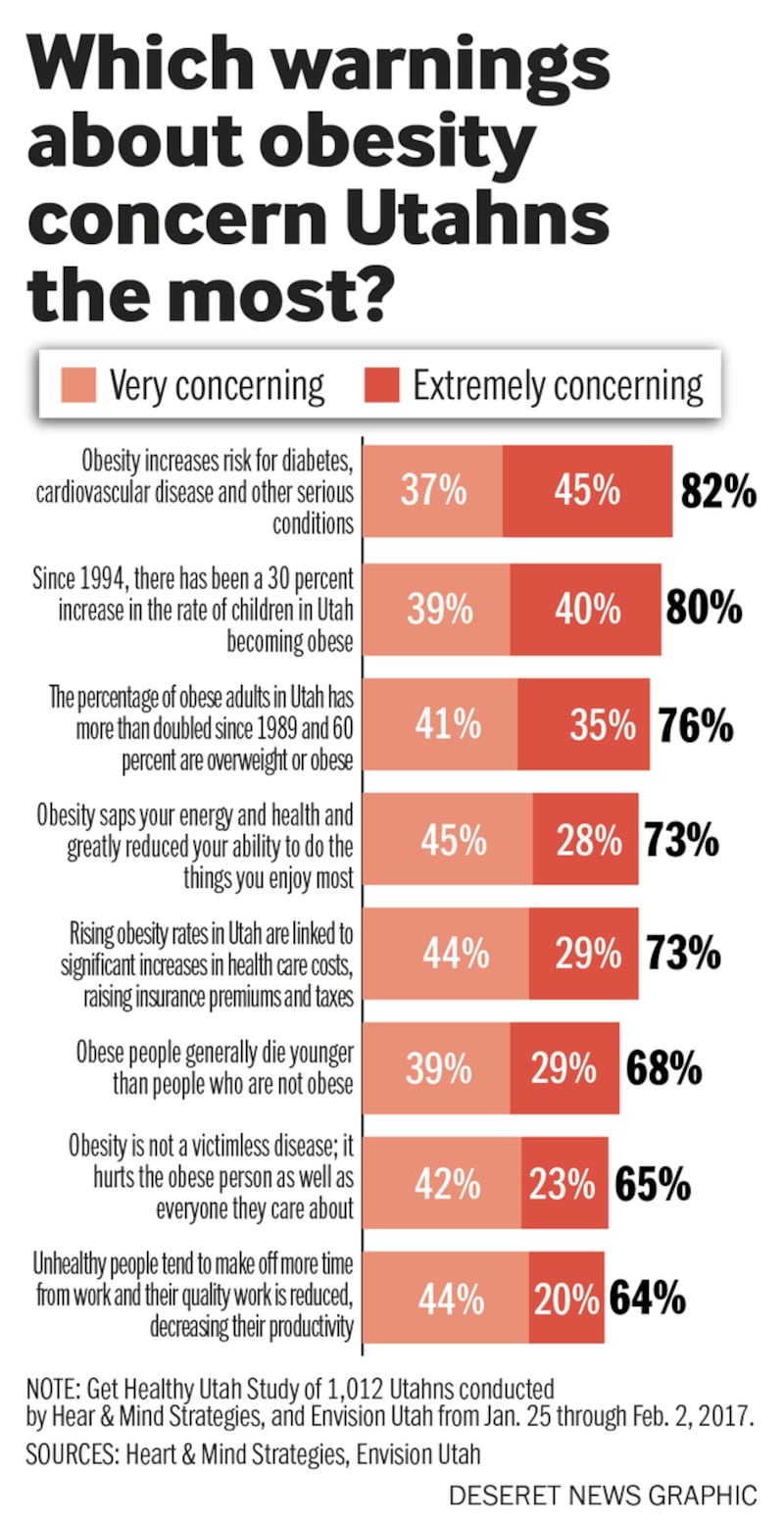
The study, conducted through surveying 1,012 Utahns in January and February, found that identifying obesity as a strong predictor of chronic diseases was the most effective way to get people's attention as it relates to the threat of obesity. The condition is closely linked to higher rates of diabetes, cardiovascular disease, cancer, high blood pressure and other ailments.
When presented with that information, 45 percent of respondents said it was "extremely concerning." About 40 percent said the same when presented with information about growing childhood obesity rates, and 35 percent gave the same answer when presented with increasing adult obesity.
In contrast, just 23 percent reported being "extremely concerned" by information presented saying obesity "hurts the person who is obese as well as all those that person cares about." And just 20 percent said they were similarly concerned that obesity can require a person to take more time off from work and have a negative effect on the quality of their work.
Heather Borski, director of the Utah Department of Health's Division of Disease Control and Prevention and a Get Healthy Utah board member, said health care providers and public officials don't do themselves any favors when they produce unfocused messaging about why weight management is important.
Knowing precisely what matters to Utahns is important to cutting through the noise and motivating them, she said.
"We do need to do more about educating the public about the link between weight and … chronic conditions," Borski said. "We (ought to be) educating people in the right way in a way that really speaks to the values that people care about."
That's why the values study is a useful tool and can help health care providers avoid ineffective messages, she said. For example, respondents resoundingly indicated that weight loss information campaigns focusing on physical appearance do very little to motivate them, Borski said.
Some organizations are better positioned to make a larger impact than others, said Jason Brown, spokesman for Envision Utah, a wide-ranging advocacy group that helped coordinate the study.
According to the study, Utahns consider families and schools to be important sources of healthy lifestyle education, but think that way much less so with religious groups and employers, he said.
But Brown said that doesn't mean those groups should abdicate themselves of responsibility for promoting good health.
"Maybe it's not front of mind that there are policies (from less looked-to groups) that could be put in place that could make it easier (to live healthy), but that doesn't mean that there's not a place for it," he said.
The study found that along with avoiding chronic disease, being "better able to physically do the things I want/need," being "sick less often," having a "better mood/mental outlook" were listed by respondents as the top "absolutely essential" benefits to eating healthily and exercising.
For Clark, all of those motives ring true. Not only does she feel more confident since her weight loss, but her mind and body no longer disagree about what seems fun.
Two experiences of hers illustrate that dramatic shift in her life. The first was a wake-up call that occurred four years ago when Clark and her friend, who had terminal cancer, got together for a playdate between their children.
When the kids beckoned the moms to play with them, Clark said, it was her friend, suffering from a terminal illness, who was more enthusiastic at the prospect of getting up and going down a slide with them. Clark realized then that she didn't have a good excuse for the low energy she lived with.
"She got up to go play with the kids, and I just wanted to sit there," Clark said. "I realized this wasn't the life I wanted to lead. The person on the inside wanted to go down the slide with my kids. The person on the outside wanted to sit on the bench."
That realization was the catalyst for Clark's eventual weight loss. Today, she doesn't feel like the same person, as evidenced by the things that all of her — both inside and outside — want to do. On a trip to Costa Rica this year, she said, she found herself doing everything she set her heart on.
"I went zip-lining, and I went hiking up a volcano, and I went down a waterslide and I went horseback riding, and I went snorkeling," Clark said. "And I wouldn't have had the energy to do that 65 pounds ago, or the energy to do that 35 pounds ago. There is magic to being healthy."