

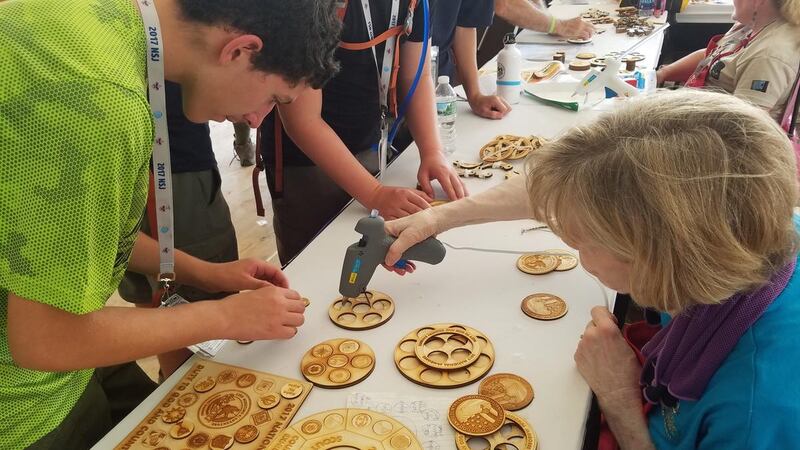

GLEN JEAN, West Virginia — The tentative young Boy Scout glances nervously at the tables covered with laser-etched wooden trinkets of all shapes and sizes — coins, medallions, sheriff’s badges, pocketknives, bolo ties, bear claws, Scout emblems … all made of wood.
The boy musters up enough courage and asks if he can buy something.
“Buy it?” blurts out a surprised Matt Swan from behind a table. “Son, this is Scouting.”
Among Scouts young and old, most things are traded — or given at no cost with a commitment or a challenge.
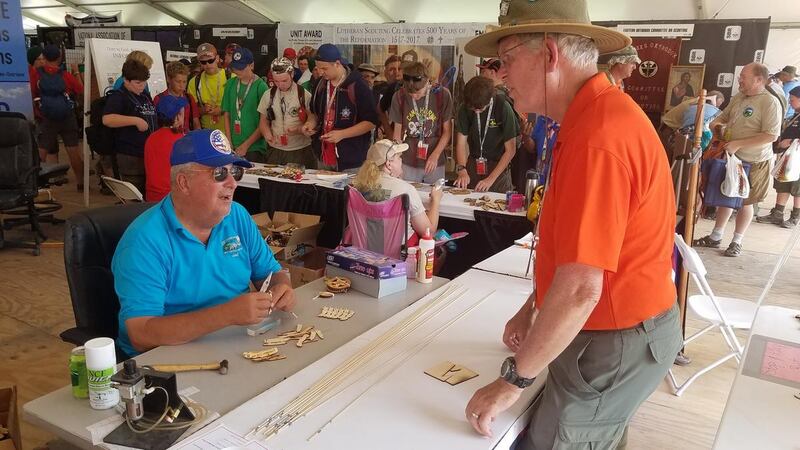
In a prominent corner of the Duty to God and Country exhibit tent, Matt and Brenda Swan from Las Vegas and Gail and Linda Roper from Orem, Utah, and a dozen of their good friends are manning a booth proving to be a popular draw at the 10-day 2017 National Scout Jamboree in southern West Virginia.
Actually, their intent is not to draw the Scouts to the wood items, but rather to use the wood items to help draw more Scouts to visit the adjacent 30 religious, service and fraternity groups sponsoring exhibit areas in the Duty to God and Country pavilion.
Scouts can earn a coin when they visit one of the booths sponsored by the likes of the Baptists or the Presbyterians, the Elks or the Rotarians, the Salvation Army or the American Legion. Once there, the Scouts are treated to displays, materials, discussions, demonstrations and even their own trinkets by those staffing the various exhibits.
For example, participants can string plastic beads into their own rosaries at the Catholic exhibit or snap a photo in front of the inflatable mosque and minaret. Those staffing the American Sikh Council booth are wrapping Scouts’ heads in turbans. And the Latter-day Saints are handing out a spinning metallic compass-like object when Scouts complete the requirements to earn this year’s Compass Award.
Collecting coins for each exhibit visit, Scouts can mount their wooden tokens on boards that display four, six, eight or more coins. They can redeem certain quantities of coins for larger, more elaborate wooden items at the booth.
Gail Roper estimates that his group produced more than 150,000 wood tokens and trinkets for the jamboree, the result of a laser printer running 24/7 nonstop since the first of the year to etch and cut the wood items.
National Scout and jamboree leaders invited the group last year to brainstorm ways to increase Scout visitation and participation at the religious and service exhibits. At the last jamboree in 2013, the area — then called “Faith & Beliefs” — got very little traffic from the Scouts, other than the exhibit by The Church of Jesus Christ of Latter-day Saints, with its displays and awards.
“It was a two-edged sword,” said Roper. “There were a lot of exhibits and a lot of effort going into them, but only a few kids were coming. And usually they were only coming to their own religion, so they missed out on that diversity of faiths.”
So the group decided on creating and distributing the wood coins, supplementing that with all the other wood items as well. The idea emerged from a similar effort at the World Scout Jamboree in 2015 in Japan, when Roper and Smart and friends took over 14,000 wood items — less than a tenth of what they’ve brought to West Virginia.
And it’s working. A religious or faith booth that saw only a couple of hundred visitors total at the 2013 jamboree are now seeing that many in a single day. “It’s very humbling that we’ve been able to accomplish much more than we ever dreamed of,” Roper said.
So popular, in fact, that they had to adjust the distribution of the top prizes — a five-foot-long engraved walking sticks, that originally were to be earned by any Scout collecting a total of 26 coins from 26 exhibit visits. The group quickly realized they would have more Scouts able to redeem the prizes than they had walking sticks, so they created a lottery — Scouts with 26 coins could enter a daily drawing for one of eight walking sticks.
Matt Swan says the increased visits by Scouts to more faiths helps foster a sense of religious freedom and understanding. “They’re now here learning about other religions and learning that they’re good people,” he said.
Roper and Swan hesitate answering when asked how the wood-coin project was funded — the supplies, the shipping, the man-hours to staff the booth. One can tell it’s a labor of love.
“It’s all about the boys,” Swan said.
For Roper, enough reimbursement comes in moments like when a young Scout who comes up and redeems coins, saying with tears in his eyes, “I didn’t think I could earn that.”