
We’re trying to just help give them (coaches) feedback on the session and the toll it took on the guys, and how we use that to keep building fitness and to keep fresh for games. – RSL director of physical performance Henry Ruggiero
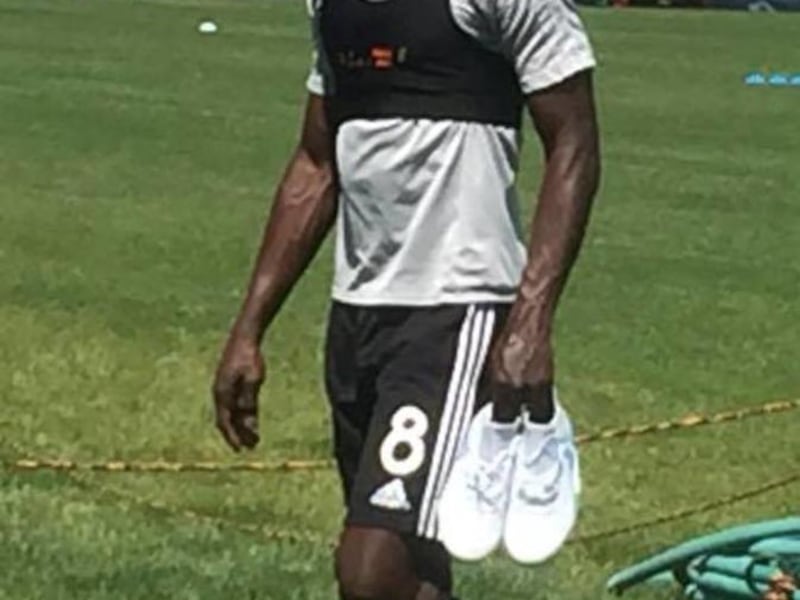
SANDY — "What are the little tank-tops the players are wearing?" an observing child asked at a recent Real Salt Lake training session, noting the black half-shirts that players wear in preparation for competition.
The "tank-tops" he was referring to are Catapult GPS and heart-rate-monitoring systems, which RSL began using at the beginning of the 2017 season.
Henry Ruggiero, RSL's director of physical performance, says the Catapult technology is mainly used to best augment performance on the pitch and to try to avoid injuries.
“We try and look at some specific variables in terms of distances covered, high-speed running distances, the amount of sprints that they’ve had, the amount of accelerations and decelerations they’ve had," he said.
Though Ruggiero said the current MLS collective bargaining agreement says the players have a choice of whether they wear their Catapult systems in games, they are required to wear them in practice to maximize the athletic gains the coaching staff looks for, without tiring the players too much for competition.
“We’re trying to just help give them (coaches) feedback on the session and the toll it took on the guys, and how we use that to keep building fitness and to keep fresh for games," he said. “If we’re doing a drill in practice, for example, the coaches may ask how long they should do it for so that we have an understanding of what kind of load we’re putting on guys, so we’re not just constantly breaking them down.”
Also, with such a large roster, and Monarchs and Academy players rotating in and out of RSL practices almost daily, the data is helpful in gaining a better understanding of how everybody worked when the staff cannot monitor every player individually throughout training.
“When you have 27 or 28 guys on a roster, it allows you to hopefully be able to manage them a little bit better because you’ve got numbers in front of you," Ruggiero said.
"What it does for us, it gives us a really good reading of who worked hard, who didn’t, and where we’re at as a team,” coach Mike Petke said.
Certain players differ in the amount of weight they put into the numbers though.
Some players, like forward Brooks Lennon, who said he has experience with tracking technology from his days on the U-20 World Cup team and Liverpool, along with RSL, take the statistics into account, but still want to push themselves heavily regardless.
“Technology these days is really good, especially for players that run a lot," he said, adding, "They have all the stats and everything with the GPS and monitors, but every time I go out I just try and run as much as possible, and put all my effort out there."
However, the athletic staff is more concerned with improving upon the effort the players put out, rather than slowing them down. Ruggiero also said that getting reserves extra work can be helpful to keep them in shape when playing time does come.
"Sometimes what we’re doing is more to help maintain fitness of guys that haven’t seen as much playing time, and then also be able to manage minutes and loads that we’re asking guys to do,” Ruggiero said.
He noted the team's athletic and fitness staff also understands that it is working with people who understand their own limits as well as anybody, and that the Catapult systems are just another tool in helping mold solid athletes.
“We’re working with professional athletes, and they know their bodies better than anyone, but we give the guys a lot of respect in that they are pretty open to feedback and the information we’ve been able to get for them," he said.
Overall, in just about three months of use, the use of technology is still a work-in-progress, but Ruggiero said he's seen the team adapt to the technology and that he has seen the staff and roster warm up to its use.
Because of the team's bad luck keeping its players healthy, and a run of different-looking rosters every week, Petke said he has had to catch on quickly.
"I’m an old-school guy, but I’ve really adapted and I’ve really put stock into it," he said. "It’s because of the injuries we’ve had, and I have to adapt, and I have to put stock, and I have to put faith in this type of thing."
Some players even take time during training to go over to the staff and ask how they are performing based on the numbers.
Defender Justen Glad said there have been times he went to the staff and asked if he could run a little bit more or push himself harder because he felt he had more energy, or other times asked if he had already worked a little bit too hard because he felt more tired than normal.
"You look at it after and you can see how hard you push yourself but even during training if you want to do stuff after, you take it into account," he said.
As athletic training goes, Ruggiero understands the collaboration between staff, coaches and players still has a way to go before the Catapult technology can be utilized best, but the progress so far has him looking positively toward the future.
"As we get to know them more and they know us more, we want to be able to individualize it to everybody, so that takes a bit of time. That’s a process that we try to get better with every day," he said.