



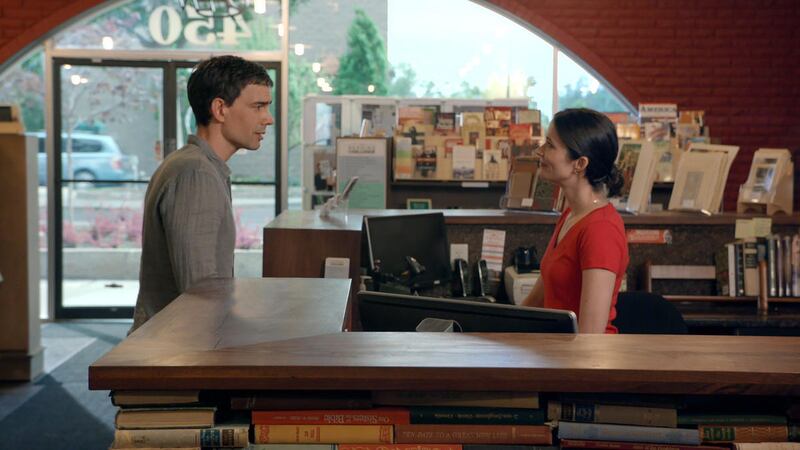


“What if Stephenie Meyer didn’t exist?” asked director Christopher Gorham, summarizing writer Daryn Tufts’ original idea for “We Love You, Sally Carmichael!” “What if she was just a pseudonym for this grumpy old guy who wrote this book about a young woman falling in love with a vampire just to make a few bucks, and then it turned into this massive thing he couldn’t get away from?”
In “Sally Carmichael,” that “grumpy old guy” is Simon Hayes, a writer who achieves unexpected success when his young adult romance between a young woman and a merman — penned under the pseudonym Sally Carmichael — develops a massive cult following. "Sally Carmichael," which arrives in theaters this weekend, is a tribute to fandom that Gorham hopes will win the attention of Utah audiences.
Tufts made his pitch when Gorham was in town for a recent Comic Con in Salt Lake City. Gorham — who local audiences will recognize from his turn as Elder John Groberg in 2001’s “The Other Side of Heaven” — has enjoyed Utah connections to his career ever since appearing in Danny Boyle’s 1997 film “A Life Less Ordinary.” Once he heard the pitch, Gorham convinced Tufts to let him direct the film.
“I knew how to make it great,” he said.
To achieve that greatness, Gorham insisted that the film be produced in the Beehive State.
“We have to make this take place in Salt Lake City,” Gorham said. “We have to shoot Utah for Utah.”
Gorham lent his Los Angeles contacts to the effort, bringing in familiar faces for the cast to belie the film’s modest budget. Then Gorham combined Tufts’ knack for comedy with his own narrative instincts.
“My strength,” Gorham said, “is taking those funny situations and finding the emotional truth of them.”
The result has elements of a “Twilight” parody, but extends deeper into the public’s passion for popular culture.
“This movie is very much about celebrating fandom,” said Gorham, who also plays the lead role. “(It’s about) loving the things that you love without shame.”
“Sally Carmichael” will offer familiar visual nods to local audiences, featuring locations in Salt Lake City and Utah County, as well as local media personalities.
Gorham’s film will also feature Utah’s predominant religion. According to the director, Tufts and executive producer Dave Nibley “wanted to make a movie about a character who happens to be Mormon.” Hayes identifies himself as a member of The Church of Jesus Christ of Latter-day Saints in the film, but “the movie is not about his faith,” Gorham explained.
According to Gorham, Simon’s story is more “about accepting your strengths, accepting who you are and kind of learning to let go of what you wish you could be, and instead celebrating what you are.”
Despite the Utah-specific content, Gorham’s goals are universal.
“I want (audiences) to come out of the theater with a big smile on their face,” he said. “We didn’t design this to be discussed in film school for the next 50 years. We designed this to make a movie that you can take your entire family to.”
Working as both the director and the film’s lead, Gorham has a substantial investment in “Sally Carmichael’s” success.
“Being the lead in a movie is a difficult job,” he said, "and directing a movie is a much more difficult job. Combining the two is a ridiculous amount of work, and frankly just a foolish enterprise.”
Still, Gorham finds perspective beyond his weary state.
“It’s incredibly rewarding to see it all come together at the end of the day, and definitely worth the effort,” he said.
“Sally Carmichael” is a small independent film looking at the relationship of critical vs. popular acclaim and, given the choice, Gorham would prefer that his effort achieve both goals.
Unlike his reclusive character, Gorham is unabashed in his hopes that “We Love You, Sally Carmichael!” survives the uphill climb of the independent film.
“If you love these types of movies, it is important for you to go out that opening weekend,” he said. “If you love it — which I think you will — tell your friends and family and get them out, too.”